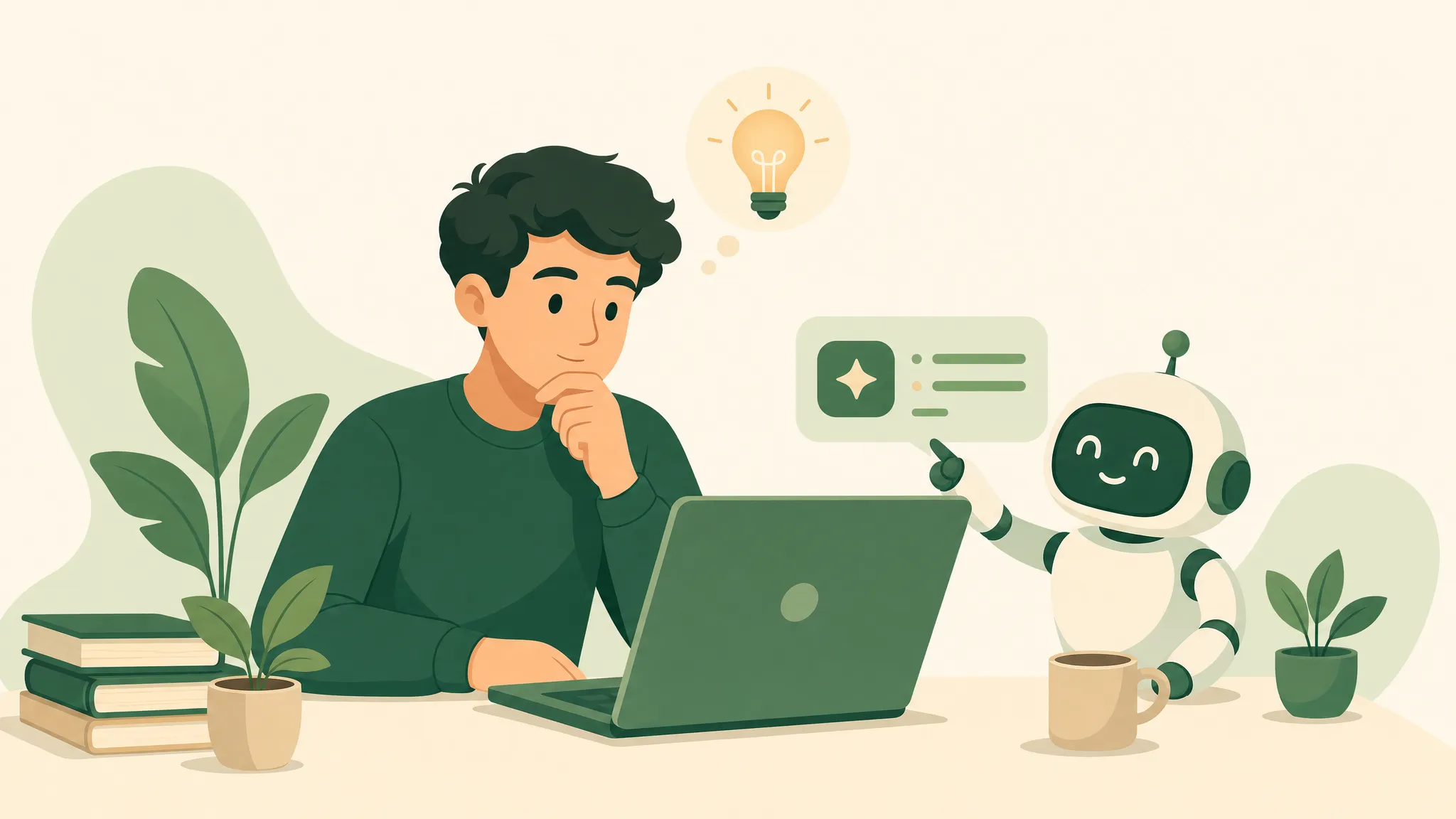

A student messaged me at 1 a.m. last month, three weeks into a course, halfway through their first real project. The message was one line: “Sir, should I even continue? AI will write all of this in two years anyway.” I have gotten some version of that message at least a dozen times this year. Same fear every time. They are scared there will be no jobs left by the time they finish learning.
Let me answer it straight. No hype, and I will not hide the hard parts.
Yes. It is still worth learning to code. But the job you are training for is not the job that existed in 2021, and if you learn the old way you will struggle. Here is what actually changed, and what to do about it.
| In this post |
| Is it worth it? Yes, but the job changed |
| Are you a developer or only a prompt engineer? |
| Why AI makes the easy parts easy and the hard parts harder |
| How do you learn with AI without depending on it too much? |
| Will AI take junior developer jobs? |
Is it worth it? Yes, but the job changed
The work moved up a level, from typing code to deciding whether the code is right. That is the whole shift in one sentence.
Two years ago, a big part of being a junior was being fast and accurate at the boring stuff. Wiring up a form. Writing a loop to filter a list. Looking up the syntax for the tenth time. That work is close to free now. A model writes it in a second, usually correct, sometimes confidently wrong.
What did not get cheaper is knowing what to build and spotting when a generated answer is quietly broken. That is judgment, and judgment is the part you are actually here to grow.
Skip the fundamentals because “AI does that part,” and you skip the only path to the judgment. You cannot review code you never learned to read.
Are you a developer or only a prompt engineer?
You are a developer the moment you can tell whether the answer is correct. The prompt is the easy half.
I get why this question stings. You type a request, paste the result, and a quiet voice asks: did I do anything? Watch what happens when the result does not work. The vending-machine user pastes the error back in, gets a different broken answer, then circles for an hour. The developer reads the code, finds the wrong variable, and fixes it in two minutes.
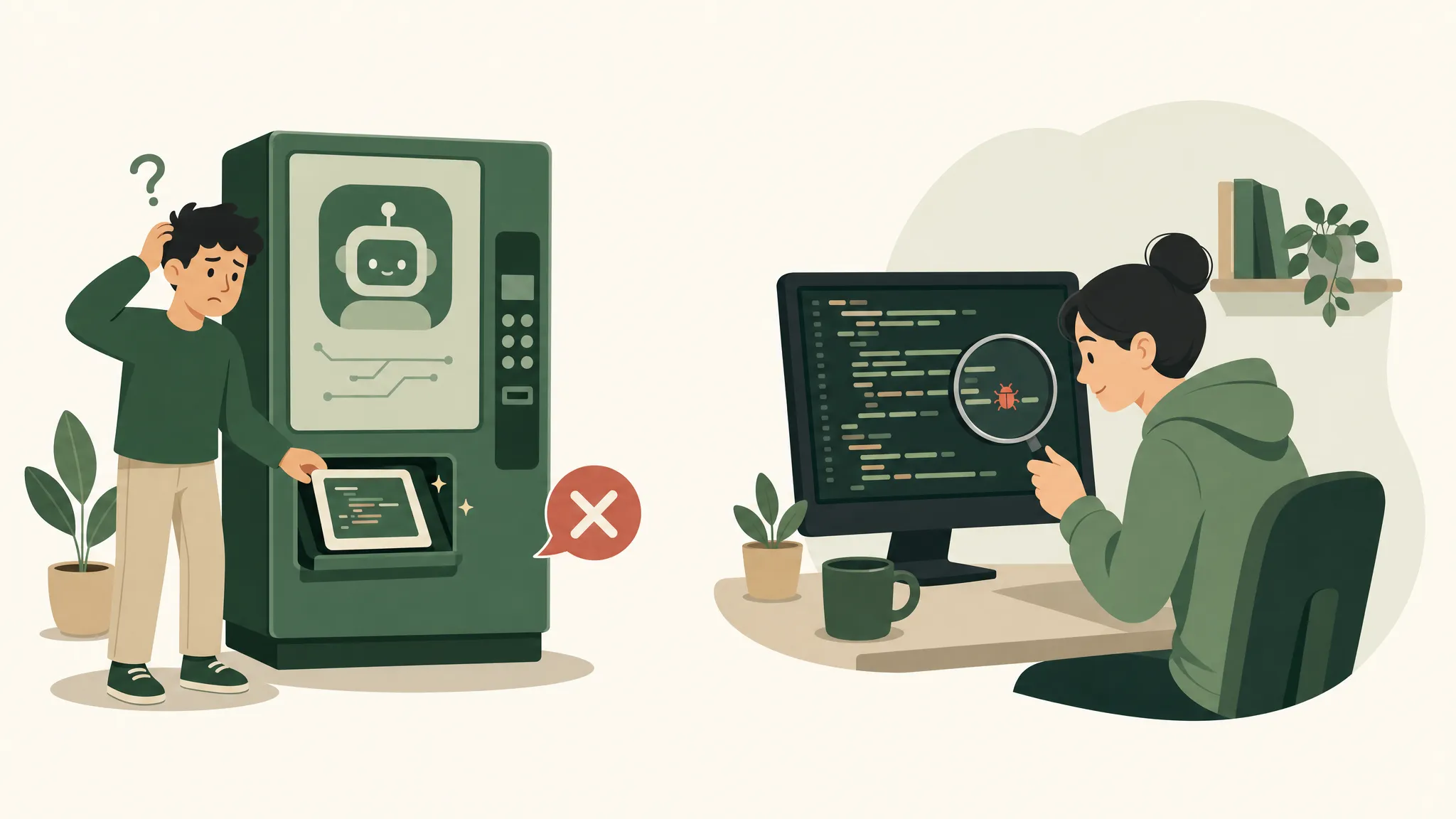
Same tool. Completely different outcome. The difference is not the prompt. It is everything you know that lets you judge the output.
Anyone can ask the question. You get paid for knowing when the answer is wrong.
So no, you are not “only” a prompt engineer. Prompting is a skill, and a small one. Reading code you did not write, then debugging it into something that survives real users, is the job. That has always been the job.
Why AI makes the easy parts easy and the hard parts harder
AI compresses the easy 70% of a task and leaves you alone with the hard 30%, which is exactly where experience is required. The engineer Addy Osmani calls this the “70% problem,” and it matches what I watch happen on real student projects every week.
Here is a moment I have now seen play out maybe twenty times. A student builds a to-do app with AI in an afternoon and feels unstoppable. Then they add user login. The AI hands them auth code that “works” in the simple case and silently leaks every user’s tasks to every other user. The student cannot see the bug, because seeing it needs an understanding of sessions they were never forced to build.
The easy part got easier. The hard part got harder, because now the broken code looks polished and confident instead of obviously unfinished.

That last 30% is what keeps you valuable. Edge cases. Security. Performance under load. Code the next person can actually maintain. None of it gets handed to you. You earn the ability to handle it the slow way, by understanding the layers underneath. If you want to see where that ability is built, read the MDN guide on how JavaScript actually works under the hood, then notice how much of it an AI assumes you already know.
How do you learn with AI without depending on it too much?
Treat AI like a fast, confident tutor who is sometimes wrong, never like a vending machine that hands you finished answers. The difference shows up in what you do before you ask.
Here is the rule I give every DevHives student:
- Try it yourself first. Write the broken version before you ask for the working one. The struggle is what builds the memory.
- Ask it to explain, never only to produce. “Why does this work?” teaches you. “Give me the code” teaches you nothing.
- Never paste code you cannot read line by line. If you could not defend it in an interview, you do not understand it yet.
- Break the answer on purpose. Change a value, predict what happens, run it. A failed prediction teaches more than a working copy-paste.
This is the same discipline I wrote about in how to study a programming book without skimming it. AI makes skimming dangerously easy, because it always sounds sure of itself. The fix is the one that worked for textbooks: slow down, predict the answer, then verify it.
One concrete habit: keep a “things AI got wrong” note. Every time the model hands you a confident answer that turned out broken, write down what it was and how you caught it. Within a month that note becomes your sharpest skill, the radar for bad answers that no prompt can give you.
Will AI take junior developer jobs?
It is making entry-level jobs harder to get, and pretending otherwise would be dishonest. A 2025 Stanford study, “Canaries in the Coal Mine?”, found employment for workers aged 22 to 25 in the most AI-exposed jobs (software development among them) fell about 16% since late 2022, while experienced workers in the same roles held steady or grew.
Read that carefully before you panic. The decline hit people whose only value was the easy, codified work. It did not hit people with judgment. The lesson is not “give up.” The lesson is “do not be a junior whose whole skill set is the thing AI now does for free.” Become the person who can take an AI draft all the way to production. Those people are getting more valuable, not less.
The honest bottom line for the 1 a.m. student
I told that student to keep going, and I will tell you the same. The fear is rational. The conclusion you drew from it is wrong.
Coding was never about typing. It was about thinking clearly in a language a machine understands. AI removed the typing tax and put a brighter spotlight on the thinking. Learn to think and you win in either world. Learn to copy-paste and you lose in both.
Your next step today: open whatever you are building, find one chunk of code an AI wrote for you, and explain every line out loud as if teaching a friend. Where you stumble is exactly where your real learning starts. While you are at it, the Day One post explains why I started DevHives for students learning outside the Silicon Valley bubble, which is precisely who this advice is for.



[…] If you are still asking whether learning to code is worth it at all in the AI era, I wrote a full answer here: Is It Worth Learning to Code Now That AI Exists? […]
[…] Is it worth learning to code now that AI exists? Filed under Self Growth, now live. […]