How to Run NVIDIA Nemotron 3.5 (Super VL & Bolt) Locally in 2026
NVIDIA open-sourced Nemotron 3.5 Super VL and Bolt. Bolt runs on a 24GB GPU, and the 4GB E4B variant targets edge devices. Learn the exact steps to run them locally and what this means for your projects.

NVIDIA just released open models you can run on your own GPU: a 120B model that scores 26 on the Intelligence Index and a 4GB model for edge devices, both with open weights.
You can run NVIDIA's new Nemotron 3.5 Super VL (120B) and Bolt (74B-A9B) locally on a 24GB desktop GPU, and the Bolt E4B (4GB) on edge devices. Both are open-weight, with full recipes and datasets released, no API key needed.
For students building agentic AI projects, this changes the math. You no longer need to rent expensive API credits to experiment with frontier-class reasoning. The models are on Hugging Face, the training data is public, and the deployment guides are straightforward.
What NVIDIA released: Nemotron 3.5 Super VL and Bolt
On Oct 15, 2026, NVIDIA open-sourced two model families: Super VL (120B/12B, 1M context) for data-center-grade reasoning and Bolt (74B-A9B, 256k context) for 24GB GPUs, with a 4GB E4B variant coming Oct 23 [source].
Super VL is the flagship. It handles a million tokens of context, enough to feed it an entire codebase or a full textbook. The Bolt family targets the other end of the spectrum: models that fit in the VRAM of a single consumer GPU.
The "open" part matters more than the specs. NVIDIA released the weights, the datasets, and the training recipes. That means you can fine-tune these models on your own data and deploy them anywhere, with no per-token fees and no vendor lock-in.
For a student, the practical path is simple. Download Bolt on a machine with a 24GB RTX GPU, or test Super VL free on hosted providers first. The deployment steps are exactly what you would do with any open model — which is the point. NVIDIA is making frontier-class AI something you can own, not rent.
How Super VL compares on benchmarks
Super VL scores 26 on the Artificial Analysis Intelligence Index — the top US open model — with 2x the intelligence of its predecessor and 60% fewer output tokens per task [source].
That token reduction is a cost story hiding inside a performance story. Fewer tokens to complete a task means lower API bills and faster responses. The efficiency comes from how the model is trained to reason, not just what it knows.
Here is how the models stack up:
| Model | Intelligence Index | Parameters | Context | Local VRAM |
|---|---|---|---|---|
| Nemotron 3.5 Super VL | 26 | 120B/12B | 1M | Data center |
| Nemotron 3.5 Bolt | 21.4 | 74B-A9B | 256k | 24GB |
| Nemotron 3 Super | 12.8 | ~120B | 128k | Data center |
| Nemotron 3.5 Bolt E4B | — | 4B | — | 4GB |
The Bolt numbers come from the Artificial Analysis leaderboard [source]. The jump from Nemotron 3 Super to Bolt is significant — 8.6 points with fewer parameters.
Output speed is where Super VL gets interesting. On DeepInfra it runs at roughly 630 tokens per second, making it the fastest model among those scoring 20 or higher on the index, about 5x faster than the next best [source].
Bolt: the 24GB model for your desktop
Bolt is a 74B-A9B model with native 2-bit quantization, scoring 21.4 on the Intelligence Index, 8.6 points above Nemotron 3 Super with 39% fewer parameters, and it runs on RTX and DGX Spark hardware [source].
Two-bit quantization is the trick that makes this fit. Instead of storing weights as 16-bit or 8-bit numbers, Bolt packs them into 2-bit values. That cuts memory requirements dramatically while keeping most of the quality intact. NVIDIA claims near-lossless performance in NVFP4 for Super VL [source], and Bolt applies the same efficiency philosophy to fit consumer hardware.
Bolt is the #1 open model in its class on PinchBench and #2 on BrowseComp [source]. Those benchmarks test real-world agentic tasks — browsing, tool use, multi-step problem solving — not just textbook knowledge.
Pros: Run Bolt locally
- No per-token API costs — run unlimited prompts
- Full data privacy — nothing leaves your machine
- 256k context window for large codebases
- Fine-tune on your own data freely
Cons: Run Bolt locally
- Needs 24GB VRAM — a costly GPU upgrade
- Slower than hosted 630 tokens/s inference
- Setup and maintenance are on you
- 2-bit quantization may lose edge-case quality
For a student, the honest trade-off is between upfront hardware cost and ongoing API fees. A used RTX 3090 or 4090 with 24GB VRAM is a real investment. But if you plan to experiment heavily with agents — running hundreds of test prompts — the local route breaks even quickly.
How to run these models on your own hardware
You can run Bolt on a 24GB RTX GPU today using standard inference tools, while Super VL needs a data-center setup — but you can test it free on OpenRouter or DeepInfra first [source].
The deployment process is no different from running any other open-weight model. If you have used Llama or Mistral locally, you already know most of the steps.
Check your GPU VRAM
Run nvidia-smi and confirm you have at least 24GB free. Bolt needs all of it.
Download from Hugging Face
Pull the Bolt 74B-A9B weights using the huggingface-cli tool. The repo includes quantization configs. The exact repo path is on the model page on Hugging Face — link it in your notes.
Start the vLLM server
Run this command:
vllm serve nvidia/Nemotron-3.5-Bolt-74B-A9B. This starts an OpenAI-compatible server on http://localhost:8000. (The exact repo path is on the model page on Hugging Face.)Send a test request
Run this curl command to verify the server works:
curl http://localhost:8000/v1/completions \
  -H "Content-Type: application/json" \
  -d '{"model": "nvidia/Nemotron-3.5-Bolt-74B-A9B", "prompt": "Hello!", "max_tokens": 50}'
You should see a JSON response with the generated text.
Verify context length
Send a long test prompt to confirm the 256k context window works on your setup.
Super VL is a different story. With 120B parameters and 1M context, it needs a multi-GPU data-center setup. The realistic path for most students is to test it on a hosted provider first — OpenRouter offers free tiers for new users [source].
You can also use Bolt for development and switch to the hosted Super VL for final runs when you need maximum quality.
What the open release means for your projects
With open weights, datasets, and training recipes, plus post-training collaborations with Scale AI, Perplexity, and Salesforce, you can fine-tune these models for your own data and deploy them without per-token fees [source].
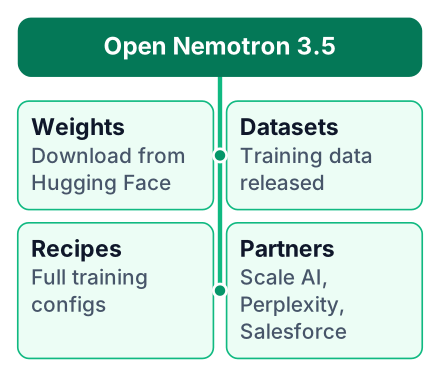
This is the ecosystem story. NVIDIA did not just drop weights and walk away. They released the full pipeline — pretraining data, alignment recipes, and evaluation suites. That means a student can study how a frontier model is actually built, step by step.
For projects, the implications are concrete. You can build a coding assistant trained on your college's course materials. You can deploy a local chatbot for a small business that never sends customer data to the cloud. You can experiment with agentic workflows without watching a credit meter drain.
The open nature also means a community can build on it. NVIDIA has already worked with post-training partners including Scale AI, Perplexity, and Salesforce [source]. Those collaborations produced specialized versions fine-tuned for specific tasks, and the recipes for those are public too.
Why the Indic pretraining release matters for Indian developers
NVIDIA also released Nemotron-pretraining-Indic-v1: 2.8 trillion tokens across 22 Indian languages, with an open data-generation pipeline you can use to build or fine-tune models for local-language apps [source].
This is the release students in India should pay attention to. Most frontier models are trained mostly on English. If you want to build a chatbot for a Hindi-speaking user, a Telugu-language document summarizer, or a Bengali code assistant, you need models that understand those languages well.
The 22 languages covered include Hindi, Bengali, Tamil, Telugu, Marathi, and others. The 2.8 trillion token corpus is a serious training resource — and it is open [source].
Even better, the pipeline that generated this data is released too. You can use it to create your own high-quality training data in a local language, then fine-tune a model like Bolt for a specific use case. This is a real opportunity — there is far less competition building AI for Indian languages than for English.
For a student portfolio, this is a smart niche. An app that does something useful in an Indian language, powered by open models, demonstrates skills that few others have.
If you want to see how this fits into a broader AI learning path, check out my guide to using AI to learn coding without cheating. And for a sense of how fast this space moves, see what changed with Gemini 4 Argon.
Your move: Pick your hardware. If you have a 24GB GPU, download Bolt from Hugging Face today and run your first prompt. If not, open OpenRouter, try Super VL for free, and plan your upgrade path.