The Indian Fresher Interview Process: All 7 Rounds Explained
Most freshers don't fail the Indian interview process because the coding was hard. They fail a round they didn't know existed. Here are the 7 rounds, what each one filters for, and where to spend your prep time.
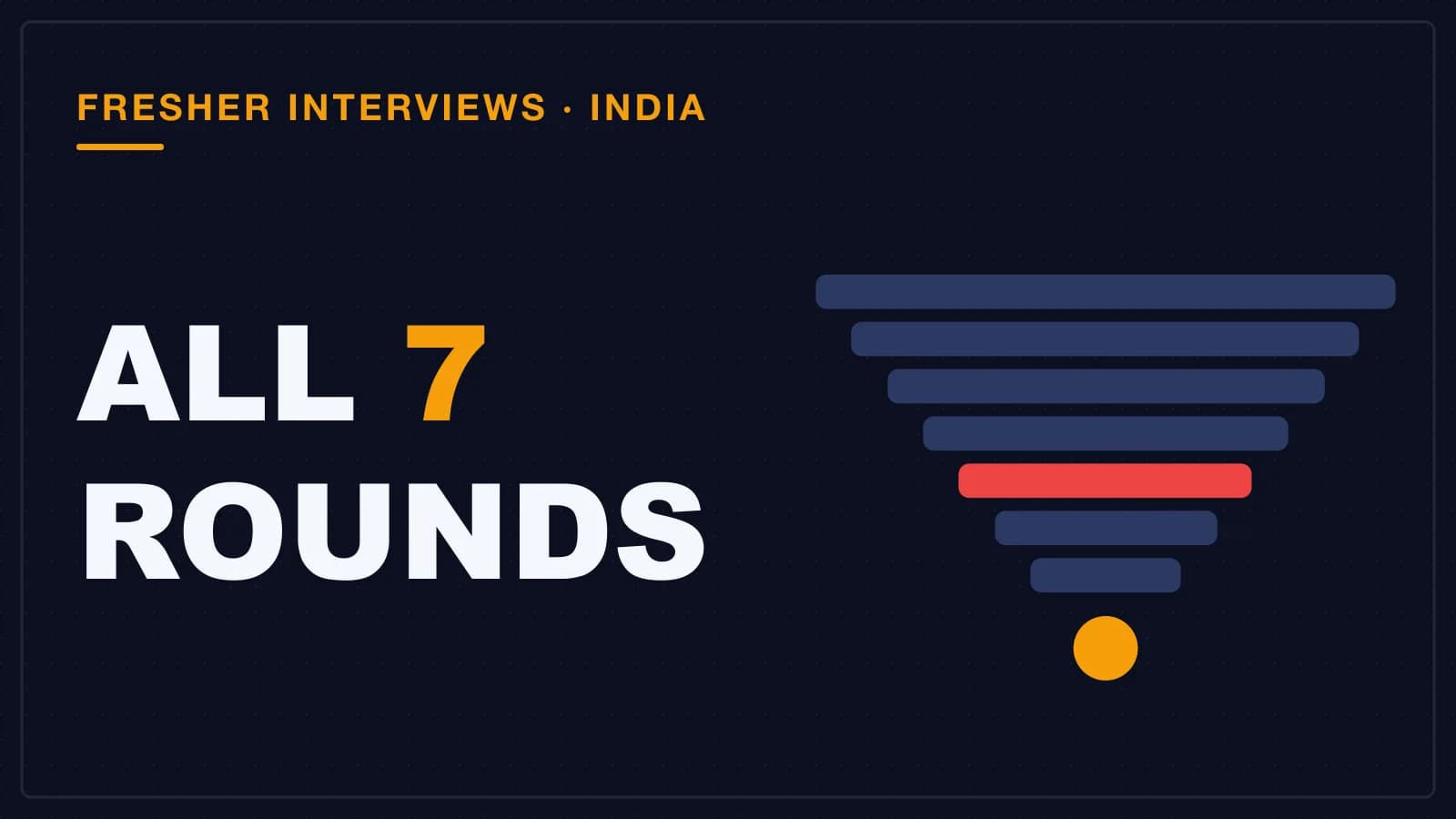
The worst part of the Indian fresher interview process isn't the coding. It's the surprise. You spend months grinding Data Structures and Algorithms (DSA), walk into the technical round feeling ready, and then get rejected after a 15-minute aptitude test. You don't lose to something hard. You lose to a round you didn't know existed.
- Seven distinct rounds sit between college and an offer letter.
- Each one is a filter. Each one removes a specific type of candidate.
- Knowing the map reduces anxiety and tells you exactly where to spend your prep week.
- You don't need to be perfect at everything; you need to know what each round filters for.
- Company registration usually happens through your college's placement cell.
- You submit your resume, and the company gives a pre-placement talk describing the role, salary, and selection process.
- Treat this talk as research: note the company's tech stack and any hints about the interview.
Here is the one-sentence answer: the Indian fresher interview process runs through 7 steps, and each step filters for a different risk. The steps are company registration and pre-placement talk, aptitude and online assessment, an optional group discussion, the technical interview, the managerial round, the HR interview, and finally the offer letter. Your job is to find the gate you are least prepared for and target that one first.
Does the aptitude test decide more than you think?
This is the first filter, and it removes more freshers than any technical round. Your college ranking and DSA skills mean nothing here. You sit in a virtual proctored test with 60 seconds per question.
Those questions are not hard. They are tricky under time pressure.
For example, say a train 600m long travels at 60 kmph (16.67 m/s) and crosses a platform in 45 seconds. The total distance covered is the train length plus the platform length: 750m. So the platform is 150m. You know the formula, but the clock makes you panic.
The assessment usually splits into three sections.
- Quantitative aptitude covers percentages, time and work, and ratios.
- Logical reasoning covers blood relations, seating arrangements, and syllogisms.
Some companies add a verbal ability section. According to Placement Preparation's blog, many service companies treat this round as a strict cutoff.
You don't need to be a math genius. You need to be fast at easy questions and smart about guessing. The prep is not learning new math. It is doing 50 previous year questions every day for two weeks until the patterns jump out at you. If you aim for TCS or Infosys, this round decides whether you even get to fail the technical interview.
What is the group discussion or JAM filter?
This round filters out people who cannot speak or cannot listen. It is a leftover from old campus placement days, and many companies now skip it. But when it appears, it decides who moves forward.
The topic could be anything. "Is AI a threat to jobs?" "Cricket vs. Football in India." They don't want the right answer. They want to see you make a coherent point and respect the group. The candidates who fail are the ones who stay silent or talk over everyone.
The JAM (Just A Minute) variant is simpler. You get one minute to speak on a random topic. The filter is the same. Can you organise your thoughts fast and speak clearly? If you freeze under that pressure, the interviewer sees a risk. They wonder how you will talk to a client or present in a standup.
What does each company tier actually ask in the technical round?
The technical round is not one thing; it splits by company tier. Service companies and product companies test completely different skills.
For a service role at TCS, Infosys, or Wipro, the interview is a screening for basic logic and communication. They ask CS fundamentals: What is a pointer? What is the difference between an array and a linked list? What is an inner join? You might get one easy coding question on a shared screen. They want to know you remember your coursework.
For a product company like Flipkart or Zomato, the round is different. It is 45 minutes of DSA on a tree or a dynamic programming problem, followed by a design question. For example, you might be asked to find the lowest common ancestor of two nodes in a binary tree, or to design a URL shortener. They check how you think under pressure, not just whether you can code.
Practise medium-level LeetCode problems on trees, graphs, and DP, and learn the basics of system design like load balancing and caching. According to the India IT Interview Guide, product companies expect medium-level DSA even from freshers. Between these two tiers sit captive centers (Goldman Sachs, Walmart) and startups — they ask moderate DSA, plus strong project depth and system design basics.
The interview usually starts with "tell me about yourself" and a deep dive into your resume. They pick a project you listed and ask you to explain the database schema. If you copied a project from a tutorial, they sniff it out. They ask you to change a feature on the spot.
How do you pass the managerial round culture-fit checkpoint?
This round tests your ego, not your knowledge. There is no right answer to study. The manager is a senior tech lead or project manager. They ask about a time you had a conflict with a teammate or disagreed with a senior.
They are not testing your memory. They test whether you can take feedback without getting defensive. They want to know if you can handle pressure without blaming others.
The pass is simple. Be honest. Admit a mistake and explain what you learned. The fail is just as simple. Get defensive, blame your teammate, or claim you never make errors. A full breakdown of this round is available in our guide on the technical screening round.
For example, if asked about a conflict, you could say: "I disagreed with my teammate on the database design. I listened, we tested both approaches, and we went with his because it scaled better." That shows conflict handling, not just honesty.
Why is the HR round the hidden eliminator?
This is the final filter for attrition risk. Your technical skills take a backseat. The company has spent money to get you to this stage. They don't want to hire you if you will leave for a higher salary in six months.
The questions are predictable. Tell me about yourself. Why do you want to join our company? Where do you see yourself in five years? The traps are in the details. If you say you want an MBA in two years, they reject you. They want a return on their investment. If you say you have no idea what the company does, they reject you for lack of research.
The best way to pass is to align your goals with the company's goals. Signal stability. You need to show that this job is the plan, not a stepping stone. For the tricky questions, see our guide on HR round preparation.
What policies decide your offer letter and PPO?
The offer letter is not the end; it is where the policies kick in. In India, you don't just interview for a job. You interview against logistical constraints.
The biggest one is your start date. Final-year students are expected to join within a specific window after graduation. Experienced candidates face the notice period question. In my experience, product companies often hesitate at a 90-day notice period, and they cannot wait three months for a candidate. They will often simply move to the next person.
Relocation is the second constraint. A company in Pune does not want to hear that you only want to work in Kolkata. You need to decide your non-negotiables before you start applying.
Once you clear HR, read the offer letter like a developer reads a code review. The CTC includes your basic salary, HRA, bonus, and the employer's provident fund contribution. Your take-home salary is much lower. Watch for the hidden clauses.
A service agreement that locks you in for two years with a bond of 2 lakh rupees. A joining bonus you must repay if you leave within 12 months. A bond is a service agreement with a penalty for leaving early; a clawback clause on a signing bonus is separate.
If you hold multiple offers, ask how long you have to accept. The job market is tight. For guidance on managing this, see our post on negotiating your first offer.
What this system gets right
- Structured and predictable once you know the map.
- It gives you multiple chances to recover, even if one round goes poorly.
What this system gets wrong
- It is time-consuming and mentally draining.
- It often filters for attrition risk more than job capability.
How should you plan your prep round by round?
Most freshers fail because they treat every round like a technical grilling. You ace the aptitude test, then relax in the HR round. That is the moment you lose the job.
Here is a two-month plan. The first two weeks go to your resume and online screens. The next two weeks go to aptitude and logical reasoning. This is the highest-yield prep because it is the easiest to study for and the most likely to get you past the first gate.
Then spend three weeks on DSA and core CS fundamentals. Focus on the top 50 most asked questions, not the entire LeetCode database. The final week goes to mock interviews. If your target company runs a group discussion, do one mock GD with friends in that final week.
Week 1–2: Resume gate
Fix your resume and brush up on old projects so you pass online screens.
Week 3–4: Aptitude
Do 50 previous year questions daily until patterns are automatic.
Week 5–7: DSA fundamentals
Cover the top 50 questions and core CS topics, not the entire LeetCode database.
Week 8: Mock interviews
Record yourself answering "tell me about yourself". Do a mock HR round with a friend.
You cannot practice speaking by solving problems silently. The student who gets the offer is not always the smartest person in the room. They are the one who understands the rules and plays every round.
Start this week by taking a mock aptitude test. That single action will tell you exactly what you need to study next.
Frequently asked questions
Is the process the same for service and product companies?
No. Service companies like TCS and Wipro put more weight on the aptitude test and basic technical screening. They hire in large volumes. Product companies like Zomato and Swiggy have a harder technical interview with a focus on DSA, even for freshers.
Why do companies ask "tell me about yourself"?
It is a test of communication skills and how you summarise relevant information. It also reveals what you consider important. If you immediately talk about your projects, that signals you are technical.
How long is the gap between the technical and HR round?
It depends on the company. It can be the same day or take up to a week. If you don't hear back within a week, send a polite follow-up email to your point of contact.
Does a bond in the offer letter mean I should reject it?
Not necessarily. A service agreement is common in Indian IT. Read the exact terms. If the bond is for two years with a heavy penalty, weigh it against your other options. Some freshers accept it for the experience, others reject it.
Can I ask for more time to accept an offer?
Yes. HR usually gives you a deadline, but you can ask for a short extension. Be direct about why. If you are waiting on another company, say you are in the final round and need a few more days. Many companies will accommodate you.


