The Junior Developer Job Market in India Has Split — Here's Where It's Growing
The Indian IT job market is not shrinking. It is splitting in two. Bulk entry-level hiring is down 20-25%, yet fresher hiring grew 6% year on year. AI roles, GCCs, and tier-2 cities are the growing side. Here's a 12-week plan for the side that is hiring.
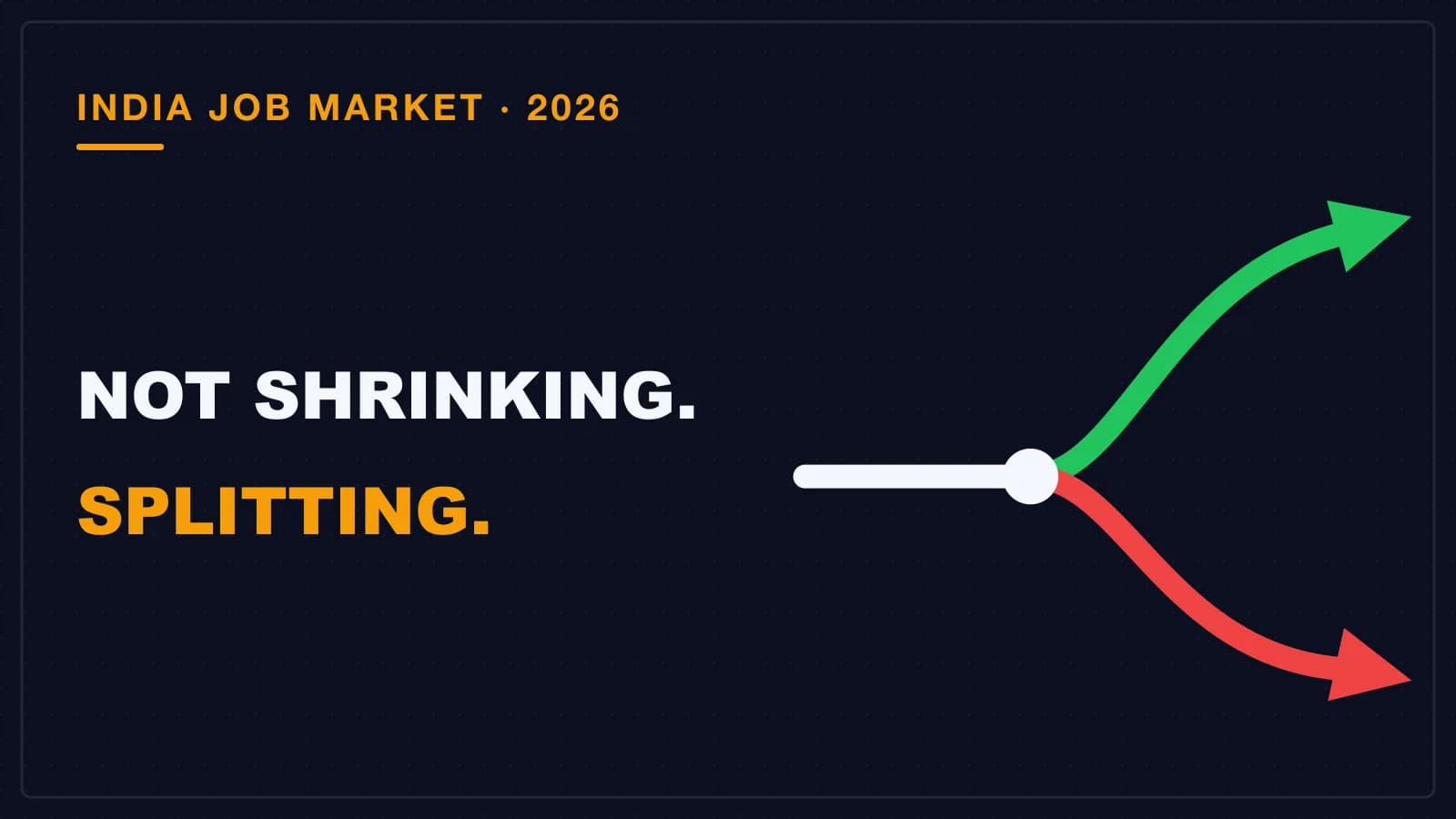
The Indian IT job market is not shrinking. It is splitting in two, and the side you were told to aim for is the one that is shrinking.
The junior developer job market in India has not collapsed, but it has split. Bulk entry-level IT hiring is down 20–25%, yet total fresher hiring grew 6% year on year in the same quarter. The growth is in AI-adjacent roles, global capability centres (GCCs), and tier-2 cities. Bet your next 12 weeks on the side that is hiring.
The IT entry-level market has split in two
One market, two directions: the old bulk-hire path is shrinking, while AI, GCCs and tier-2 hiring is growing.
Here is the contradiction every fresher is living with right now. Entry-level IT roles in India shrank by 20–25% as firms moved to specialised hiring, according to a Mint report covered in the entry-level jobs in India 2026 analysis. At the same time, the Naukri JobSpeak index for July 2026 showed fresher hiring up 6% year on year, with IT and software services specifically up 6% too.
Both numbers are true. The market did not disappear. It split.
The old path treated freshers as raw material. Companies hired thousands, put them through months of training, and billed them out to clients. That model assumed the training was the product. It is no longer the product.
Where the jobs shrank: the bulk-hire service path
Mass campus placement into large IT service firms is the side that is shrinking.
The numbers are stark. TeamLease data, cited in a Livemint opinion piece by Devina Mehra, shows hiring of fresh graduates by Indian IT companies is down 50% compared with pre-COVID levels. Entry-level salaries have stagnated at around Rs 3.5–5 lakh per year in the same period.
Even the cities tell the story. Bengaluru, the country's tech capital, saw fresher hiring growth of only 8% year on year in July 2026, the slowest among major metros, per the same analysis. The places with the most IT companies are hiring the least relative to their size.
This is the side of the split that most career guidance still talks about. It is also the side that is shrinking.
Where the jobs grew: AI, GCCs and tier-2 cities
AI/ML roles, GCCs and tier-2 cities are the growing side.
Look at the contrast in the same July 2026 Naukri data, again per the entry-level jobs analysis. AI/ML roles are up 33% year on year, and information security roles are up about 23%. Fresher hiring in Jaipur grew 27%, Kochi 16%, and Coimbatore 19%. Kolkata and Hyderabad each grew around 16–17%, and Chennai 11%.
The global capability centre story is bigger still. India now has 2,117 GCCs spread across 3,728 units, employing 2.36 million professionals with $98.4 billion in revenue, per the Zinnov-Nasscom GCC Landscape 2026 data. These centres have over 506,000 AI/ML positions, making India the largest AI hiring market by headcount.
| The shrinking side | The growing side |
|---|---|
| Entry-level IT roles down 20–25% | AI/ML roles up 33% year on year |
| Fresh-grad hiring by IT firms down 50% vs pre-COVID | GCCs employ 2.36 million professionals |
| Salaries stagnant at Rs 3.5–5 LPA | 506,000+ AI/ML roles in GCCs |
| Bengaluru fresher hiring +8% (slowest metro) | Jaipur +27%, Kochi +16%, Kolkata +17% |
| Hire-then-train model ending | IT fresher intake 35% of hiring vs 14% cross-industry |
Sources for the table: Livemint and arunkumarsaxena.com.
The direction is clear. The jobs are moving to where the work is newer and the costs are lower.
What the split means for a fresher
The old hire-then-train model is gone; companies now want job-ready candidates from day one.
NASSCOM president Rajesh Nambiar put it plainly in The New Indian Express: the industry is shifting from mass hiring to selective recruitment, and FY26 hiring focused on "job-ready candidates" rather than large-scale hire-then-train. He added that for FY27, firms prioritise AI fluency, problem-solving ability and learnability in entry-level roles.
Bulk-hire path (shrinking)
- Campus placement is familiar and structured
- Training was provided on the job
- No prior portfolio expected
Job-ready path (growing)
- Fresher hiring is growing, only selectively
- Companies want demonstrated skill, not potential
- Off-campus applications reach GCCs directly
Selective hiring means your application must prove you can work, so here is the plan.
A 12-week plan for the growing side
Over 12 weeks, build one finished deployed project, rewrite your resume around outputs, apply off-campus to GCCs, and drop the city constraint.
The plan is simple because the market has already told you what it wants: proof you can work. Here are the steps.
Week 1–2: Pick a real problem and build
Choose one small problem you actually have, and build a web app for it. Not a tutorial project. A tool you will use. For example, an auto-rickshaw fare calculator, a UPI transaction splitter, or a college timetable clashing tool — these have impressed GCC hiring managers.
Week 3–4: Deploy it properly
Put it live on a real domain. Add a README that explains the problem, your choices, and how to run it.
Week 5–6: Rewrite your resume for AI screening
The India Skills Report 2026, which you can download here, says 70% of IT companies now use AI in their recruitment. Write a summary line, list the project's outcomes, and use the exact role title in your headline.
Week 7–10: Apply off-campus to GCCs
India has 2,117 GCCs, and 583 of them are mid-market. Apply directly through their career pages, not just through campus drives.
Week 11–12: Drop the city constraint
Add Jaipur, Kochi, Coimbatore and Kolkata to your job search filters. Also add non-IT sectors and BPM roles.
The MIT city growth data supports this: Jaipur at +27% and Kochi at +16% are hiring faster than Bengaluru at +8%. The offer may come from a city you did not plan for. That is fine for offer number one.
Why off-campus GCC roles beat waiting for campus placement
Campus placement serves the shrinking path; GCCs are hiring on the growing side, and off-campus applications reach them directly.
Campus placement is a funnel built for the bulk-hire era. A single company visits a campus and interviews hundreds of students for a handful of roles. That funnel now has fewer roles at the end of it, because the large service firms are hiring selectively.
GCCs do not wait for campus visits. They post roles online and screen applicants directly. The GCC Landscape 2026 data shows 2,117 centres and 2.36 million employees. The 583 mid-market GCCs in particular are a blind spot for most freshers who only apply to the ten biggest names. Those mid-market centres need developers and are more likely to consider a candidate with one strong deployed project over a candidate with a degree alone.
Also note the fresher hiring pattern within IT: 35% of IT hiring is fresher intake, versus a 14% cross-industry average. IT still takes freshers at a higher rate than other sectors do. The question is whether you go through the campus funnel or straight to the growing employers.
Waiting for campus placement is waiting on the shrinking side. Applying off-campus to GCCs is betting on the one that grows.
Should you look outside IT?
No, if you want a developer title: IT still hires freshers at a higher rate than other sectors. But BPM roles are growing 30% and can be a bridge.
Here is the clear comparison: IT's fresher intake is 35% of its hiring, while the cross-industry average is only 14%, per the India Skills Report 2026. So IT hires freshers at a higher rate than the average across all industries, and non-IT sectors sit below that 14% line.
Yet Naukri's January 2026 JobSpeak data, quoted by NASSCOM president Rajesh Nambiar in The New Indian Express, shows fresher hiring in the BPM (business process management) segment rose over 30% year on year. BPM is not the old call-centre path; it includes analytics, process automation and client operations.
The trade-off is honest and worth stating. A non-IT role may not carry the developer title you want, and the salary may start lower. But overall employability is rising, from 54.81% to 56.35% in the India Skills Report 2026. A first job in a BPM analytics role can become a bridge into a more technical one, especially if you keep building projects on the side.
Do not dismiss the non-IT option. The goal is the first offer, not the perfect title.
Today, go to one GCC career page (e.g., the first result for "GCC India careers") and find one entry-level developer role. Save the JD. Tomorrow, build the smallest possible project that matches it. That is week 1.


