Machine Learning Engineer Starting Salary in India 2026: Fresher Pay, City & Skills
A fresher machine learning engineer in India usually earns about ₹5.5–9 LPA at IT services companies and ₹6–12 LPA at product companies. Company type, city, and a project you can defend in an interview decide the exact number.

Say you are a final-year student with two offers on the table. One is from an IT services company at five and a half lakh a year for an "AI/ML role". The other is from a product company at nine lakh. Both letters say "Machine Learning Engineer". The gap between them is not luck, and you can plan for most of it.
A fresher machine learning engineer in India usually earns about ₹5.5–8 LPA at IT services companies and ₹7–12 LPA at product companies and GCCs. Separately, offers near ₹9 LPA go to candidates who defend a real project in the interview, whatever the company type. The exact number depends on company type and city, plus one thing you can show: a project you can defend in an interview. National averages hide this spread. (Sources: Asmorix, Scaler.)
Machine learning engineer starting salary in India by company type
Company type sets the biggest part of your first offer, and careerskillguide's 2026 breakdown shows IT services AI/ML teams starting lower than production ML teams at product companies and GCCs, with research labs far above both. A GCC is a global capability centre: an Indian office that a foreign company owns and runs for its own products.
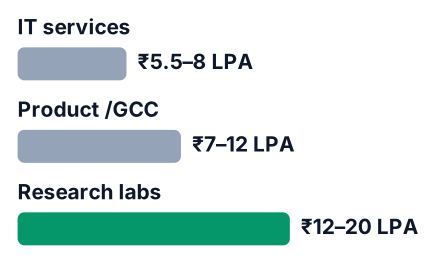
The table puts the three ML salary pages side by side. Each row names where its number comes from.
| Company type | Fresher ML range | Source |
|---|---|---|
| IT services AI/ML teams (TCS, Infosys style) | ₹5.5–8 LPA | careerskillguide |
| Product companies and GCCs, production ML | ₹7–12 LPA | careerskillguide |
| Research labs | ₹12–20 LPA | careerskillguide |
| IIT/NIT freshers at product companies | ₹8–10 LPA | Scaler |
These sources do not fully agree. Asmorix's fresher band tops out lower than Scaler's. Asmorix gives ₹5.5–8 LPA when the interview tests only definitions and ₹9 LPA when you defend a project. That is a different way to split the same freshers, by interview result rather than by company type. Scaler's top end is higher because it counts graduates of top colleges hired by product companies.
Research lab roles are rare and often ask for a master's degree or published work. Plan around the first two rows. Treat the third as a later goal.
Why one national average misleads freshers
A single average mixes experienced engineers with freshers, so it can look higher than a first offer, even though fresher pay has risen about 18% since 2023, according to Scaler. Search pages show one number because one number is easy to read. Your first offer is decided by a much smaller group of people: freshers like you.
Each source also groups freshers in its own way. Careerskillguide splits them by company type. Asmorix splits them by what the interview tested. Scaler splits them by college and company. Read the method before you trust the range.
One more term to read carefully: LPA means "lakh per annum", or lakh rupees a year. One lakh is a hundred thousand rupees. Offer letters quote LPA as CTC, which stands for cost to company. CTC includes money you never get as monthly cash, which the in-hand section below shows. If you are still choosing this path, read how to become a machine learning engineer after 12th first.
City premium: Bengaluru and Hyderabad against the other cities
Bengaluru and Hyderabad pay the most above the national figure, while Chennai pays about the same or slightly less. The two sources measure this differently. Scaler gives a range for ML roles. Careerskillguide gives one figure above or below the national mean.
| City | Premium (Scaler) | Vs national mean (careerskillguide) |
|---|---|---|
| Bengaluru | +25–35% | +18% |
| Hyderabad | +20–30% | +12% |
| Delhi NCR | +12–18% | +9% |
| Mumbai | +15–20% | +6% |
| Pune | +10–15% | +3% |
| Chennai | +5–10% | –1% |
Both sources give the same order at the top. The size of the gap is the part they disagree on. Use the lower careerskillguide figure when you set a target, so you do not aim too high.
Data science shows the same pattern. Fresher data scientists earn ₹6–10 LPA in Bangalore and ₹4–8 LPA in Chennai, according to Systech. The data engineer fresher salary breakdown shows a similar city gap.
Rent takes back part of the premium. A shared flat in Bengaluru or Mumbai costs much more than one in a smaller city. Compare offers by what remains after rent, not by the CTC line.
Skills that move a fresher's first offer
Python and SQL only get you into the interview; deployment skills, along with RAG and deep learning, are what raise the offer, based on Asmorix's four interview filters and Scaler's skill premiums. RAG means retrieval-augmented generation: a language model answers questions using your own documents. MLOps means getting a model running in production and keeping it working. The percentage premiums below are Scaler's figures for ML roles in general, not guaranteed raises on a fresher offer. As an illustration only, a ₹6 LPA offer with a 20–50% premium would become about ₹7.2–9 LPA.
The most useful point on Asmorix's page is about the interview itself. When the interview tested only definitions and tutorial projects, offers landed around ₹5.5–8 LPA. When a candidate could defend a real project, offers came near ₹9 LPA (Asmorix). The skill is the same in both cases. The proof is different.
My order for learning: the four filters first, then deployment, then RAG or deep learning. Deployment comes early because it turns any project into one you can defend. A model on a public link answers more questions than a notebook does. The AI engineer fresher skills list covers each one in more depth. If Python is your only strong skill today, compare against the Python developer fresher salary as a fallback.
What 5.5 and 9 LPA actually pay per month
Your monthly in-hand pay is lower than CTC divided by twelve, because fixed pay is usually 75–85% of a clean CTC, as Asmorix explains. The rest is variable pay, benefits and your employer's PF contribution. Tax and your own PF then come off the fixed part.
| CTC | CTC ÷ 12 | Estimated in-hand per month, before rent (Asmorix) |
|---|---|---|
| ₹5.5 LPA | ₹45,833 | about ₹32,083 |
| ₹9 LPA | ₹75,000 | about ₹58,500 |
These in-hand figures are rough estimates from Asmorix, which does not state its fixed share, PF or tax assumptions, so treat them as a guide and not a calculation.
Here is how to work out your own number from an offer letter:
Find the fixed pay
Look for the fixed component in the salary breakup. If the letter does not show one, expect 75–85% of CTC (Asmorix).
Divide by twelve
This gives your gross monthly fixed pay.
Subtract PF and tax
Take off your PF share and income tax. Check the tax slab for the regime you choose and treat the result as an estimate until your first payslip arrives, because employers deduct tax from their own projection of your year.
Subtract rent
What is left is the number to compare between offers.
Before you accept any offer, ask HR one question in writing: "What is the fixed and variable split?"
Camerinfolks' 2026 Kerala salary guide covers data analysts, not ML roles, so for ML pay outside the big hubs compare against Bengaluru remote roles.
DevOps engineer fresher salary in Bangalore, for comparison
A DevOps fresher in Bangalore earns about ₹6–9 LPA, according to Cambridge Infotech, which overlaps the ML fresher band, so ML is not automatically the higher-paying start. A DevOps engineer builds and runs the systems that ship code. An ML engineer builds the models.
MLOps sits between the two paths. It is DevOps work applied to models, and it is the skill with the largest premium in the skills table above. Learning deployment helps you in either direction.
- Pick DevOps if you enjoy servers, automation and fixing broken pipelines more than maths and data.
- Pick ML if you enjoy statistics and asking why a model is wrong, and you will deploy what you build.
Negotiate before the interview, not after the offer
At fresher level you win the higher number by showing a project and strong fundamentals, not by arguing against a campus pay grid, which is the pattern Asmorix describes. Campus placement grids are fixed for the whole batch and rarely move for one student. Off-campus interviews are where a project changes the offer.
Deploy one project you can defend
Use real data and put it on a public link. Be ready to explain every choice, from cleaning the data to serving the model.
Revise the four fundamentals
Python, ML algorithms, model evaluation and SQL. These are the filters before any talk about pay.
Set a target range
Pick your row in the company table, then adjust it with the city table.
Ask about fixed and variable pay
Compare offers on in-hand pay after rent, never on CTC alone.
Back to the two offers at the start. Company type explains most of the gap on paper: IT services starts at ₹5.5–8 LPA, while product companies and GCCs start from ₹7 LPA. A defended project explains the rest of the climb, since Asmorix sees offers near ₹9 LPA when candidates can defend one. City moves both offers by a smaller amount, from +18% in Bengaluru to –1% in Chennai against the national mean (careerskillguide). The sources do not split the gap into exact shares, so treat this as a map and not a sum.
This month, deploy one small ML project, such as a house-price model served as a public API, and write down your target band before you apply.


