DeepSeek V4.1 Flash 1017: Coding Score Jumps from 31.2 to 42.3
DeepSeek's latest Flash update pushes coding scores from 31.2 to 42.3 on Terminal-Bench while cutting API costs to as low as $0.003 per million input tokens on cache hits. For Indian students, this is the cheapest way yet to practice coding and build agentic projects.

DeepSeek just shipped a Flash update that pushed its coding score from 31.2 to 42.3 on Terminal-Bench while cutting API costs to as low as $0.003 per million input tokens. For Indian students, that is the cheapest way yet to practice coding and build agentic projects.
The model, DeepSeek V4.1 Flash 1017, is a minor dated update to DeepSeek-V4.1-Flash that raises coding and agentic benchmarks and lowers output costs. It is MIT-licensed, free to download, and very cheap on the API, so you can use it for projects and learning without burning money.
What is DeepSeek V4.1 Flash 1017
It is a minor update to DeepSeek-V4.1-Flash, released under the MIT license, with 763B parameters and a 1M token context window (source). The model also supports a 256K max output, which is plenty for long code files or detailed explanations.
This is a dated release, meaning the name carries the date it shipped. Version numbers like this tell you exactly which snapshot of the model you are using, so results stay reproducible.
You do not need to set up anything yourself. The API handles prompt formatting. Only someone hosting the model on their own hardware needs a special toolkit (deepseek-recipe), which is not relevant for your first project.
Benchmark jumps: coding and agentic scores
The update lifts Terminal-Bench from 31.2 to 42.3 and DeepSWE from 74.2 to 77.0, while raw reasoning trails rivals like Opus 5 (source). These are big jumps for a minor release, especially on Terminal-Bench, which tests how well a model can actually use a terminal to complete tasks.
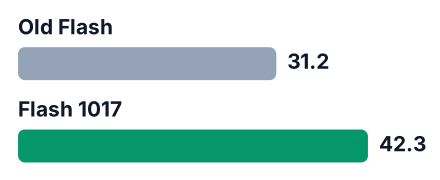
Here is the full picture from the Hugging Face benchmark table:
| Benchmark | DeepSeek-V4.1-Flash | V4.1-Flash-1017 |
|---|---|---|
| Terminal-Bench | 31.2 | 42.3 |
| DeepSWE v1.1 | 74.2 | 77.0 |
| Apex Bench v1.1 | 64.6 | 72.1 |
| HLE without tools | — | 42.6 |
| HLE text-only | — | 44.0 |
The MindStudio review reports that Flash 1017 beats K3, GLM-5.3, and GPT-5.6 Sol on agentic and coding tasks. But it trails Opus 5 on pure reasoning. That means if your task is solving a hard logic puzzle, another model might do better. If your task is writing and running code, this model is now very strong. You can verify the benchmark numbers on the Hugging Face benchmark table.
What it costs per token
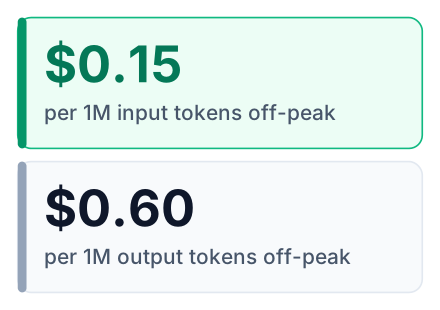
Cache-miss input is $0.15 off-peak and $0.30 peak per million tokens, while output is $0.60 off-peak and $1.20 peak, with peak hours on weekdays (source). Here is the full pricing table:
| Token type | Off-peak (per 1M) | Peak (per 1M) |
|---|---|---|
| Cache hit input | $0.003 | $0.006 |
| Cache miss input | $0.15 | $0.30 |
| Output | $0.60 | $1.20 |
Peak hours are 01:00–04:00 and 06:00–10:00 UTC, Monday to Friday (source). Convert that to Indian Standard Time: peak is 06:30–09:30 and 11:30–15:30 IST. That means late evening and night usage in India is almost always off-peak, which is when most students study anyway.
Cache hits are the real win. If you send the same system prompt repeatedly, the API charges you $0.003 per million tokens instead of $0.15. That is $0.15 vs $0.003 per million, which is 50x cheaper.
How Indian students can use it for cheap coding practice
Use the API in off-peak hours to run code reviews, generate practice problems, and debug errors for a few rupees per session. A million tokens is a lot for student-scale work, so even a dollar lasts a while.
Sign up for the DeepSeek API
Create an account at the DeepSeek platform and generate an API key.
Add a small credit
Top up with a dollar or the rupee equivalent. You do not need a big balance.
Pick off-peak hours
Use the model after 4 PM IST on weekdays (and before 6:30 AM), since peak hours end by 3:30 PM.
Use it for coding practice
Ask it to review your code, explain an error, or generate a practice problem from a topic you are learning.
Track your spend
The dashboard shows your token usage. After a week, check how much of that dollar you actually used.
Say you are learning Python and keep getting a KeyError. Instead of staring at the screen, paste the traceback and a few lines of your code. The model explains what went wrong and shows the fix. A single request like this costs a fraction of a rupee at off-peak rates.
If you are just starting out and want to build something free, our guide on deploying your first web app for free pairs well with this. Use the API to help you write the code, then ship it without paying for hosting.
Using it to learn agentic AI
The jump in agentic benchmarks (tests that measure how well a model can plan and use tools on its own) means the Flash model can follow multi-step instructions reliably, which is what you need to build simple AI agents (source). An agentic benchmark tests whether a model can plan a task, use tools, and check its own work, not just answer a question.
For a learner, this matters because the model can actually do things: browse a page, run a command, edit a file. That opens up projects you could not build with a chat-only model.
Three low-cost projects to try:
- A chatbot that uses tools. Give it a calculator or a weather API and let it call those tools when needed.
- An automated study assistant. It can fetch a webpage, summarise it, and quiz you on the content.
- A code review bot. Point it at a GitHub repo and ask it to find bugs or suggest improvements.
The MIT license means you can also run the model locally if you have the hardware, but most students do not have a GPU with enough memory for a 763B model. The API is the practical path. If you want to learn the concepts without spending anything, our post on using AI to learn to code without cheating covers the mindset side of this.
What is new in this update
MindStudio reports that the update cuts task execution time and output length, improving the balance between performance and cost (source). That means the model finishes tasks faster and writes shorter, more direct answers. Shorter outputs use fewer tokens, which costs you less money.
The previous Flash version already had solid benchmarks. This update tightens the gap on agentic tasks and improves the efficiency of the output. If you were already using DeepSeek-V4.1-Flash, switching to the 1017 snapshot costs nothing and gives you the better scores.
For context on how this fits the broader model landscape, our write-up on Reflection Beam 501B covers another budget-friendly open model. And if you are comparing options, our notes on Gemini 4 Argon show what the Google alternative looks like.
What to do now
Sign up for the DeepSeek API, add a dollar to your account, and this week use the Flash 1017 model in off-peak hours for one coding problem a day. Track your spend to see how far a dollar goes.


