Amazon SysDE Interview Experience 2026: 5 Rounds & Questions
A real Amazon System Development Engineer interview experience from GeeksforGeeks, covering all five rounds: online assessment, phone screen, two technical rounds, hiring manager, and bar raiser. Learn the exact coding problems and leadership-principle questions asked.

Say you have cleared the Amazon online assessment and have a loop booked. Your coding rounds go well. Then one interviewer from outside the hiring team can still block the offer. That interviewer is the bar raiser, and the questions they ask are not about code.
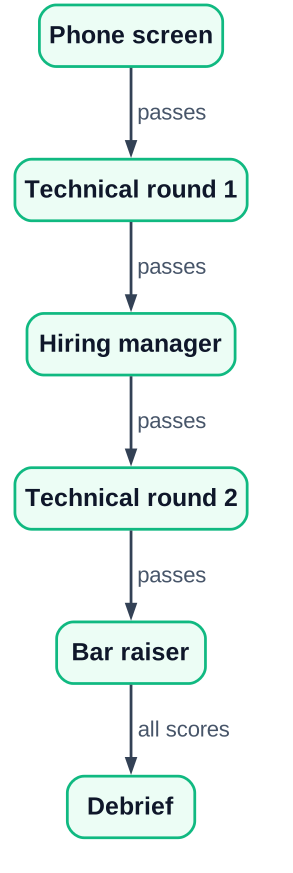
Prepare for five stages: online assessment, phone screen, two technical rounds, a hiring manager round and a bar raiser round. A SysDE loop mixes data-structure problems with troubleshooting questions, and leadership principles are scored in every round. This post follows one candidate's loop and adds a preparation method on top: troubleshooting checklists and a story template. The questions come from the four interview rounds, not from the online assessment. Do not skip leadership-principle stories, because every round scores them and the bar raiser can block a hire the rest of the loop wants. Keep coding practice in your plan too.
Know the SysDE loop before you prepare
The System Development Engineer role is about keeping services running, so its interviews test both code and operations thinking. AWS's own System Development Engineer page says SysDEs write code to fix bugs, automate tasks, implement monitoring and deal with infrastructure. It calls them "the glue that keeps AWS services up."
In plain words, an SDE mostly builds the features customers use. A SysDE makes sure the machines under those features stay healthy. That is why an interviewer may ask how you would debug a broken website right after a linked-list problem.
The questions here come from one candidate's published SysDE interview experience on GeeksforGeeks, written with 6 months of work experience. Your loop may run in a different order, with different people, depending on the team and the level you apply for.
Clear the online assessment first
The online assessment is the gate that comes before any human interview, and for student and grad roles it is the first step after you apply. Amazon's student and grad SDE page lays out the full process and says the offer stage comes within 5 business days.
Apply
Submit your application on amazon.jobs.
Online assessment
Finish the timed test before anyone interviews you.
Virtual interviews
Sit the loop of rounds described below.
Offer
Hear back on the decision.
Practise with a timer running, because a clock changes how you code. Solve easy and medium array problems under time pressure. Answer any work-style questions honestly instead of guessing what Amazon wants to hear.
The candidate account starts at the phone screen, so I won't claim any assessment questions from it.
Solve the phone screen with code and one troubleshooting question
The phone screen already mixes a coding problem with a troubleshooting question, so you cannot treat SysDE as a pure algorithms interview. This candidate's screen opened with a resume walk-through, then two problems:
- Boundary traversal of a binary tree: print the left edge, then the leaves, then the right edge from bottom to top.
- Add 1 to a linked list: each node holds one digit, so you must carry, including when every digit is a nine.
Then came the operations question: "What if your website can't fetch data from your SQL database?" There is no single right answer. The interviewer wants to hear you narrow the problem down in a sensible order.
Here is a general method you can say out loud. It is my own checklist, not Amazon's official answer.
- Read the exact error message. A timeout and a login failure point in different directions.
- Check the network path. Can the app server reach the database host and port?
- Confirm the database is running and has free connections and disk space.
- Check credentials and permissions. A changed password or a missing grant breaks reads quietly.
- Run the query by hand, then read the logs on both the app and the database side.
Notice the order: the cheapest check comes first.
Work through technical rounds one and two
The technical rounds use common array and string problems, plus troubleshooting and basics like OOP and databases, and you are expected to talk through your thinking. The same account lists these problems:
| Problem | Round | What the interviewer is checking |
|---|---|---|
| Best time to buy and sell stock II (modified) | Technical 1 | Can you spot a simple pattern, then adapt it to a new rule? |
| Search in a sorted, rotated array | Technical 1 | Binary search when half the array is out of order |
| OOP and DBMS questions | Technical 1 | Classes, inheritance, joins and indexes explained without notes |
| Balanced parentheses in O(1) space | Technical 2 | Do you respect the space limit instead of reaching for a stack? |
| Two-sum | Technical 2 | Trading memory (a hash map) for speed, and saying why |
The base stock problem has a short answer: add every rise in price from one day to the next.
function maxProfit(prices) {
  let profit = 0;
  for (let i = 1; i < prices.length; i++) {
    if (prices[i] > prices[i - 1]) {
      profit += prices[i] - prices[i - 1];
    }
  }
  return profit;
}
The candidate did not publish the modifications. Before you change the loop, ask what the new rule is, what the input limits are and what to return when no trade makes money.
O(1) space means memory that does not grow with the input size. For balanced parentheses, one bracket type needs only a counter: add one for each opening bracket, subtract one for each closing bracket, and fail if it drops below zero. With several types, ask whether the constraint still holds, because that question shows you read the brief. For extra backend practice, the Node.js interview questions post covers similar debugging ground.
Round two's troubleshooting question was "What if the page blacks out?" Walk from the user outward:
- Browser: open developer tools and look for console errors or scripts that failed to load.
- Network: check the Network tab for failed requests and their status codes.
- Server: confirm the service is up and ask whether anything was deployed recently.
- Logs: read application and server logs around the time the page went blank.
Use the hiring manager round to show ownership
The hiring manager round blends one more coding problem with questions about what you built, your deadlines and your hardest problem. In the GeeksforGeeks account, the coding part was sorting letters by how often they appear, then finding a subsequence that sums to zero.
For the letter sort, count each letter in one pass using a map or a small fixed array. Then order the letters by count and build the output string. For the zero-sum problem, ask whether "subsequence" means any picked elements or a continuous block, because the solutions differ.
The behavioral half asked three questions. Each one is a chance to show ownership:
- "The coolest thing you built": say which part you personally decided on, not what the team shipped.
- "A strict timeline": say what you cut, what you protected and who you told early.
- "A difficult problem": show you stayed with it after the easy fixes failed.
This manager is also judging fit for their own team. Ask what systems the team owns, since that tells you what their daily work looks like.
Leadership principles are scored in every round
There is no separate leadership-principle round: every interviewer scores principles alongside your technical answers, so a strong coding round with a weak story still costs you. Both Aced and Grokking System Design say this holds even in the system design round.
The table maps the behavioral questions from the candidate's account to each round. It is a sample from one person's loop, not Amazon's official map, and the principle labels are my own guesses.
| Round | Question asked | Principles it tests |
|---|---|---|
| Technical 1 | A time you went above and beyond | Ownership, Customer Obsession |
| Hiring manager | Coolest thing built, strict timeline, difficult problem | Ownership, Deliver Results |
| Technical 2 | A time you did a lot of research | Dive Deep |
| Bar raiser | React quickly, dive deep, challenging project | Bias for Action, Dive Deep |
Dive Deep and Ownership appear in more than one round here. For an operations role that makes sense, so build at least two stories around something you debugged yourself.
Prepare for the bar raiser like it is the real exam
The bar raiser is a trained interviewer from outside the hiring team who can block a hire the whole loop wants, but cannot force one. According to Grokking System Design, they also chair the debrief where interviewers decide, and their job is to protect the hiring bar.
In the account, this round had no code at all. The questions asked for a time you had to react quickly, a time you went deep into a problem and a challenging project.
A weak behavioral signal can also cost you a level instead of the offer. One bar raiser's estimate, reported by Grokking System Design, puts down-leveling at around 10-15%. Treat that as one person's guess, not an Amazon figure, and use it as a reason to rehearse each story out loud before the loop.
Write five or six stories, each covering two or more principles. Use this template:
| Field | What to write |
|---|---|
| Story title | A short name you can recall under pressure |
| Situation | Where you were and what was going wrong |
| Task | What you, personally, had to do |
| Action | The steps you took, using "I" |
| Result | One number you can verify, such as a count from a log or database |
| Principles | Two or more, for example Ownership and Dive Deep |
| Round | Which question it answers best |
Here is an outline that works whether you study in Pune or Ohio. Say you ran the registration site for your college fest. The night before, signups started failing. You read the logs, found database connections that were never closed, fixed the code and added an alert. Signups ran for the rest of the event, and you can show the registration count from the database. That one story covers Bias for Action, Dive Deep and Ownership.
Common mistakes that sink SysDE candidates
Most avoidable rejections come from silent coding, jumping to fixes before diagnosing, and stories that say "we" with no personal action. Here is each mistake with its fix:
Do
- Talk while you code, even when you are unsure.
- Check the error and the logs before naming a cause.
- Repeat the space limit back before you start.
- End every story with a result you can verify.
- Prepare a different story for each round.
- Show you care about monitoring and uptime.
Don't
- Code in silence and explain only at the end.
- Guess a fix in your first sentence of troubleshooting.
- Reach for a stack when O(1) space was asked.
- Stop a story at the action with no outcome.
- Reuse one story in every round.
- Prepare as if SysDE were a pure coding role.
Your next steps:
- Tonight, write five leadership-principle stories in the story bank template, each with one result you can verify.
- Tomorrow, say the SQL-database troubleshooting steps out loud.
- Then solve buy-sell-stock-II and two-sum without looking at a solution.


