Front End Developer Fresher Salary in Bangalore: ₹3.5–22 LPA by Company Type
A front-end fresher in Bangalore earns about ₹3.5 LPA at IT services firms and up to ₹22 LPA at product MNCs. This guide breaks down each company type and what the pay actually leaves after Bangalore's living costs.

Say you hold a ₹6 LPA offer. That is about ₹42,000 in-hand, by this Bangalore cost-of-living guide. After a ₹24,000 Bangalore budget, ₹18,000 is left. The same city at ₹3.5 LPA tells a very different story.
A front-end fresher in Bangalore earns roughly ₹3.5 LPA at an IT services firm and up to ₹22 LPA at a product MNC, so one 'fresher salary' number is the wrong question. Company type sets the range. Treat these ranges as directional, not exact.
I will go through the four company types one by one. After that, I will put each range against what Bangalore costs. The second part matters more than the first.
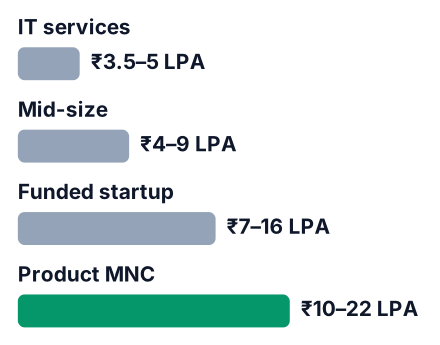
IT services firms pay ₹3.5–5 LPA
TCS, Infosys and Wipro-type firms offer the lowest fresher pay in Bangalore, about ₹3.5–5 LPA, and front-end work is not guaranteed in the role.
A word on trust. Cambridge Infotech is a training academy in Bangalore, not a salary survey. It has a reason to make tech jobs look attractive. I cross-checked its numbers against other pages and they hold up roughly, but read every range in this post as a direction, not a promise.
Services companies mostly hire through campus placements and national tests. You join a large batch, go through training, and then get placed on a project. The project decides your work, not your resume. A fresher who built three React apps in college can still land on Java maintenance, manual testing or a support desk.
That is the real cost of this tier for a front-end developer. The pay is low, and the skill you want to grow may sit unused for a year. If you are weighing a services offer against a global capability centre (GCC), read my comparison of GCC vs IT services for a first job first.
Mid-size companies pay ₹4–9 LPA
Mid-size firms such as Mphasis and Hexaware sit in the middle, with a broad band of ₹4–9 LPA that depends on your skills and interview result. GlobalLogic appears in the same group on the Cambridge Infotech list.
Why is the band so wide? These companies hire in smaller numbers than TCS or Infosys. They often interview for a specific team, and that changes the conversation. Three things move you up inside the band:
- Your portfolio. A live project with real users is worth more than five course clones.
- Your interview. Clear answers on JavaScript basics and one framework push the offer higher.
- Negotiation. Mid-size firms have more room to adjust than mass recruiters do.
For context, the same page puts the average fresher pay across all company types at about ₹5–7 LPA. It also says Bangalore holds 34% of India's tech job postings (Cambridge Infotech). More postings means more choice, which is why it is worth knowing where an offer sits before you sign.
If you want help with that last point, I wrote a separate guide on how to negotiate your first dev offer without losing it.
Funded startups pay ₹7–16 LPA
Funded startups like Razorpay, CRED, Swiggy, PhonePe and Groww pay about ₹7–16 LPA, but they hire fewer freshers and test harder.
Startup interviews for front-end roles usually test what you will do on day one. Expect questions on how JavaScript works underneath, such as closures, promises and the event loop. Expect React questions about state and re-renders. Many add a small build task: make a search box, a to-do list, or a page that loads data from an API.
If you are preparing for that, MDN's JavaScript Guide and the official React docs cover what these rounds ask. Both are free.
The trade-off is security. A funded startup can grow fast, and it can also cut teams fast when funding slows. Higher pay in year one does not help if the role is gone in year two. Ask how long the company's money is expected to last. A fair recruiter will at least answer the question.
One cross-check matters here. Vtricks, another Bangalore course provider, lists entry-level front-end and full-stack pay at ₹5–8 LPA. It says the figure comes from Glassdoor in May 2026. I could not confirm that myself, so I treat this page as moderate trust. Still, it points the same way: ₹16 LPA is the top of the startup band, not the normal offer.
Product MNCs pay ₹10–22 LPA
Product MNCs such as Amazon, Microsoft and Google pay the highest fresher range, about ₹10–22 LPA, and they are the hardest to get into.
The selection process is long. You usually start with an online coding test. Then come several interview rounds. Most rounds test data structures and algorithms, even for a front-end role. A later round may ask you to design a simple feature or explain how a web page loads. Front-end skill helps, but it does not replace problem-solving practice.
Watch out for one trap when you search for front-end salaries in Bangalore. GreatFrontEnd's July 2026 salary breakdown quotes a Levels.fyi median total pay of about ₹36.6 LPA for software engineers in Bengaluru. That figure covers every level of engineer, from new hires to senior staff. It is not a fresher number, and it is not front-end only.
The same article gives a NodeFlair median base pay for front-end developers in India of ₹62,500 a month, inside a band of ₹37.5K to ₹1.87L (GreatFrontEnd). That one is front-end specific. It is still not fresher-only, because it mixes every level of experience.
The author's own advice is the part I agree with most. Do not invent precise city-and-level fresher numbers. Classify the company type first, then read the range for that type. If you are comparing front-end with other tracks, my data engineer fresher salary breakdown uses the same approach.
What ₹6 LPA leaves after Bangalore costs
On a ₹6 LPA offer you take home about ₹42,000 a month, spend about ₹24,000 on a shared-PG life, and keep about ₹18,000. All three figures come from desisalary's 2026 Bangalore guide.
Here is that budget, line by line. These are the guide's numbers for one fresher living in a shared PG.
| Item | Per month | Source |
|---|---|---|
| In-hand pay on ₹6 LPA | ₹42,000 | desisalary |
| Shared PG | − ₹12,000 | desisalary |
| Food | − ₹6,000 | desisalary |
| Metro | − ₹2,000 | desisalary |
| Miscellaneous | − ₹4,000 | desisalary |
| Left over | ₹18,000 | desisalary |
In-hand pay here is approximate. Your real figure depends on tax, provident fund and other deductions, and on how much of the CTC is variable. Ask for the exact split before you plan around it.
Now run the same sum down the company-type ladder. I only use the anchor points the sources give. The ₹6 LPA row is exact; the others are placed against it.
| Company type | Fresher CTC | In-hand vs the ₹6 LPA anchor | Left after ₹24,000 budget |
|---|---|---|---|
| IT services | ₹3.5–5 LPA | Below ₹42,000 | Less than ₹18,000; thin or close to nothing at the bottom |
| Mid-size | ₹4–9 LPA | On either side of ₹42,000 | Around ₹18,000, more or less |
| Funded startup | ₹7–16 LPA | Above ₹42,000 | More than ₹18,000 |
| Product MNC | ₹10–22 LPA | Well above ₹42,000 | Comfortable; ₹10 LPA is the guide's "comfortable" point |
Sources for this table: CTC ranges from Cambridge Infotech; in-hand, budget and the ₹10 LPA "comfortable" point from desisalary.
Two more lines from the same guide help you read the table. At ₹35,000 a month in-hand or below, you live a frugal, shared life. At ₹10 LPA, Bangalore becomes comfortable.
This is where the "Bangalore or WFH" debate starts. People argue about rent and commute. The table shows the bigger factor is which row you are in.
Bangalore or WFH is really a company-type choice
Whether you can afford Bangalore depends on your company type first, so settle that before you argue about remote work.
The desisalary guide puts a single professional's monthly spend in Bangalore anywhere from ₹25K to ₹75K. The low end is a shared PG and the metro. The high end is a solo flat and eating out. A fresher on a services salary can only live at the low end, and even then saves little.
Say you have two choices on a lower-end offer. You can move to Bangalore, or you can stay at home and work remotely or hybrid. Here is how the two sides compare.
Pros
- Moving to Bangalore puts you near most tech job postings, so switching jobs later is easier.
- You meet other developers at work and at meetups, which helps you learn faster.
- In-person teams often give freshers more direct feedback.
Cons
- On a services offer of ₹3.5–5 LPA, the monthly saving after a shared-PG budget is thin or zero (desisalary, Cambridge Infotech).
- Staying at home on the same offer lets you save most of it.
- One surprise cost, like a medical bill or a deposit, can wipe out a month.
At the top of the ladder, the picture flips. Living in the city stops being a money question and becomes a lifestyle choice.
My view: if your offer sits low on the ladder and the company allows it, stay home for the first year and save. Spend the saved time building the portfolio that gets you one row up.
Check any offer in four steps
You can test any Bangalore offer by finding the company type, the in-hand pay, your monthly budget and what is left.
Classify the company type
Is it IT services, mid-size, a funded startup or a product MNC? This tells you which range to expect. See my list of companies hiring freshers in 2026 if you are unsure.
Convert CTC to in-hand pay
CTC is not what reaches your bank. As one anchor, ₹6 LPA comes to about ₹42,000 a month (desisalary). Use a salary calculator for your exact offer.
Subtract your own budget
Start from the guide's shared-PG budget of ₹24,000 (desisalary). Change each line to match your real rent and food.
Compare what remains with your goal
Is the leftover enough for savings, family support or a loan payment? If not, the offer works only as a short stop.
One more question for the recruiter: ask for the fixed and variable split in writing. A variable bonus may not be paid in full, especially in your first year. Plan your budget on the fixed part only.
Front-end developer salary in Bangalore: which type should you aim for?
Aim for the highest company type your portfolio and interview skills can reach, and accept services only if you plan to move up within two years.
If you came here searching "front end developer salary in Bangalore" or "fresher front end developer salary India", the honest answer is the ladder. Services firms pay about ₹3.5–5 LPA, mid-size ₹4–9 LPA, funded startups ₹7–16 LPA, and product MNCs ₹10–22 LPA (Cambridge Infotech). The single average you see quoted hides all of that.
Services is not a bad start. It gives you a stable salary, a known brand on your resume and time to learn. The danger is staying there by default while your front-end skills go unused. Set a date. Build in public. Apply one tier up every few months.
A startup or mid-size offer is the best fit for most front-end freshers. The work is usually closer to real React and JavaScript, and the pay makes Bangalore livable. Product MNCs are worth trying, but do not wait for them while better offers expire.
All the numbers in this post come from pages dated 2026, and GreatFrontEnd itself warns that salary data moves fast. Recheck them before you negotiate.
Take the offer you have, or the one you want, and run the four-step check today: find the company type, convert to in-hand pay, subtract ₹24,000, and write down what is left. Then compare it with the next company type up on the ladder.


