GCC vs IT Services for Freshers in India: Which Pays More in 2026?
Global Capability Centres (GCCs) pay freshers Rs 6-12 LPA, nearly double what IT services offers. With 2,117 GCCs in India hiring 200,000 net new roles, here's how to get in through campus programs and build the AI skills that get you hired.

Imagine two freshers joining their first jobs on the same day. One goes to a software company that builds apps for other companies. The other joins a bank's Indian office and works on the bank's own trading app. That second office is a Global Capability Centre (GCC) — an in-house office a multinational sets up in India to do its own work, not a vendor. It often pays more from day one: freshers there earn higher salaries, work on core products, and get better increments than at IT services. The gap is real, and it is worth aiming for.
In short: GCC freshers earn Rs 6-12 LPA, IT services freshers Rs 3.5-7 LPA. Source
What is a GCC in India
A GCC is a multinational's own in-house Indian arm, not a vendor. When you join a GCC, you work directly for that company. Your employer could be Goldman Sachs, Walmart, or JPMorgan. Your job is to build and run their products, not to write code for a client project.
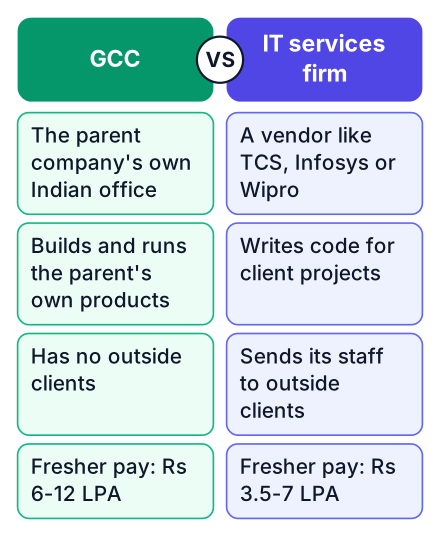
This is different from IT services. Companies like TCS, Infosys, and Wipro send their employees to work for outside clients. A GCC does not have clients. It does the parent company's own work from India.
Multinationals set up GCCs to save money and access Indian talent. The Zinnov-NASSCOM India GCC Landscape Report 2026 counts 2,117 GCCs across 3,728 units in India. They employ 2.36 million people and earned $98.4 billion in revenue in FY2026. That revenue grew 32% since FY2021. India is their largest hiring market for AI talent.
GCC fresher salary vs IT services salary
GCC fresher salaries are higher than IT services across every role. The advertised band for a fresher at a GCC in Bengaluru or Hyderabad is roughly Rs 6-12 LPA, per 360digitaltransformation.com. IT services typically starts lower. Note: All figures are advertised ranges and approximations from cited reports, and may vary by city and company.
| Role | GCC fresher pay | IT services fresher pay |
|---|---|---|
| Software Engineer | Rs 6-10 LPA | Rs 3.5-7 LPA |
| Data Scientist / ML | Rs 8-14 LPA | Rs 5-9 LPA |
| GenAI / Data (premium GCCs) | Rs 10-18 LPA | Not common |
These are the figures reported by gccjournal.in. Even the low end of the GenAI band (Rs 10 LPA) is higher than most IT services offers. That is the scale of the difference.
The gap is not just in offers. GCCs are hiring faster. India added ~200,000 net GCC roles in FY2026 (approximate), against ~110,000 at IT services (approximate), per TeamLease Digital data cited by 360digitaltransformation.com. And 364,000 new GCC jobs are expected in 2025, per gccjournal.in.
Why GCCs pay freshers more
GCCs pay more because they own the product and need skilled talent for core work. When you build a bank's trading platform, a mistake has direct consequences. If a trading app crashes during a transaction, the bank loses real money and faces fines. The parent company cannot afford that risk, so it invests in stronger hires and higher pay.
IT services have a different business model. They win a contract and staff it with a large team. The margin depends on volume. High volume presses salaries down.
GCC advantages
- You work on the parent company's own product.
- Higher salary and faster increment cycles.
- Lower employee-to-client ratio; you are often closer to the business.
GCC disadvantages
- Fewer openings than IT services.
- Harder entry, with more skill screening.
- Less variety in domains early on.
Skill demand is shifting the market too. 64% of new GCC roles ask for AI, data, or automation skills, per the Zinnov-NASSCOM report. These skills are scarce, so companies compete for them. The shortage pushes salaries up for freshers who have them.
Skills that get you into a GCC as a fresher
The practical skill set includes Generative AI (GenAI), machine learning, data engineering, cloud platforms, and automation tooling. A strong grasp of Python and SQL is the base. Add one cloud platform, like AWS or Azure, and you start to stand out.
GCCs are also moving to skills-first hiring, per the EY GCC Pulse Survey 2025 cited by gccjournal.in. They care more about what you can do than which college you attended. That is a real advantage for a fresher who self-studies.
Here is a practical path to build those skills:
Pick one focus area
Choose GenAI or data engineering. Do not learn everything. Depth wins.
Build two portfolio projects
One must use an AI or data library. Put the code on GitHub with a clear README.
Learn one cloud platform
Start with AWS or Azure free tier. Deploy one project there and mention it in your resume.
Practice on a coding platform
Solve problems on LeetCode or HackerRank every week. Focus on data structures and algorithms.
Apply to GCC campus drives
Watch for programs like Walmart Sparkplug and JPMorgan Code for Good. They hire freshers directly.
Campus programs that hire freshers into GCCs
Known campus programs like Walmart Sparkplug, JPMorgan Code for Good, and Goldman Sachs campus hiring are direct doors into GCCs. These are not obscure job boards. They are structured entry points with published pay and benefits.
The numbers for these programs are serious. gccjournal.in reports that Walmart Sparkplug offers a stipend of Rs 1-1.1 lakh per month for its student program. JPMorgan's Code for Good is a hackathon-style event that runs every year. Goldman Sachs runs its own campus hiring process for engineering roles. Amazon also hires SDE1s through campus drives into its GCC roles.
Each of these programs looks for the same things. A working knowledge of data structures, one solid project, and basic problem-solving under time pressure. Most of them do not ask for a specific degree. They ask for proof of skill.
Your search should be practical, not passive. Start with a LinkedIn search like "site:linkedin.com/jobs GCC Bengaluru fresher software engineer" or visit the careers page of known GCCs in your city — for example, in Bengaluru try Goldman Sachs, Walmart Global Tech, or JPMorgan; in Hyderabad try Amazon, Google, or Wells Fargo. Find their campus hiring pages. Apply before the placement season starts, not during it.
Are GCCs better than IT services for your first job?
For most freshers, a GCC is better than IT services if you can get in. Higher pay, stronger increments, and closer contact with a real product are hard to beat.
The increment gap compounds over years. GCC increments are projected at ~10.4% (approximate) in 2026 (EY Future of Pay via 360digitaltransformation.com) against 6.6% at technology consulting and services (Aon via the same page). On a Rs 8 LPA base, 10.4% is more than Rs 4,000 extra per month in the first year alone. That difference keeps growing.
IT services have their own advantages. They hire ~110,000 net new people a year (approximate) vs ~200,000 at GCCs (approximate), per 360digitaltransformation.com. That means far more openings. If you need a job fast, IT services is the safer bet. The work also exposes you to many industries over time, which builds breadth.
My pick for a fresher who can wait and prepare: aim for a GCC. The Zinnov-NASSCOM report calls India the #1 AI hiring market globally (see the report for the leaderboard). That demand is what pays your salary. It is not going away.
If you already have an IT services offer, take it. Gain experience, build projects, and move to a GCC after a year or two. Your first job does not decide your career. Your skills do.
Related reading: if you are still choosing between a service and a product company, see my post on service vs product company for your first dev job. For realistic pay expectations, read the software developer salary guide for 2026. And to know which companies are hiring now, check the list of companies hiring freshers in India.
Start building AI/data skills today. Join a GCC campus program in the next placement cycle. The guide to getting your first software internship is a good place to begin. The door is open, but it does not stay open forever.


