Build a Coding Habit That Actually Sticks (21 Days Won't Work)
The 21-day rule is a myth. Research shows habits take a median of about 66 days to form, and coding is a complex skill. Here is a cue-based plan with immediate rewards that actually works.
Last year a student told me he kept restarting his 21-day coding streak every single month. He would code for three weeks, miss one day, and quit. Then he would wait for the next month to start over. He was sure he just needed more willpower. He was wrong, and so is the 21-day rule.
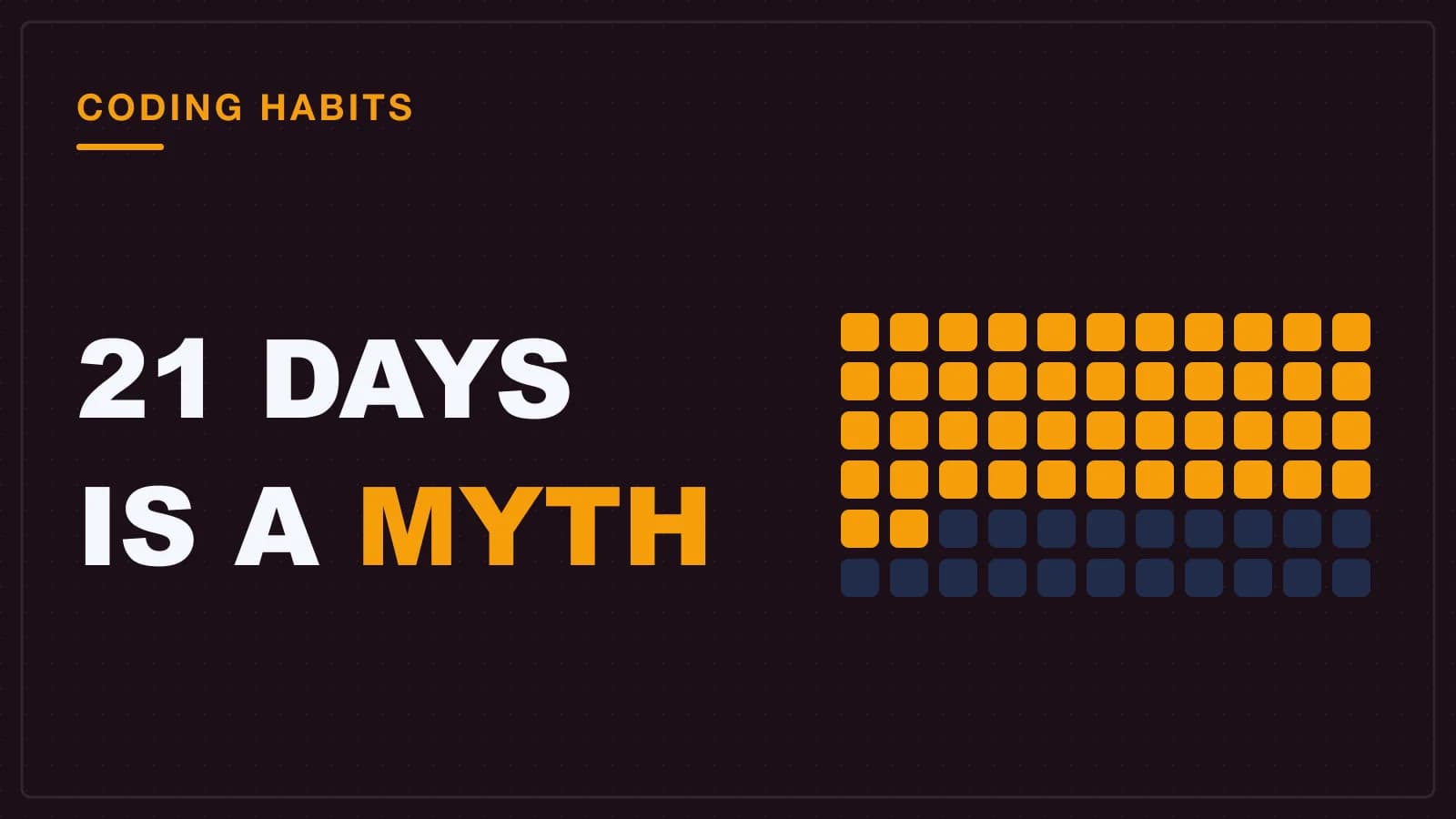
The 21-day rule is a myth: research shows habits take a median of about 66 days to form, and coding is a complex skill that takes even longer. The real fix is not more willpower. It is a specific, small, cue-anchored schedule with an immediate reward. This post explains why the 21-day idea is wrong and gives you a plan that actually works.
Where does the 21-day rule come from?
The 21-day rule comes from a plastic surgeon's 1960 book, not from any experiment. Maxwell Maltz wrote Psycho-Cybernetics after noticing that his patients took about three weeks to get used to their new faces after surgery. He called it a "minimum time" for mental adjustment. He had no data behind it, just his own observation.
Somewhere along the way, that observation became a rule. Books and self-help blogs repeated the number so often that people started treating it as science. It never was. Scientific American notes that the origin story is a plastic surgeon's anecdote, not a controlled study. The number spread because it is simple and gives people a finish line, not because it is true.
Here is the danger: when you expect a habit to form in 21 days, you give up on day 24. You think you failed. You did not fail. You just believed the wrong number.
So how long does a habit actually take?
Habits form in a range of 18 to 254 days, with a median of about 66 days.
That number comes from a 2009 study by Phillippa Lally at the University of Surrey. Her team tracked people forming three daily habits, like drinking water or taking a walk. The results showed huge variation. Some people were automatic in under three weeks. Others took over eight months. The median was about 66 days.
Two other findings matter for you. First, daily repetition was the biggest factor in automaticity. Doing the behavior every day beat doing it perfectly once a week. Second, complex skills take longer than simple behaviors. Research on new gym-goers found they needed four sessions per week for six weeks just to establish the routine. Coding is far more complex than going to the gym.
So expect two to three months, maybe more. That is not bad news. It is realistic. When you know the real timeline, a missed day in week six stops feeling like the end of the world.
Why can't you just rely on willpower?
Willpower runs out, but a specific plan doesn't.
Think about how you usually try to build a habit. "I'll code more." That is a vague goal. Vague goals depend on remembering to act, then summoning the energy to act. Both fade by the end of a long day. Lally's research shows that a specific plan like "study grammar for 20 minutes three times a week" works far better than a vague intention to study more.
Specificity removes the decision. You do not ask yourself whether to code today. You already decided, and the plan tells you when and for how long.
Two more things weaken willpower's role. Environment matters: the gym study mentioned earlier found people went more often when the reward was tied to the location, not to their daily resolve. And rigid daily schedules can deter people. Lally found that expecting perfection every single day actually made people give up sooner. A flexible plan survives real life. A strict plan collapses at the first disruption.
What makes a coding habit stick?
A coding habit sticks when you make it small, anchor it to an existing cue, and give yourself an immediate reward.
Three ingredients, and all three are in your control:
- Small: Start with 10–15 minutes a day. Not two hours. Fifteen minutes fits into any evening. You can always extend it if you are in flow, but 15 minutes is the floor.
- Cued: Attach coding to something you already do daily. Morning coffee, after dinner, right after you brush your teeth at night. The existing habit reminds you to do the new one.
- Rewarded: Have something pleasurable that immediately follows. A fun episode, a snack, a walk. The reward trains your brain to want the sequence again tomorrow.
Tracking helps too, but keep it simple. A paper calendar with a tick mark per day is enough. I've seen students use a wall calendar because they pass it every morning; the physical reminder is the cue.
Accept missed days as normal. Lally's work confirms that missing one day does not break the habit. You are not aiming for a perfect streak. You are aiming for a higher proportion of good weeks.
How do immediate rewards help?
Immediate rewards make the habit feel worth repeating now, not just someday.
This is not motivational fluff. A 2014 study found that people went to the gym 51% more often when audiobooks were the only content available there. The reward was locked to the behavior. You could only listen to the book while exercising, so exercising became the path to the book. No extra willpower required.
The timing matters too. Rewards are most effective during the task, not delayed. A reward next month for a month of coding is too far away. Your brain wants the payoff soon, ideally while the work is happening or immediately after.
Practical ways to add an immediate reward to coding:
- Learn while a favorite playlist plays only during coding sessions.
- Allow one episode of a show or one chapter of a novel right after coding.
- Keep a special snack or drink for coding time only.
- Call a friend or text someone about what you built, right after you finish.
The reward does not have to be big. It has to be immediate and tied to the behavior.
What if you miss a day?
Missing one day is normal, and it does not break the habit.
Lally's research is clear on this. Missed days are part of habit formation, and rigid daily schedules tend to deter people from continuing. When you miss a day, the habit is not gone. You just have one gap.
What actually kills the habit is the story you tell yourself after the miss. "I broke the streak, so I failed." That story makes you wait for a fresh start next month. Instead, do this: the next day, code again at your scheduled time. No apology, no extra session to "make up" for it. Just resume.
Focus on the week's total, not the streak. Four or five coding days a week is a success. A perfect seven is a bonus. This simple reframe turns one missed day from a catastrophe into a non-event.
Common mistakes to avoid
The biggest mistake is making your goal too big and too vague.
Here are the six most common errors I see from students who struggle with coding habits:
- Starting with hours instead of minutes. A two-hour goal on day one feels heroic and dies by day three. Start with 15 minutes.
- Having no cue. "I'll code when I have time" means you never have time. Attach coding to an existing daily action.
- No reward. Without an immediate payoff, coding feels like pure cost. Add something enjoyable right after.
- Expecting results in 21 days. Plan for 66 days or more. You are building a skill, not a reflex.
- Quitting after one missed day. One miss is normal. Two or three in a row is a signal to shrink the task, not to quit.
- Comparing your progress to someone else's streak. Their 200-day streak says nothing about your situation. Compare yourself only to last week.
If you are feeling burnt out, step back before you restart. Read how to recover from coding burnout first. And if you have trouble remembering what you learn, this post on why you forget code will help. A structured plan makes habits easier, and a 90-day learning plan gives you a bigger framework to fit this habit into.
What should you do this week?
This week, pick one tiny coding task, attach it to a daily cue, and give yourself a small reward right after.
Here is the concrete plan. It takes five minutes to set up:
- Choose 15 minutes. Pick a specific time of day that is usually free and calm.
- Identify a cue. Name the thing you already do right before that time. "Right after I finish dinner" or "right after I pour my morning coffee."
- Schedule it. Put it in your calendar as an event, not a vague intention.
- Reward immediately. Decide what you get right after coding. Make it concrete and enjoyable.
- Track for 7 days. Tick off each day on a calendar. Do not judge the days you miss.
- Evaluate and adjust. After a week, ask: did 15 minutes feel too long or too short? Is the cue working? Adjust and continue.
That is all you need to start. The research says the habit will take about two months to feel automatic. You have the right timeline now, so you will not quit at day 24 thinking you failed.
Tonight, before you sleep, write one line: "I will code for 15 minutes right after I finish dinner, and then I'll watch one episode of my favorite show." Put it on your desk. Start tomorrow.