Burnout While Learning to Code: How to Spot It Early and Recover
Coding burnout hits self-taught learners hard because there is no boss to blame. Here are the early signs, an honest recovery plan, and how to rest without guilt.
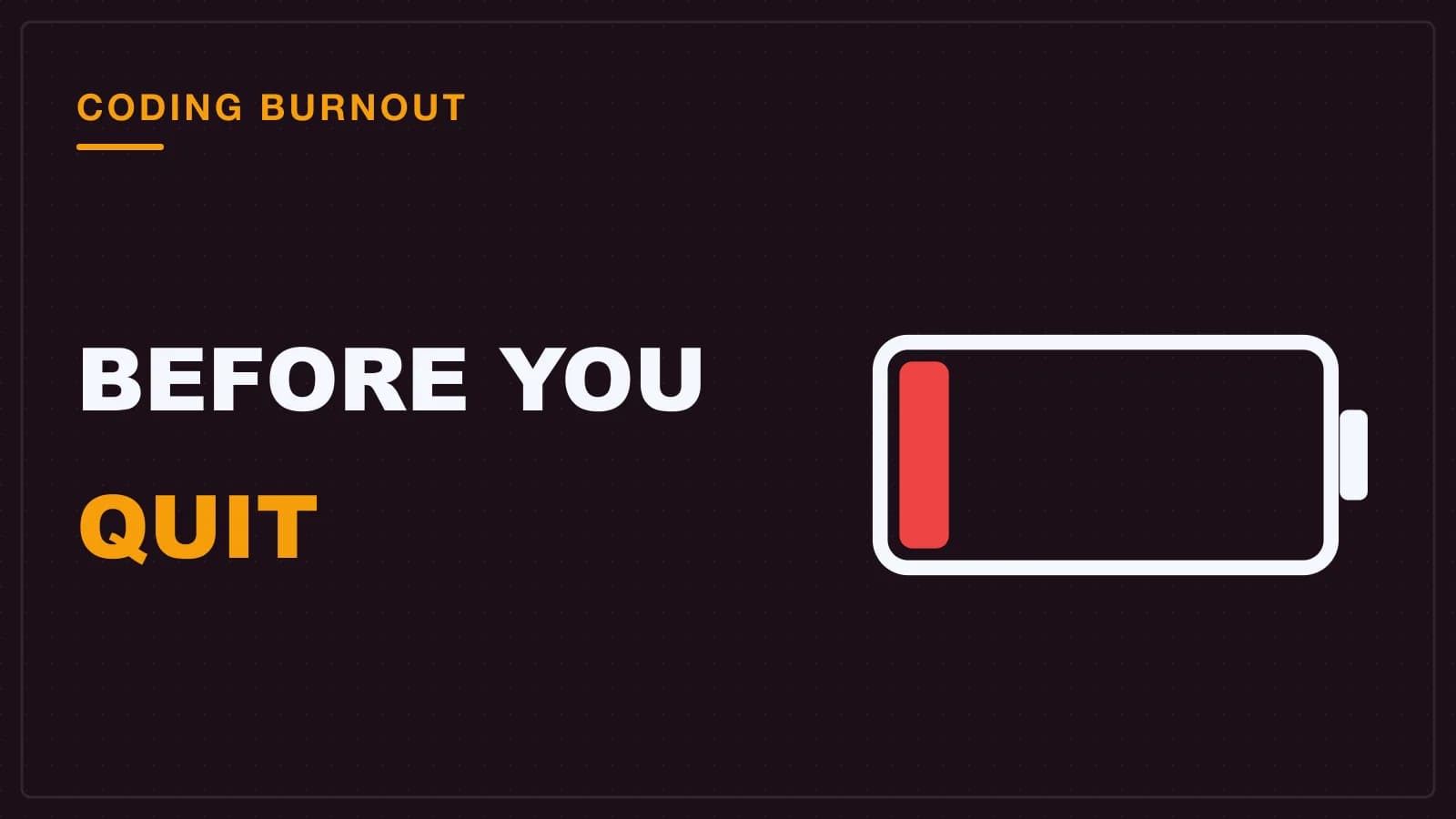
One of my students went nine days without opening his code editor. Not because of a holiday — because the thought of it made him feel sick. He was certain it meant he was lazy and not cut out for coding. It meant nothing of the sort. It was coding burnout, and he was back to full strength in about six weeks.
I have seen this same story in dozens of learners. Today I want to give you the honest version that nobody posts on LinkedIn.
What is coding burnout, in one short answer?
Coding burnout is mental and physical exhaustion from too much pressure and too little recovery, and the fix is real rest plus a smaller, sustainable plan, not pushing harder. The World Health Organization classifies burnout as an occupational phenomenon, not a personal weakness. For self-taught learners it shows up as dread, tutorial fatigue, and constant comparison. You can recover without quitting.
What does burnout look like when you’re learning to code?
It looks like dread before you even open the editor. The work that once felt fun now feels heavy and pointless.
The American Psychological Association describes burnout in three parts. You feel drained. You start to feel cynical about the work. And you feel less able to do it well. All three can hit a learner, not only a worker with a job.
Here is how that looks for someone learning to code:
- You open VS Code, stare at it, and close it again.
- You watch tutorials all day but build nothing.
- You scroll other people’s projects and feel small.
- Small bugs make you want to give up for the week.
- You sleep badly and feel tired even after rest.
If two or three of these feel familiar, keep reading. You are not broken.
Why does learning to code burn you out faster than the job does?
Because you carry all the pressure and get none of the structure that a real job gives you. There is no manager, no fixed hours, and no paid leave to fall back on.
The self-taught trap: no one to blame but you
When an employee burns out, they can point at the workload or the boss. When you are self-taught, there is no boss. So you blame yourself.
That self-blame is the most damaging part. It turns normal tiredness into a story about your worth. The story is false, but it feels very real at 1 a.m.
Hustle culture and the comparison feed
In India especially, the pressure to grind is loud. Everyone seems to be cracking interviews, shipping side projects, and posting about it daily.
You only see their highlight posts, never their bad weeks. So you compare your messy middle to their polished outside. That gap drains you fast.
You are comparing your behind-the-scenes to someone else’s highlight reel. Of course you feel behind.
What are the early warning signs most learners miss?
The early signs are quiet, not dramatic. You do not collapse. You slowly stop enjoying things and start forcing yourself.
Here is what most learners miss until it is bad. Catch these early and recovery is much faster.
| Early sign | What it really means |
|---|---|
| You delay starting every day | Your brain links coding to stress |
| You binge tutorials, build nothing | Tutorial fatigue: motion without progress |
| You feel angry at small bugs | Your tolerance is already used up |
| You scroll dev posts and feel low | Comparison is draining your fuel |
| You skip sleep to catch up | You are borrowing energy you do not have |
None of these mean you should quit. They mean your current pace is too high for your current rest. If the tutorial-fatigue line is the one that stung, that has its own fix, and I wrote it up separately in escaping tutorial hell.
Is it burnout, or am I just not good enough?
Almost always, it is burnout, not a lack of talent. Talent does not vanish in a week, but energy does.
Here is a simple test. Think back two or three months. Did you once enjoy coding and make progress? If yes, the skill is still there. What changed is your energy, not your ability.
I will be honest about my own version of this. Early in my career I spent a full month convinced I had hit my ceiling. I had not. I was sleeping five hours and saying yes to everything. Once I fixed my rest, the same problems became easy again within two weeks.
Feeling slow is a symptom of being tired. It is not proof you cannot code. If you want a calmer way to study that does not drain you, my guide on how to study a programming book walks through a slower, structured method.
How do you recover without quitting?
You recover by resting first, then re-entering slowly with a smaller plan. You do not push through. Pushing through is what caused this.
This is where beginners get stuck: they try to recover and study hard at the same time. That does not work. Recovery needs its own space. Here is a realistic four-step path.
- Stop fully for a short time. Take three to seven days with zero coding and zero guilt. Real rest, not “rest while feeling bad about it.”
- Reconnect with why you started. Remember the goal under the grind. My post on whether it is still worth learning to code can help you re-anchor.
- Re-enter at 25 percent. On your first day back, code for 20 to 30 minutes only. Stop while it still feels okay. Confidence rebuilds from small wins.
- Rebuild a sustainable plan. Replace the unrealistic schedule with a smaller one you can actually keep. My guide on how to learn to code in 2026 shows how to plan for the long game.
The HelpGuide burnout recovery guide says the same thing in clinical terms: rest, reconnect, and rebalance before you add load again.
How do you rest without the guilt?
You rest without guilt by treating rest as part of the work, not a break from it. A tired brain does not learn well. Rest is how you keep the skill, not how you lose it.
I want to be clear here, because the internet is full of toxic positivity. “Just push through” is bad advice for a burnt-out brain. So is “grind now, rest when you are successful.” That mindset is exactly what breaks people.
Try this reframe. You are not falling behind when you rest. You are removing the exhaustion that was slowing you down. A rested learner in three weeks beats a burnt-out learner in three months.
Save this for your next bad week: rest is not the reward for finishing. Rest is part of how you finish at all.
How do you prevent the second burnout?
You prevent it by building rest into your normal week, before you feel exhausted. Prevention is boring and it works.
A few habits keep most learners safe:
- Pick fixed off-days each week and protect them.
- Set a daily stop time, even when the bug is not solved.
- Mute the comparison feeds during your learning months.
- Track small wins, not only what is still left to do.
- Study in short focused blocks, then take a real break.
The NHS guidance on stress backs this up: regular breaks and protected downtime are the main ways to keep stress from building into burnout.
When should you stop self-managing and get help?
Take it seriously when the low mood, poor sleep, or hopelessness spread beyond coding and last more than two weeks. That is no longer just study fatigue.
Burnout and depression can look similar from the inside. Burnout usually lifts with real rest. If rest is not helping, or if you feel low about everything in your life and not only your code, please talk to a doctor or a mental health professional. That is a strong move, not a weak one.
If you ever feel unsafe or hopeless, reach out to someone you trust today. Your health comes before any learning goal, always.
Frequently asked questions about coding burnout
What are the signs of coding burnout?
The common signs of coding burnout are dread before opening your editor, watching tutorials without building anything, anger at small bugs, low mood after scrolling other developers’ work, and poor sleep. If a few of these last for weeks, treat it as burnout.
How long does it take to recover from burnout?
Mild coding burnout often eases in one to two weeks of real rest. Deeper burnout can take a month or more. Recovery is faster when you stop fully first, then return slowly at a lower pace instead of forcing yourself back to the old schedule.
Is burnout the same thing as depression?
They can feel similar but they are not the same. Burnout is tied to a specific demand and usually lifts with real rest and a lighter load. Depression tends to affect everything in your life and does not lift with a holiday. If rest is not helping after a couple of weeks, that is the signal to speak to a professional.
How do I rest without falling behind?
You do not fall behind by resting. A tired brain learns poorly, so rest protects your progress instead of erasing it. Take a short full break, then return at 25 percent of your old load. A rested learner moves faster than a burnt-out one.
Is burnout a sign I’m not cut out for coding?
No. Burnout is a sign of too much pressure and too little rest, not a lack of talent. If you once enjoyed coding and made progress, the skill is still there. What dropped is your energy, and energy is something you can rebuild.
Where does recovery start?
Do not plan a big comeback today. Just pick your next off-day and write it down. One protected rest day this week is how recovery starts.
Then, when you are ready, come back and read how to learn to code in 2026 to rebuild a plan that does not break you next time.
Arnab Biswas, full-stack instructor at DevHives, Kolkata.
This post is for general guidance only and is not medical advice. The WHO classifies burnout as an occupational phenomenon. If your symptoms persist, please speak with a qualified professional.