Python vs JavaScript for Beginners: Which Should You Learn First?
Python's adoption jumped 7 points on Stack Overflow's 2025 survey, but JavaScript still lands more entry-level web jobs in India. Pick based on your target role — data/AI means Python, web development means JavaScript — not on trending charts.
You see a chart showing Python ranked first in a coding survey, but your cousin in Bangalore got a web developer job after learning JavaScript. The headlines say Python is the future, yet the job listings in your city ask for JavaScript. Which one should you follow?
Here's the honest answer: If you have no job preference, start with Python for data/AI, but if you want a web job fastest, choose JavaScript. In short, Python is the better default if you lean toward data or AI, while JavaScript is the fastest route to a web development job. Your decision should come from the job you want, not from a popularity chart. Popularity tells you what is trending; your career goals tell you what to learn next.
What is the actual difference between Python and JavaScript?
Python and JavaScript were built for different places. Python runs on servers and in notebooks; JavaScript runs inside every web browser on earth, and on servers too. Everything else in this comparison follows from that one difference.
| Python | JavaScript | |
|---|---|---|
| Where it runs | Servers, notebooks and scripts. It cannot run inside a browser. | Inside every browser, and on servers too through Node.js. |
| Your first program | A script that reads a file and prints an answer. | A page that changes when you click something. |
| How the code feels | Close to plain English. Indentation is part of the language. | More punctuation, but you see the result on screen straight away. |
| Fresher roles in India | Data analyst, junior data engineer, ML engineer. Usually with SQL and some statistics on top. | Front-end developer, React developer, Node.js developer, full-stack. |
| What you add next | SQL, pandas, a little statistics. | HTML and CSS, then React, then a back end. |
| The hard part | The extra maths that data roles expect at interview. | The size of the ecosystem. It is easy to pick up too many tools too early. |
Read the table row by row and you will already know which column sounds like the job you want. The rest of this post is the evidence behind it.
What does the latest Stack Overflow survey actually say?
The 2025 Stack Overflow Developer Survey shows that Python's adoption jumped 7 percentage points, but JavaScript remains the most used language overall — used by 63% of developers, while Python sits at 51%. That gap matters for entry-level jobs. The survey measures what developers already use, not what a fresher in India should learn first. It tells you where the industry is heading, not where your first job will be.
- Here's where beginners get misled: a 7-point jump sounds like Python is taking over everything.
- It isn't. JavaScript still dominates the web, and the web is where most entry-level software jobs live.
- Reading it as a personal career roadmap is a mistake I see constantly.
Think of it this way: the survey tells you where the industry is heading, not where your first job will be. Those two things often diverge for a beginner.
What job do you want in 2026?
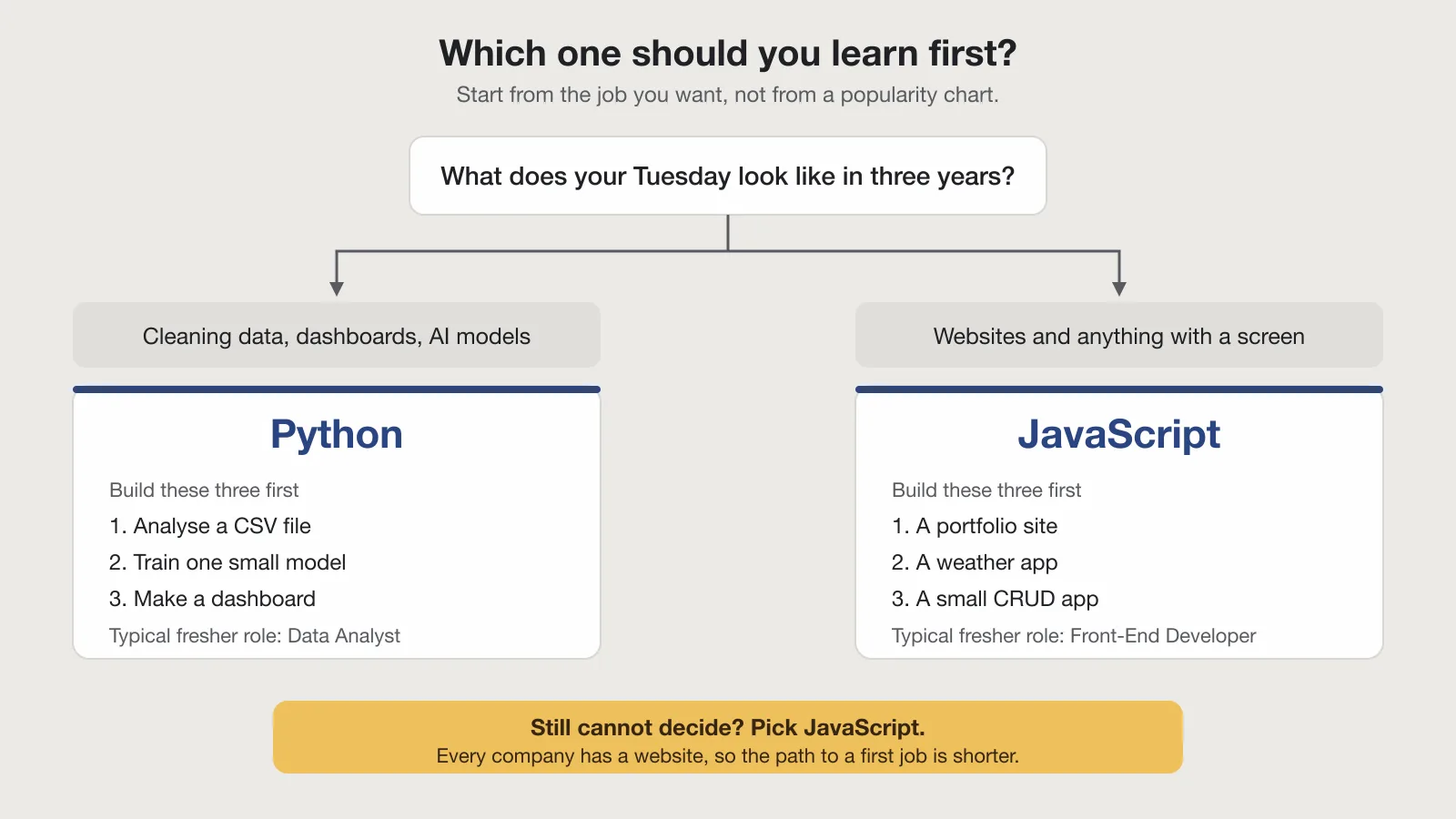
The right language for you depends on your target role, not on which language is trending. Data scientist, web developer and back-end engineer are three different jobs. Before you write a single line of code, sit down and answer one question: what does your typical Tuesday look like in three years?
If your Tuesday involves analyzing sales numbers and building dashboards, that is a data analyst role, and Python and SQL will get you there. If it involves fixing a website's login page, that is web development, so JavaScript is your path.
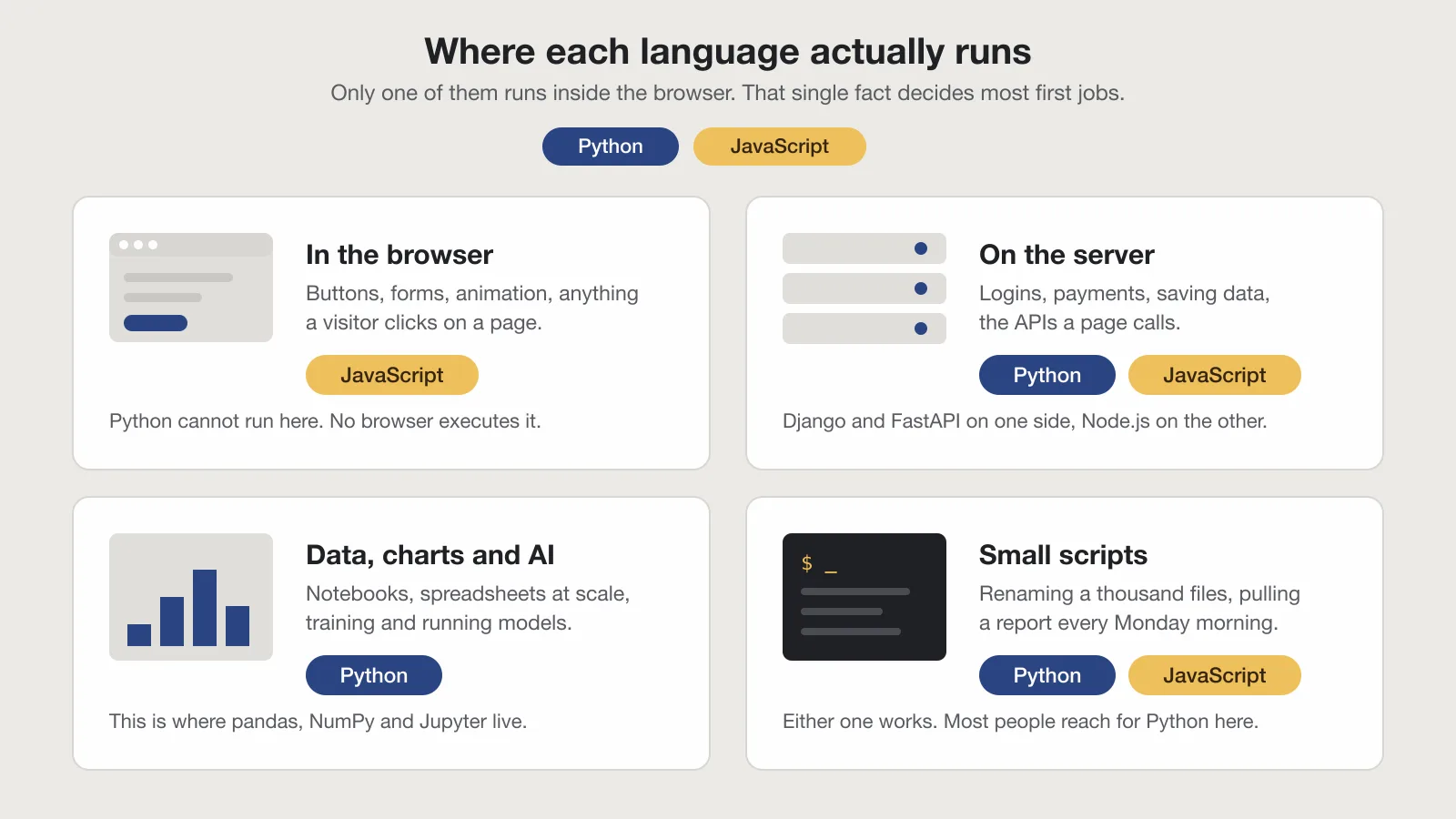
Let me map the common Indian entry-level roles to languages:
- Data analyst or AI engineer → start with Python. You'll use it for data cleaning, model training, and automation. Your first projects will involve pandas, NumPy, and Jupyter notebooks.
- Front-end or UI developer → start with JavaScript. You'll use it to make websites interactive, build single-page apps, and eventually work with React or Vue.
- Full-stack developer → start with JavaScript, then add Python later. Most Indian startups and product companies expect full-stack engineers to handle the web layer first; Python becomes a bonus skill for back-end automation and data work.
I've mentored students who picked Python because "AI is the future" and then struggled to find front-end roles. I've also seen students pick JavaScript for web development and later pivot into data science by adding Python. Both paths work. The key is picking the one that matches your target role, not the one that matches the news cycle.
Which language has more entry-level jobs in India?
JavaScript powers most entry-level web jobs in India, while Python jobs are growing fastest in data and AI roles. Open any fresher job board and you'll see the pattern immediately.
Search for "React developer fresher" on Naukri or LinkedIn and you'll find hundreds of postings. Search for "Node.js developer fresher" and you'll find another batch. These roles accept JavaScript experience from self-taught developers and bootcamp graduates alike. The barrier to entry is low because companies need people who can build and maintain websites.
Now search for "Python developer fresher" or "data analyst fresher." You'll find jobs, but they often ask for additional skills: SQL, statistical knowledge, or familiarity with specific tools like Power BI. ML engineer roles frequently demand a degree in CS, math, or statistics. The jobs exist, but the checklist is longer.
A typical JavaScript fresher role: "Front-End Developer — Build responsive UIs with React and integrate REST APIs." A typical Python fresher role: "Data Analyst — Write Python scripts to clean data, create dashboards, and present insights to stakeholders." These are two different careers, not two different languages.
Which language is easier to learn first?
Python has simpler syntax and reads like English, but JavaScript is equally beginner-friendly and gives you instant visual feedback in a browser. Both languages have their own learning curves, and the "easier" one depends on how you learn best.
Python's syntax is famously clean. This is a complete Python program, the whole file:
# average.py  -  run it with:  python3 average.py
marks = [72, 85, 64, 91]
print("Average:", sum(marks) / len(marks))
Three lines, and one of them is a comment. Indentation is built into the language, so you learn good habits early. Math operations feel natural, and concepts like lists and dictionaries map directly to real-world ideas. If you're someone who wants to focus on logic rather than syntax, Python wins.
JavaScript's strength is immediate feedback. Save this as index.html, double-click it, and the page reacts to you:
<button id="go">Click me</button>
<script>
  document.getElementById("go").onclick = function () {
    document.body.style.background = "gold";
  };
</script>
No installation, no terminal. Change a colour, move an element, respond to a button click, and the visual payoff keeps you motivated. That feedback loop matters when you're spending evenings and weekends learning after a day of classes or work.
Consider this: a Python beginner runs their first script in a terminal and sees text output. A JavaScript beginner writes their first script and sees a button change color on a webpage. Both are learning the same fundamentals, meaning variables, loops and functions, but the JavaScript learner sees something they can show a friend. For many beginners, that visible progress is the difference between sticking with it for three weeks or quitting in the first month.
If you're the type who needs to see results to stay motivated, JavaScript's browser feedback is a genuine advantage. If you prefer quiet logic and clean syntax, Python's simplicity will keep you moving.
Which language pays more for freshers?
At year zero the language barely moves the number. Fresher offers cluster in the same bands whichever one you picked: roughly ₹3.5–6 LPA at a service company and ₹6–15 LPA at a product company. What moves your first offer is the kind of company that hires you, not whether you wrote Python or JavaScript to get there. The blog's software developer salary breakdown for India lists those bands with their sources.
The two tracks separate later. Python roles in AI and data often push higher after two or three years, while a front-end developer and a data analyst start close together.
Here's what I see in the Indian market: Python roles in data analysis and ML engineering currently offer higher upside, but they require more math and statistics. Many beginners ignore this reality. They see the salary numbers and jump in, then hit a wall when interviewers ask about hypothesis testing or regression analysis.
JavaScript roles start you in web development, where the career path is more visible. You start with front-end, move to full-stack, and eventually lead projects. The salary growth is steady and predictable. It won't skyrocket the way AI roles can, but it also doesn't require a statistics refresher before your second interview.
Think about the software developer salary trends in India. The pattern holds: freshers in both tracks start close, but specialization drives the divergence. The question becomes: are you willing to invest in the math foundation that AI and data roles require?
Which language should you learn if you're still unsure?
If you genuinely can't decide, pick JavaScript. Here's my reasoning: JavaScript's ubiquity in web development means you won't need to learn a second language for your first job. Every company has a website. Every website needs front-end developers. The path from "I know JavaScript" to "I have a job offer" is shorter and more direct.
For Python, if you want to work in AI or data, you'll also need to learn SQL and pandas, but Python is the core language you'll use daily. The comparison is not about which language is better, but which one matches your target job.
Learning both at once is a common trap that halves your progress, so I advise doing one first and adding the other after you've built three projects. I've watched too many students try to learn Python and JavaScript simultaneously, only to confuse print() with console.log() and abandon both in frustration.
Here's a concrete plan:
- Python first for the data/AI path → build three data projects (CSV analysis, a small ML model, a dashboard), then learn JavaScript for web dashboards and data visualization.
- JavaScript first for the web path → build three web projects (a portfolio site, a weather app, a simple CRUD app), then learn Python for back-end automation and data work.
Many Indian college courses teach both in the same semester. Don't follow that model. It exists to cover syllabus, not to build job-ready skills. Pick one, commit for 90 days, and build real projects before touching the second language.
Your first language is not a lifelong commitment. It's a starting point. I know data scientists who started with JavaScript and web developers who started with Python. What matters is that you start moving and build momentum. The reason you forget what you learn to code is not your language choice. It is learning too many things at once without building anything.
What's the fastest way to make your decision today?
Spend 30 minutes with each language's official beginner tutorial and pick the one where you write your first "Hello, world" without getting stuck. Python has the official tutorial at python.org; JavaScript has MDN's getting-started guide. Both are free, both are high quality, and both take less than an hour.
After that 30-minute session with each, commit to a concrete action: open a text editor right now, write a Python one-liner that prints 'Hello, world' and a JavaScript one-liner that changes a webpage's background color. Whichever one makes you want to continue, that's your choice.
Pay attention to how you feel during each session. Did Python's clean syntax feel natural? Did JavaScript's instant browser feedback feel exciting? Your gut reaction during that first 30-minute session is a better signal than any survey or salary chart. The language that keeps you engaged for that first session is the one you'll still be using on day 30.
Also consider your learning environment. If you're working from a phone or a low-end laptop, Python runs anywhere. If you have a decent computer and a modern browser, JavaScript gives you a richer playground. Practical constraints matter more than you think.
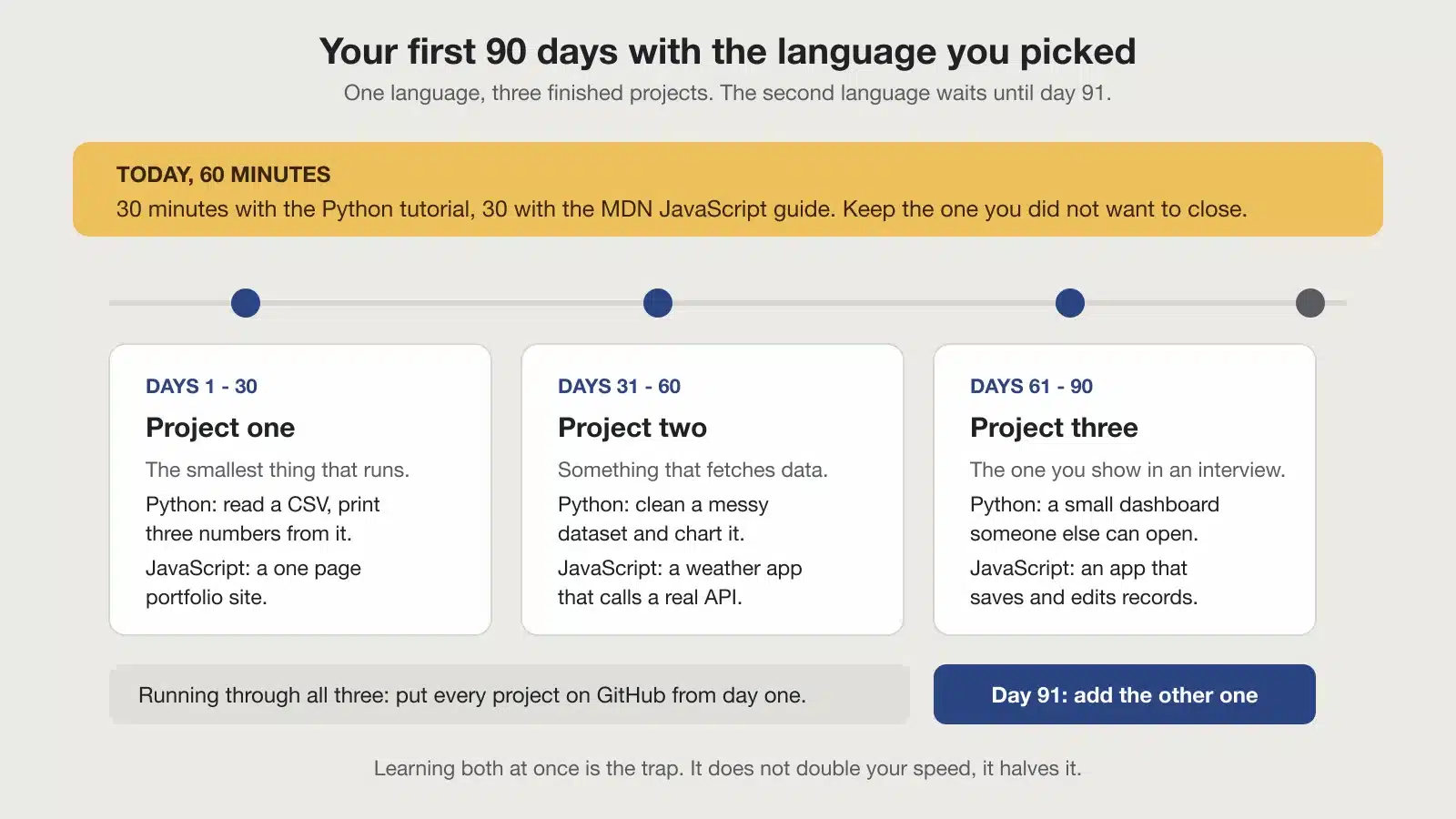
Once you've made your choice, commit fully for 90 days. Set a 90-day goal such as "Build a weather website" or "Analyze a CSV with Python", something concrete you can show in an interview. Learn Git basics early so you can track your progress; the Git and GitHub guide for beginners will help you get started. Open your first tutorial tomorrow morning and begin. No more comparison articles.
The language you choose today is not the language you'll use forever. It's the language that gets you your first job. After that, you'll learn whatever your work requires, and that is how every developer grows. The only wrong choice is postponing the decision while reading one more comparison article.


