Claude Duet: Anthropic's Proactive AI Agent, Launch Details for 2026
Anthropic's Claude Duet is the first proactive AI agent, working in the background and asking before it acts. We break down who can access it, what it costs, and how its approval gates work.

Anthropic launched Duet on 21 October 2026, and the first release is open only to people in the US who join a waitlist. That gap matters to Indian students, because what Duet does shows where AI tools are heading next, even before you can try it yourself. Here is what it does, what it costs and how to copy the idea.
Claude Duet is Anthropic's first proactive AI agent: it works in the background and asks you before it acts. It sends a morning brief, keeps working on a cloud computer while you are away, and stops for your approval before it sends, pays, signs or deletes. It is a research preview for US Pro and Max subscribers only.
What Claude Duet is and what it does
Duet is an app, powered by Claude Opus 5.5, that checks your connected apps and starts work without you typing a prompt first. Anthropic's launch page calls it a research preview, which means features and limits can still change.
Each morning it reads across the apps you have linked and writes you one brief. From there it can pick up tasks and carry them on by itself. It works on its own cloud computer with its own browser, so it can open web pages while your laptop is shut.
Connectors are what let Duet read your Gmail or Google Calendar, and it supports a large library of connectors and plugins. It also reuses what you already saved in Claude, such as memory and skills. If you already set up connectors in the regular Claude app, Duet starts with those too.
Approval gates stop it before it sends, pays, signs or deletes
Duet must get your yes before any action that is hard to undo, and two actions are blocked even with your yes: trading securities and moving money between accounts.
Payments run through Stripe's Link on a virtual card, not your real card number. Duet never sees your passwords directly. A separate classifier also rejects requests to share the strictest kind of data, such as credit card numbers, as The Verge reports.
Here is how one task moves through those gates:
Duet spots a task
Something in your connected apps needs a reply or an action.
It drafts the action
It writes the message or fills in the form on its cloud computer.
It stops at the gate
Sending, paying, signing or deleting needs a human decision.
You review it
You approve, edit or reject the draft.
It acts or drops it
Only an approved action leaves Duet's computer.
Access is US-only, waitlist and paid plans
Today you need a US location, a waitlist spot and a Claude Pro or Max plan, so most readers in India cannot get in, according to Anthropic's product page.
Pro costs $20 a month, or $17 a month billed yearly. Max starts at $100 a month. These are the existing Claude plan prices, not a separate Duet price. Duet adds no extra fee during the preview. Team and Enterprise plans do not get it yet.
For readers in India, the honest answer is to wait. Our sources give no rupee price, because Duet is not offered here yet. For readers in the US, a paid plan alone is not enough. You still join the waitlist and wait for a spot to open.
Limits to know before you pay
Duet's background work uses up your plan's allowance, and it is weaker at personal errands than at work tasks, according to SaaSCity's review. These limits and the prices above come from that one third-party review, not from Anthropic, so confirm them on Anthropic's Duet page before you pay.
The allowance point hits hardest if you also use Claude for coursework or coding. A busy afternoon of Duet tasks can leave less for your own chats.
Pros
- No extra cost on top of your plan while the preview runs.
- Every risky step has a clear point where you can say no.
- Strong at work tasks that span several connected apps.
Cons
- Reported by SaaSCity: it checks your apps only every few hours, so it is not instant.
- Reported by SaaSCity: its background work shares the same usage limits as your normal chats.
- Reported by SaaSCity: there is no API, so you cannot call it from your own code.
- Reported by SaaSCity: it struggles with errands such as booking tickets.
Four always-on agents launched in ten weeks, and what we know about each
Four companies shipped always-on agents within about ten weeks, and Duet is the newest of them, per SaaSCity's timeline. The Verge frames Duet as Anthropic's answer to Meta's Muse, and our post on what is new in Meta Muse covers that rival in detail.
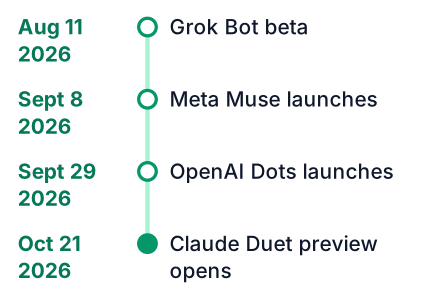
| Agent | Maker | Launched |
|---|---|---|
| Grok Bot | xAI | 11 Aug 2026 (beta) |
| Meta Muse | Meta | 8 Sept 2026 |
| OpenAI Dots | OpenAI | 29 Sept 2026 |
| Claude Duet | Anthropic | 21 Oct 2026 (research preview) |
The table gives launch dates only, because Duet's own access and approval rules are covered in the sections above and we do not have the same detail for the rivals. Before you pick one, open each vendor's own page and look for two things: who can sign up, and which actions need your approval.
Build the same agent pattern yourself
You can practise the same loop of watch, act in the background and ask approval with free tools, without waiting for access. Here is that loop in a short Python sketch, with small stand-in functions so it runs as written and prints output before you build anything real:
import time
CHECK_INTERVAL = 5
pending = ["Is my order on time?"]
def fetch_new_items():
    items = list(pending)
    pending.clear()
    return items
def write_reply(item):
    return "Re: " + item
def send(action):
    print("Sent:", action["draft"])
def log(label, action):
    print(label, action["item"])
def check_apps():
    # Read new items from one place, like an inbox or a task board
    return fetch_new_items()
def draft_action(item):
    # Ask a model to write a reply, but do NOT send it
    return {"item": item, "draft": write_reply(item)}
def ask_approval(action):
    print(action["draft"])
    answer = input("Send this? (yes/no): ")
    return answer.strip().lower() == "yes"
while True:
    for item in check_apps():
        action = draft_action(item)
        if ask_approval(action):
            send(action)   # the only line that touches the outside world
        else:
            log("skipped", action)
    time.sleep(CHECK_INTERVAL)  # wait, then look again
The key line is the if. Nothing leaves your machine until a human types yes. One run prints the draft, Re: Is my order on time?, then asks Send this? (yes/no):, and after you type yes it prints Sent: Re: Is my order on time?. In a real build you would swap input() for a button in a chat app, but the gate stays in the same place. The call to time.sleep simply pauses the program for that many seconds before it looks again, so the waiting part is easy to follow if it is new to you.
Our step-by-step guide to building an AI agent in Python fills in fetch_new_items and write_reply with free tools.
What proactive agents mean for early-career developers
In my view, agents that act without being asked make approval design and permissions the skills worth learning, with testing close behind. The Verge's coverage treats Duet as one more move in a fight between big labs. I think the bigger story is the shift underneath it.
AI is moving from a tool you open to a worker that comes to you with a to-do list. Someone has to decide what that worker may touch. On many teams, that person ends up being a developer, so it helps to practise before you are asked.
Say you are an intern at a startup in Pune, and you build an agent that answers customer emails. Your lead's first question will not be about the model. It will be: what stops it from promising a refund nobody approved?
Or say you are a junior developer in Ohio, and your team lets an agent close old tickets. One loose filter and it closes live bugs too. Reading its logs is how you catch that on the first day, not weeks later.
- Limit what it can do. Give an agent read access first, and write access only where needed.
- Add human checkpoints. Put a yes-or-no step before every action that is hard to undo.
- Read the logs. Check what the agent did, not just what it said it did.
Your next step depends on where you live. In the US, join the waitlist on the Duet page today. In India, spend this weekend running the Python sketch above, swap its stand-in write_reply for a call to the free tier of Google's Gemini API, and make it draft one reply that waits for your yes, then follow our Python agent guide to go further. Then tell me in the comments: what is one thing your agent should never do on its own?


