Genie 4: Google DeepMind's World Model for Students
Google DeepMind announced Genie 4 on 27 October 2026, a world model that turns text into steerable 3D worlds. It's a research preview for trusted testers only, so here's what students can actually do this week.

As of 27 October 2026, Google DeepMind's own Genie 4 page describes a research preview for trusted testers only. You cannot use Genie 4 yet. You can join a waitlist on that page, but it does not promise access, and the page does not say who the waitlist is open to. Until Google opens it wider, the most you can do is watch the demo and prepare, and the steps below show how.
Genie 4 is Google DeepMind's world model, a system that turns a text or image prompt into a 3D world you can steer in real time, and it is the first DeepMind world model to generate sound with the picture. It also moves people and objects more realistically and lets you type changes, such as weather, while the world runs. Ultra costs from $100 a month (Ars Technica), which is far too much for most students.
Genie 4 world model: what Google announced
Google DeepMind announced Genie 4 on 27 October 2026 as a natively multimodal world model that builds on Gemini Omni and other Gemini models.
A world model is an AI system that draws the next moment of a scene based on what you just did inside it. Think of a video game with no game code underneath. The model paints every frame as you walk, look around or change things.
According to DeepMind, each part of the system has its own job. Gemini Omni keeps the pictures realistic. Other Gemini models handle reasoning, so the world still makes sense as it changes. Google posted the same news on its main Google blog on the same day.
Four things Genie 4 can do
The four real capabilities, as listed on the Genie model page, are real-time shaping by text, more realistic physics and human movement, native audio with interactive dialogue, and multi-step event simulation.
Shaping by text. You type a change while the world is running. You can switch the weather, add people or objects, or move the camera. Gemini rewrites your request so it fits the scene you are already in.
Physics and people. DeepMind calls this a new standard of realism, which is the company's own claim. Judge it yourself in the demo video above by watching how objects move and collide. Human characters walk and turn in a natural way, instead of sliding around.
Native audio. This is the first DeepMind world model that makes sound together with the picture. It generates music and background noise. Characters can also speak, and that dialogue adapts to what you do.
Multi-step events. Genie 4 can play out a chain of events, not only a single still scene. A Gemini 3.8 Flash model acts as a guide that checks every step, according to DeepMind's announcement. It decides what should happen next so the story stays on track.
| Capability | What you can do with it |
|---|---|
| Real-time shaping by text | Type "make it rain" or "add a crowd" while the world runs |
| Physics and human movement | Watch objects fall, fly and collide, and people move naturally |
| Native audio and dialogue | Hear music and background sound, and talk with characters |
| Multi-step event simulation | Set up a sequence of events that a Gemini agent keeps coherent |
Where Genie 4 still falls short
Worlds stay consistent for only about two minutes, double the previous model, and details still drift after that, according to both TechCrunch and Ars Technica.
For a short demo, that is enough. For anything long, such as a full game level, it is not. Here is the honest split.
Pros
- You steer a living scene by typing, with no code.
- Movement and collisions look believable.
- Sound arrives with the picture, so you need no separate audio tool.
Cons
- Objects and small details change on long runs.
- Audio accuracy is not solved yet.
- Text inside the world, like signs, is often hard to read.
Who can use Genie 4 now, and who gets it next
Access comes in three stages: trusted testers today, then Google AI Ultra subscribers in Project Genie, then early-access partners of the Gemini API and Google AI Studio, as Google's announcement lays out.
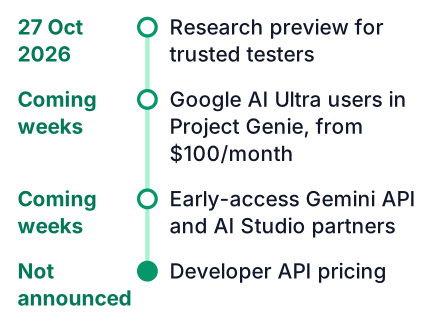
Today: trusted testers
A small invited group uses the research preview. There is no way to buy in.
Coming weeks: Project Genie
Google AI Ultra subscribers get it inside Project Genie. The Ultra price quoted above is Ars Technica's figure. No source gives a rupee price, so readers in India should check the plan page in their own region.
Coming weeks: developers
Early-access partners of the Gemini API and Google AI Studio come in. Developer pricing is not set yet, Ars Technica reports.
"Coming weeks" is Google's phrase, not a date. Launch plans like this often slip, so treat it as a rough order only.
What a student can do this week
Only one action touches Genie 4 itself today: joining the waitlist. The other two steps are preparation you can finish this week, and each gives you a result you can keep.
Say you are a second-year student with a laptop and no budget. Every door past the waitlist needs either an invite or a paid plan. You cannot change that. You can make sure you are ready when a door opens.
Join the waitlist
Sign up on the DeepMind Genie page. If a free testing window opens, people already in the queue hear first.
Practise steering Gemini
Gemini is what turns your typed request into a change in the world. Practise writing clear instructions in Google AI Studio. Paste this: "Describe a rainy street market at night in five sentences." Then send three follow-ups, one at a time: "Make the rain stop.", "Add a musician near the fruit stall.", "Move the scene to morning." This is practice for writing clear instructions, not a Genie skill. Our post on building student projects with Gemini 4 Argon gives you practice ideas.
Watch the demo and write down three ideas
Play the DeepMind video above and write three things you would try if you could steer that world, such as a game level, a film scene or a robot test. For each one, note what a game engine like Unity or Godot would need: a modelled scene, scripted physics and recorded audio. A world model draws all of that from a prompt, but only holds it together for about two minutes. Your result is a one-page list you can reuse the day access opens.
None of this replaces the skills you must own yourself. Programming, basic maths and Git still matter more than any preview. Also be careful with Gemini rumours. Our note on what students should do about the Gemini 4 Carbon leak shows how to sort confirmed news from guesses.
Where world models fit in a robotics and AI career
Google now pitches Genie for gaming, interactive learning and robotics, and other companies such as Runway are building rival world models, TechCrunch reports.
Robotics is the part that matters most for careers. A robot learning to pick up a cup can fail thousands of times in a simulated kitchen. Nothing breaks, and nobody pays for spilled cups. AI agents can train the same way, inside worlds that react to them.
Rivals such as Runway and World Labs work in this area too, TechCrunch reports, but nobody can promise jobs in it yet. The skills worth building first are Python, linear algebra, basic physics and how neural networks learn.
For a beginner, the path into this work starts with Python, linear algebra and how neural networks learn. If you are still in school, our guide to becoming an AI engineer after 12th without JEE maps out the first steps. That route works for US high school students too.
Is Genie 4 free for students?
No free student plan has been announced; the only free step today is joining the waitlist. Ultra is a paid plan and developer pricing is not set, so nothing about Genie 4 is free yet.
Should students care now? Care enough to watch it, not enough to plan around it. It is a two-minute demo tool in a research preview, and the skills that last are Python, maths and Git.
Your next step on Genie 4
- Join the waitlist on the Genie page, then write your three ideas from the demo video.
- When access opens, check your region and plan before paying for anything.


