How to Become an AI Engineer After 12th Without JEE
You can become an AI engineer in India without JEE. Pick any degree like BCA or BSc, learn Python, build one project each month, and use free AICTE internships to prove you can deliver.

Say you are in Class 12, you did not clear JEE, and a relative at a family dinner tells you AI engineering is now closed to you. The roadmap.sh AI Engineer roadmap defines the job as using pre-trained models rather than building them from scratch, which is a software test and not a JEE test. So the belief that an IIT tag is the only way in does not follow from what the job actually asks for. Below is what that test looks like and a plan to pass it.
You can become an AI engineer in India without JEE by building a portfolio of shipped projects instead of relying on a college tag. Pick any degree such as BCA or BSc, learn Python and how to use existing AI models, and build one small project each month. Add free AICTE internships and open-source work to show employers you can deliver. This plan rests on one engineer's published path plus the roadmap.sh skill list, so treat the 18 months as a guide, not a promise.
Know what an AI engineer actually does
An AI engineer uses pre-trained models and existing AI tools to improve products, and does not build models from scratch, so the job needs software skills more than JEE-style maths. That is how the roadmap.sh AI Engineer roadmap defines the role.
Three job titles get mixed up in Indian career videos. Here is the short version:
- AI engineer: connects existing models to a real product, such as a chatbot that answers questions from a company's documents.
- ML engineer: trains and tunes machine learning models and keeps them running in production, so the role needs more statistics.
- AI researcher: invents new methods and publishes papers, usually after a master's or PhD.
The first role is the one that fits you best. Its daily work is writing code, calling APIs and testing outputs. A rank in a maths-heavy entrance exam does not measure any of that. If the ML engineer path interests you more, read my guide on becoming a machine learning engineer after 12th.
Choose a degree that does not need JEE
Several routes lead to AI jobs after 12th without JEE. BCA and BSc courses often admit by Class 12 marks or CUET, which is an entrance test but not JEE, while a BTech with no entrance test at all is mostly found at private colleges, and employers hire from all of these routes. A GenAI engineer who wrote about his own path into AI came in through a BCA at a college with no placement cell.
| Degree | Duration | Typical entry requirement | Fit for AI engineering |
|---|---|---|---|
| BCA | Three years | Class 12 pass; many colleges ask for maths | Good. Heavy on programming from year one. |
| BSc Computer Science or Data Science | Three or four years | Class 12 with maths; merit list or CUET at many universities | Very good. Adds statistics and data work. |
| BTech (state or private university) | Four years | State engineering exam such as WBJEE (a state exam, not JEE Main), or the university's own test; check each college's rules | Very good. Widest choice of electives. |
His argument is that AI hiring looks at what you shipped, not at certificates or the college name. That changes how you should pick. If you are already in a non-IIT BTech, skip this choice and start at month one of the roadmap below. Choose the college that leaves you the most free hours to build, and that is recognised by AICTE or UGC. Before paying any fee, ask the college for its approval letter and check that it appears on the official AICTE and UGC websites. The second point matters for the AICTE internship portal described further down the page.
Follow a month-by-month roadmap from zero to first project
A portfolio-first plan spreads Python, data basics, model projects and deployment across about 18 months of weekly building, so you always have something to show. That 18-month figure is one engineer's zero-to-first-role time in the same practitioner's account, and your own timeline may differ. I could not find a survey of how long this takes. The account also lists what interviews test: RAG and fine-tuning, plus evaluation and deployment.
Months one to three: Python and Git
Learn variables, loops, functions and files. Push every exercise to GitHub. Solve a few easy LeetCode problems each week to train basic problem-solving.
Months four to six: data basics and Kaggle
Learn pandas and simple charts. Join a beginner Kaggle competition and publish one notebook, even if your score is low.
Months seven to nine: your first model project
Build a small app that calls an existing model through an API. A study-notes summariser is a good first idea.
Months ten to twelve: a RAG project with evaluation
Build a bot that answers from your own documents. Write a small test set and measure how often the answers are right.
Months thirteen to eighteen: deploy, contribute, apply
Put your projects online, send pull requests to open-source projects you use, and start applying.
RAG means retrieval-augmented generation: the model answers using documents you hand it, not only what it learned in training. Fine-tuning means training an existing model a little more on your own examples. For the full skill list, see skills required for an AI engineer fresher in 2026.
Use the AICTE National Internship Portal for free, verified experience
The AICTE National Internship Portal is a free Ministry of Education platform where students from AICTE, UGC and IGNOU institutions can apply for internships, including AI/ML tracks. The headline numbers on its home page:
- About 80 lakh (7.9 million) internships listed as of the portal's home page on 25 October 2026 (most are not AI-related, so filter first and count the AI results), per the portal.
- 83,170 companies registered, per the portal.
- A target of 1 crore internships by 2027, stated on the portal.
For an AI student, the useful part is the free tracks. These include AI/ML programmes, Google's Indic-language AI track and Microsoft's Future Ready Talent programme. Finished internships come with a government-issued certificate that carries a QR code, plus credits in the Academic Bank of Credits (ABC), the national system that stores your course credits.
Applying takes a few minutes:
- Register as a student on the portal with your college details.
- Complete your profile, including your skills and a GitHub link.
- Filter internships by AI, ML or data science.
- Apply, finish the work, and download the certificate.
- Add it to your resume under "Experience" and link it in your GitHub README, so a recruiter can scan the QR code.
Eligibility depends on being enrolled at an eligible institution. A student doing only online courses cannot use it, which is why your degree choice in the earlier section counts.
Certificates help, but projects get you hired
Courses such as AI For Everyone by Andrew Ng, IBM's Introduction to AI and the Columbia AI MicroMasters, all listed by Sarvgyan's AI engineer guide, teach concepts, but the practitioner evidence says hiring managers test what you shipped.
Pros
- A clear order of topics, which helps when you are starting.
- Big names on your LinkedIn profile.
- Some courses are free to audit.
Cons
- Thousands of other applicants hold the same certificate.
- Quizzes do not prove you can build or deploy anything.
- Paid tracks can cost more than your first laptop upgrade.
Finished AI For Everyone? Write down one problem at your college a model could help with, then build a rough version.
Build proof: Kaggle, open source and a public portfolio
Public work, such as Kaggle notebooks and a GitHub profile with deployed projects, lets a recruiter check your skill in minutes. Your portfolio should show the AI engineer skills roadmap.sh lists, like working with model APIs and building on pre-trained models.
Use this as your checklist before you apply:
- Two deployed projects, each with a README that explains the problem, the stack and how to run it.
- One public Kaggle notebook with clear comments.
- One merged open-source pull request, even a documentation fix.
- A short write-up on how you evaluated your model's answers.
Your first project can be this small. The code below sends a beginner's error message to a hosted model and prints an explanation:
from openai import OpenAI
client = OpenAI()  # reads OPENAI_API_KEY from your environment
reply = client.chat.completions.create(
    model="YOUR_MODEL_NAME",
    messages=[
        {"role": "system", "content": "You explain Python errors to beginners."},
        {"role": "user", "content": "What does IndexError: list index out of range mean?"},
    ],
)
print(reply.choices[0].message.content)
To run it, install the library with pip install openai, set your key in the OPENAI_API_KEY environment variable, and replace YOUR_MODEL_NAME with a model name from the provider's docs. API use may cost money, so check the pricing page first. A successful run prints a short plain-English explanation that the code asked for a list item past the end of the list. Wrap it in a simple web page, deploy it, and you have project one. Keep the LeetCode habit going too, because many company interviews still open with a coding round before anyone looks at your AI work.
What AI engineers earn in India as freshers
Entry-level AI engineers in India earn about ₹8L-₹15L a year (L means lakh rupees, so ₹8L is ₹8,00,000) at 0-2 years of experience, and GenAI skill adds about ₹7L to the median, according to OwnYourCareer, though Sarvgyan puts early roles at ₹6-9L.
| Level | Salary range (per year) | Source |
|---|---|---|
| Entry (0-2 years) | ₹8L-₹15L | OwnYourCareer |
| Mid level | ₹18L-₹30L | OwnYourCareer |
| Senior | ₹35L-₹65L | OwnYourCareer |
My reading is that the lower Sarvgyan band is a realistic first offer, especially from a non-IIT college, though no source I found splits fresher pay by college tier. OwnYourCareer also notes that entry roles lean towards product-company internships and GenAI tracks at GCCs, the global capability centres that foreign firms run in Indian cities. For a wider view, see my post on ML engineer fresher salaries in India.
Common mistakes to avoid when you skip JEE
Most students lose months by collecting certificates or by learning theory they will not use in the first job.
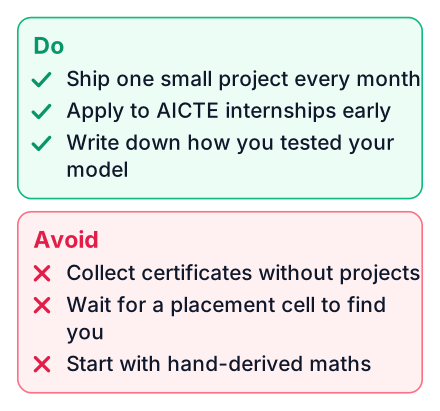
| Don't | Do instead |
|---|---|
| Stack certificates with no project behind them | End every course with something you deployed |
| Wait for a placement cell to find you a job | Apply directly, through the AICTE portal and company career pages |
| Start by deriving backpropagation by hand | Start by calling a model and testing its answers |
| Skip evaluation and deployment | Measure accuracy and put every project online |
The backprop point surprises people. The practitioner's account says interviews test practical skills, not hand-derived maths. If you want a backup skill while you build, the full-stack developer roadmap after 12th uses the same Python and deployment basics.
Today, open the AICTE National Internship Portal, check whether your college is eligible, and save one AI/ML internship to apply to. Then create a GitHub repository for your first month-one Python project.


