OpenAI Models on Google Cloud: What Students Need to Know
Google Cloud announced OpenAI's GPT-6 Astra, Sol, and Luna are coming to Model Garden. Access is limited to select enterprise customers in private preview, with no public pricing yet. Here's what's real and what's still coming soon.

On October 21, 2026, Google Cloud's own blog announced that OpenAI's GPT-6 Astra, GPT-6.1 Sol and GPT-6 Luna are coming to Google Cloud. The headline makes it sound like anyone with a Google account can try GPT models tomorrow. The fine print tells a different story. Here is what is real, and what is only coming soon.
OpenAI's GPT-6 Astra, GPT-6.1 Sol and GPT-6 Luna are now in private preview in Google Cloud's Model Garden. Select enterprise customers can use them through Google Cloud APIs, and Google Antigravity support is coming soon. You pay through your Google Cloud invoice, not a separate OpenAI contract. For a student the answer is no: right now only approved enterprise customers can use these models on Google Cloud, and there is no public price.
What Google Cloud and OpenAI announced
Google Cloud's VP of Product Management for Gemini, Michael Gerstenhaber, announced on October 21, 2026 that three OpenAI models are rolling out in Model Garden. The post sits on Google's official blog, so this is the vendor speaking, not a rumour or a leak.
OpenAI confirmed the same news in a post on its developer community forum. That page adds one detail: OpenAI's Codex agentic workflows are coming into Model Garden too. When both companies publish matching posts on their own sites, you can trust that the deal is real.
If you read our post on GPT-6 and COBOL migration accuracy, this is the same GPT-6 generation, now reachable from a second cloud.
The three GPT-6 models and what each one is for, compared
Astra is for demanding work such as coding and scientific research, Sol comes close to Astra at lower cost, and Luna is fast and cheap for everyday work at scale, according to Google's announcement. Model Garden is Google Cloud's catalogue of AI models, where you pick a model and call it through one set of APIs.
| Model | Best for (Google's words) | Relative cost |
|---|---|---|
| GPT-6 Astra | Coding, computer use, professional tasks, scientific research | Highest of the three |
| GPT-6.1 Sol | Work close to Astra's level | Lower than Astra |
| GPT-6 Luna | Everyday work at scale, where speed matters | Cost-efficient |
Notice what is missing from that table. Google's post gives no benchmark scores and no leaderboard position. Any claim that one of these beats Gemini or Claude is a guess for now. When you get access, test them on your own work instead.
Private preview means most students cannot use it yet
The way in is an interest form on the announcement page, and no pricing has been published. "Private preview" and "coming soon" are different labels. Private preview means it runs today for a small, approved group. Coming soon means it does not run for anyone yet.
Say you open a free trial account on Google Cloud tonight. Google says access is limited to approved enterprise customers, so a free-trial account is unlikely to show GPT-6 Astra in Model Garden. We did not test this ourselves. You can fill in the form, but it is written for companies. And with no listed price, you cannot estimate what a side project would cost.
Preview customers get one more option. Codex is OpenAI's coding agent, and Google says they can connect local Codex CLI or Codex Desktop workflows to the Gemini platform for inference. Inference means the model running on your prompt and sending back an answer. Your Codex setup stays on your laptop, while the model runs on Google's servers.
What a student gains
- A chance to learn how companies buy and compare models before the first job
- Time to build a personal set of test prompts while you wait
- Clear questions to ask about billing and data when you join a team
What a student loses
- No way to try these models on Google Cloud today
- An interest form that is written for companies, with no public price
One Google invoice instead of a separate OpenAI contract
OpenAI models are sold through Google Cloud Marketplace, so they appear on your existing Google Cloud bill and draw down your existing cloud commitments, as Google's post explains. A cloud commitment is a promise to spend a set amount with a provider, usually in return for a discount.
Say your team already pays Google Cloud every month. Someone wants to test a GPT model inside an internal tool. Before this deal, finance had to approve a new vendor, and someone had to open an OpenAI account or sign a contract. With Marketplace billing, the usage lands on the bill the company already pays. This works the same for a startup in Bengaluru and an agency in Chicago.
The other routes still exist. You can call OpenAI's own API directly, or reach its models through Microsoft Azure. Ars Technica notes that Microsoft remains OpenAI's primary cloud partner. Google is an extra door, not a replacement. For your personal projects, OpenAI's own API is still the shortest path.
Antigravity and Gemini Agent are next
Google says OpenAI models are coming soon to Antigravity, its coding agent tool, and to Gemini for business. For both, there is no date yet. 9to5Google's report confirms the same plan. Antigravity is Google's code editor where an AI agent can write and run code, then fix it, across your project. OpenAI's forum post also names Gemini Agent as a place its models will appear.
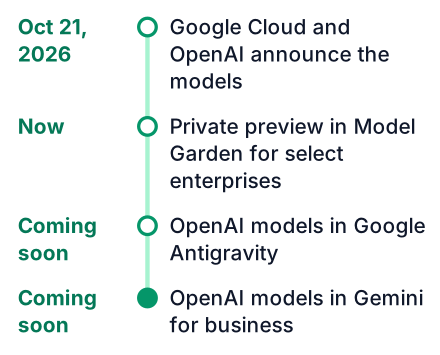
"Coming soon" tells you the plan. It does not promise a date or a price. It also says nothing about free accounts, so do not build a class project around it yet.
| Stage | Status | Source |
|---|---|---|
| Announcement | October 21, 2026 | Google Cloud Blog |
| Model Garden | Private preview, running now for select enterprises | Google Cloud Blog |
| Antigravity | Coming soon, no date | 9to5Google |
| Gemini for business and Gemini Agent | Coming soon, no date | OpenAI Developer Community |
While you wait, learn how a coding agent works from the inside. Our guide to building an AI agent in Python, step by step shows the loop that tools like Antigravity run.
Your prompts and data stay inside your Google Cloud perimeter
Google commits that prompts and the outputs they produce stay in the customer's data perimeter and are never used to train foundation models, per its announcement. A data perimeter is the boundary of systems a company controls inside its cloud account. The other promises split into two groups:
- Available now: queries pass through hardened, isolated gateways.
- Not available yet: Zero Data Retention options, listed as coming soon.
- Not available yet: Confidential Compute, also listed as coming soon.
These are Google's own claims on its own blog, not an outside audit. They still matter for your career. A bank or a hospital will ask these exact questions before any model touches customer records. Knowing what a retention policy means makes you more useful in that meeting.
Models from three vendors in one place change how teams pick models
Google Cloud says it is now the only hyperscale cloud offering all three leading closed models (Gemini, Claude, GPT) next to 200+ other models in Model Garden. Hyperscale clouds are the very largest providers, such as Google Cloud and AWS. Azure is another. That "only" is Google describing itself. Ars Technica points out that Claude was already in Model Garden, so GPT is the new arrival.
When switching models takes a settings change, teams start comparing. The question at work becomes "which model does this task best for the money?" A developer who can answer that with test results is worth more than one who only knows one vendor. We compared newer releases in our Gemini 4 Argon post and our DeepSeek V4.1 Flash post, and the same habit applies to both.
- Do: keep a small set of your own test prompts and reuse them on every new model.
- Do: store the model name in a config file, not hard-coded across your project.
- Don't: tie your skills to one vendor's SDK and its quirks.
- Don't: trust a launch post's adjectives over your own results.
What to do this week
Students cannot get into the preview yet, so practise the skill it rewards: comparing two models on a small task you already solved. If you do work at a company on Google Cloud, the interest form is linked from the Google Cloud Blog announcement.
Pick a task you already solved
A bug fix, a short function or a SQL query works well, because you know the right answer.
Run the same prompt on two models you can use today
Copy the exact wording, so the only change is the model. Use a GPT model through OpenAI's own app or API and a Gemini model through Google's own sign-up. A sample prompt to copy: "Write a SQL query that returns the top 3 customers by total order value from the tables customers and orders."
Score each answer
Check if the code runs, note how long you waited, and copy the price per use if the tool shows one.
Keep a notes file
Add one line per test. After a few weeks, you will have your own small benchmark.


