How to Become a Data Analyst After 12th Commerce in 2026
You can become a data analyst after 12th Commerce without a master's degree or advanced math. With 4-6 months of focused work and the right tools, you can be job-ready for entry-level roles paying ₹3-6 LPA.

I thought my BCom was a dead end for tech — it wasn't. With 4-6 months of focused work in Excel, Power BI, and a certificate that fits your budget, you can be ready for entry-level data analyst jobs that pay ₹3-6 LPA.
You can become a data analyst after 12th Commerce without a master's or heavy math by learning Excel, SQL, and Power BI, building 3 projects, and picking a certificate that fits your budget. Data analytics courses accept any stream after Class 12, and employers care about your skills, not your degree subject. The job market is open, with thousands of active listings on Naukri and LinkedIn.
Why commerce students fit data analytics roles
Commerce students already have the numerical comfort and business sense that data analytics jobs need, so no engineering degree or advanced math is required. This is not a guess: analytics certification eligibility explicitly accepts Class 12 pass students from any stream.
There is no minimum percentage and no math background needed. For eligibility details, see this page on data analytics course eligibility criteria. You also do not need an entrance exam to start learning.
What matters more is the comfort with numbers you already have. Reading a balance sheet, understanding profit and loss, and calculating percentages are all part of Commerce study. Those are the same instincts data analysts use every day when they look at sales figures or customer data.
Entry-level data analyst jobs pay ₹3-6 LPA in India, and employers accept any bachelor's degree, including BCom, BBA, BA, or BSc.
What data analysts actually do at work
Data analysts clean data, find patterns, and present them in dashboards, so daily work is Excel, SQL, and Power BI, not calculus. Here is a typical day. You open a spreadsheet with sales data from last quarter. You notice some rows have missing values. You clean those rows in Excel or with a SQL query. Then you write a query to group sales by city, and you build a Power BI dashboard that shows which regions grew and which ones dropped.
The skills most demanded in job listings are SQL, Excel, Python (pandas), Power BI or Tableau, Statistics, and Business Communication. Notice what is not on that list: advanced mathematics. You will meet these tools again in the roadmap below, but here is why they matter day to day.
Statistics matters, but at a practical level. You need to understand averages, percentages, and basic trends. You do not need to derive formulas. For example, say you are looking at sales data: you want to know the average order value, not prove a theorem.
The 4-6 month roadmap: tools you must learn
Learn Excel, then SQL, then Power BI in that order, and you can be job-ready in 4-6 months without a master's degree.
The tools are taught from scratch in most analytics programs: Excel, SQL, Python, Power BI, and Tableau. You do not need any prior coding experience. Here is how the timeline breaks down.
Learn Excel basics (Weeks 1-3)
Master formulas, pivot tables, and data cleaning. This is your foundation.
Add SQL (Weeks 4-8)
Learn SELECT, JOIN, and GROUP BY. Start with this SQL beginner guide.
Pick up Power BI (Weeks 9-14)
Build dashboards and visualizations. Power BI is the tool that presents your findings.
Optional Python (Weeks 15-18)
Learn pandas for data manipulation. It widens your options but is not mandatory to start.
Build 3 projects (Weeks 15-24)
Clean real datasets and publish dashboards on GitHub and Kaggle. Learn how to present these projects to hiring managers in the section below.
Certificate options from ₹1,000 to ₹2.85L
Your certificate choice ranges from a free path with an NPTEL certificate (around ₹1,000) to an upGrad PG diploma, and you just need to pick the one that fits your budget and time. For a detailed comparison of courses and costs, see this guide to the best data analyst courses in India.
Think of certificates on a spectrum. The cheapest options teach you the tools and give you a credential. The expensive ones add placement support and a well-known university name. Here is the honest comparison.
| Path | Cost | What you get | Best for |
|---|---|---|---|
| Free path | Free or low-cost (NPTEL) | YouTube courses, Kaggle projects, GitHub portfolio | Self-driven learners on a tight budget |
| NPTEL certificate | Around ₹1,000 | 8-12 weeks, self-paced, university-level content | Budget learners wanting a formal certificate |
| Budget path | Around ₹4,500/month via Coursera Plus | Google Data Analytics Certificate (Coursera Plus) + Python on Udemy | Students who want structure without big spending |
| Mid-range | ₹64K (with GST) | Simplilearn Data Analyst Master's Program, IBM co-branded certificate, JobAssist placement help | Freshers who want resume support |
| Premium | ₹2,85,000 total, instalments available | upGrad IIIT-B PG Diploma, 12 months, genuine PG credential, includes placement support | Career changers who want a recognized name |
The Google Data Analytics Certificate is the most popular structured option. Over 3.8 million people have enrolled. It is a 9-course series that takes about 6 months at 10 hours per week, and it requires no degree or experience. It covers SQL, Tableau, Python, and R. The cost is typically around ₹4,500/month via Coursera Plus. See the official Coursera page for details.
Which certificates hiring managers actually check
No job description requires a specific platform certificate, but Microsoft's PL-300 for Power BI and NSE Academy's NCFM add credibility because they test real skills.
There is a big difference between a training provider certificate and a vendor certification. The training provider certificate says you finished a course. Microsoft's PL-300 says you passed a proctored exam that tests data preparation, modeling, visualization, and security, all in 100 minutes. It has no prerequisite, so you can take it after learning Power BI on your own.
NSE Academy, a subsidiary of the National Stock Exchange of India, offers NCFM certifications. Its Business Analytics Module is respected in finance-heavy companies. NCFM course fees vary; see the IFMC Institute's NCFM page for current details.
Pros
- Microsoft PL-300: single exam, recognized globally, no prerequisite, tests real Power BI skills
- NSE NCFM: respected by Indian banks and financial firms, adds finance credibility
Cons
- PL-300: costs money per attempt, requires serious Power BI practice
- NCFM: less known outside finance, adds a registration fee on top of course fees
Build 3 projects that prove your skills
Three projects on GitHub and Kaggle showing real data cleaned and visualized in Power BI will convince hiring managers more than any certificate.
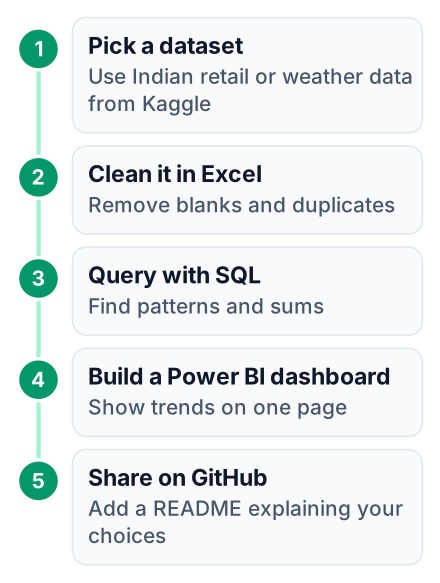
A certificate tells an employer you studied. A project tells them you can do the work. Pick Indian datasets you understand: Flipkart sales, Swiggy orders, or cricket match stats.
Here is a project template that works. First, find a dataset on Kaggle. Second, clean it in Excel or with a SQL query. Third, build a Power BI dashboard that answers one business question, like which city has the highest repeat orders. Fourth, publish the dashboard on GitHub. This is the same pattern the Google Data Analytics Certificate teaches.
A GitHub profile with three real projects also strengthens your application for entry-level tech roles. Hiring managers open your link, see clean work, and skip the stack of resumes. If GitHub is new to you, this guide to building a strong GitHub profile will help.
Where the jobs are: top employers and salaries
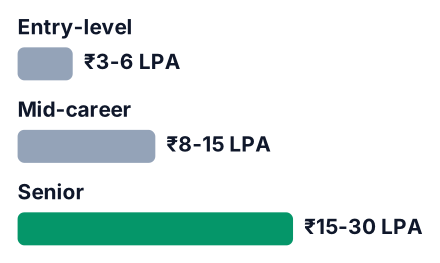
TCS, Infosys, Flipkart, and Amazon India hire data analysts at ₹3-6 LPA for entry-level, and you can find many openings on Naukri right now.
The demand is real. For current job market insights, see this guide on becoming a data analyst after 12th. Top employers include TCS, Infosys, Flipkart, Amazon India, Swiggy, Razorpay, Mu Sigma, Tiger Analytics, and HDFC Bank. This mix matters: you have IT services companies, product companies, and banks all hiring.
Salaries grow steadily with experience; the table below shows why starting at ₹3-6 LPA is a strong first step. You can verify current salary data on this page.
| Level | Salary range | Experience |
|---|---|---|
| Entry-level | ₹3-6 LPA | 0-2 years |
| Mid-career | Grows with experience | 3-6 years |
| Senior | Grows with experience | 7-10 years |
| Leadership | Grows with experience | 10+ years |
Companies like TCS and Infosys hire freshers in batches throughout the year. Check this list of companies hiring freshers in 2026 to see who is actively recruiting. You can see live listings on this guide that links to Naukri search results.
Common mistakes to avoid on this path
The biggest mistake is waiting for a master's degree before applying; the second is buying an expensive certificate before learning Excel and SQL.
I understand the instinct. A master's feels like the safe, traditional route. But no job description demands one, and the 4-6 month timeline exists specifically for people who learn tools and build projects. A PG diploma from upGrad is a genuine credential, and it costs a significant amount. The free path costs a small fee for NPTEL. Both can lead to a job; the difference is time, money, and placement support.
The second mistake is the reverse: spending on a certificate before you have skills. A Simplilearn certificate at ₹64K will not help if you cannot write a SQL query in an interview. Learn the tools first, then buy the certificate that validates them.
There is a third mistake that is quieter: skipping communication. You can build a perfect dashboard, but you must explain what it means to a manager who does not code. Practice presenting your projects out loud.
Plan your practice time realistically. This guide on daily practice hours will help you schedule consistent learning without burning out.
Start today: open a free Excel tutorial on YouTube, and by the end of this week clean one small dataset. That first project is your first step toward a job.