Best Entry-Level Tech Roles for Freshers in India 2026
Entry-level tech hiring fell from 28% to 15% of the workforce, but emerging-tech roles now carry 52% of demand. Here are the five lanes where freshers are actually wanted in 2026, and how to pick the right one for your skills and city.
Last year, 28 of every 100 tech jobs in India went to freshers. This year it's 15 of every 100, per TechGig. SDE isn't dead, but it's no longer the default first role. A fresher entering the tech market in 2026 needs to pick a lane where entry-level openings actually exist, not just chase the one everyone else is running toward.
The best entry-level tech role for you is the one with actual openings: software development, QA/testing, production support, data-centre engineering, or data/AI analytics. So pick a lane where freshers are actually wanted, not just the one everyone else chases. The numbers behind this choice appear in the sections below.
Why the SDE-only reflex no longer matches the market
Entry-level software roles shrank from 28% to 15% of tech hiring in 2025, so a fresher needs to look beyond SDE. The numbers from TechGig make the shift visible: emerging tech roles like AI, cloud, and cybersecurity now carry 52% of the hiring demand in the sector. Software development postings fell 19% in the same period, while overall Indian job postings rose 7.4% year-on-year and sit 85% above pre-pandemic levels, according to Indeed data cited by TechGig.
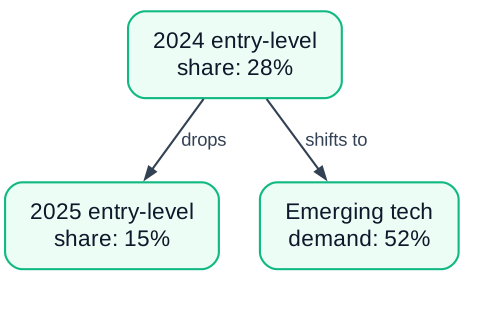
Freshers who keep aiming only at SDE are competing for a smaller slice of the pie, while other roles quietly keep hiring. The map has more than one route — your job is to find the one with openings near you.
Software development (SDE): still the biggest lane, but narrowing
SDE remains the largest single tech role, but fresher hiring there fell 19%, so competition is fierce. TechGig confirms that software development postings dropped by that margin even as the broader IT hiring picture shifted toward emerging tech. The role is far from dead, but it is crowded.
That crowding has a price effect. Infosys is advertising Rs 21 lakh for freshers in AI roles, according to TechGig, which signals where companies are willing to pay an entry-level premium. A plain SDE application without a differentiating skill competes against a very large pool. The ones who stand out tend to have a portfolio, a live project, or an AI-related edge on top of core development skills.
SDE is still a valid first job, especially if you love building software for its own sake. But you need to know that the entry door is narrower in 2026. If you want that path, treat DSA and projects as table stakes, not differentiators.
QA and testing: quality is getting more important, not less
QA/testing roles are stable for freshers because every release needs checking, even in a tight market. Companies ship software constantly, and someone has to verify it works. That reality keeps quality roles open when other entry points tighten.
TechGig describes the 52% of hiring demand as spanning AI, cloud, and cybersecurity, but quality roles run across all of those emerging areas. A product that uses AI still needs someone to test the edge cases. A cloud migration still needs someone to validate the deployment.
QA is not a dead-end. Modern testing involves writing automation scripts, understanding CI/CD pipelines, and knowing how to break software on purpose. Freshers who learn automation testing tools alongside manual testing skills make themselves far more valuable than someone who just clicks through screens.
Production support and IT operations: the always-on backstop
Support and production roles keep systems running and are easier for freshers to enter than SDE. Every company with a live product needs someone who can monitor systems, respond to incidents, and keep services available. It is the always-on backstop of the tech world.
There is a caveat in the data. Indeed data cited by LinkedIn shows that IT infrastructure and support postings fell 20% recently, a steeper drop than software's 19%. The entry path exists, but it is also narrowing, so you need to treat support as a deliberate choice rather than a fallback. What makes support roles viable is the low barrier to entry and the operational experience you gain quickly.
Pros
- Low barrier to entry for freshers
- Exposure to real production systems and incidents
- Often has shift-based openings in multiple cities
Cons
- Postings fell 20% recently, so openings are tighter (per LinkedIn)
- Can involve odd hours and on-call work
- Less direct path to architecture and design work
Data-centre engineering: fast growth, and most roles are not software
Data-centre roles are growing fast, but only 28% are software, the rest need electrical, cooling, and ops skills, per successcds. Indeed data cited by successcds shows data-centre jobs at 1.3% of all Indian job postings in August 2026, up from 1.0% a year earlier. The share sounds small, but the growth direction is clear.
India's data-centre capacity is projected to climb from roughly 1.5 GW in 2025 to 6 to 6.5 GW by 2030, according to successcds. That expansion needs people: officials cite around 1 lakh engineering roles, with TeamLease Digital projecting over 4 lakh ecosystem jobs by 2030, per successcds. Treat those as projections, not guaranteed vacancies, but the direction is real.
Here is the part freshers miss: 72% of data-centre vacancies are not software, per successcds. They split across electrical engineering, cooling systems, operations, management, and sales. A computer science graduate is not required for all of these, but a student with basic electrical or networking knowledge can enter. The openings are also not confined to Bengaluru and Mumbai. Growth is concentrated in Andhra Pradesh, Gujarat, Telangana, Karnataka, and Tier-II hubs like Jaipur, Kochi, Mohali, and Indore.
Data and AI analyst roles: where freshers with analytics skills are wanted
Data/AI analyst roles are part of the 52% emerging-tech demand and often accept freshers with strong SQL or Python basics. Companies are hiring people who can prepare data, run analyses, and feed insights into decisions. The role sits between pure engineering and pure business, which makes it accessible to a wider range of backgrounds.
The AI hiring shift in India is visible in the salary signals. Infosys advertising Rs 21 lakh for fresher AI roles, as TechGig reports, indicates that the analytics and AI track is where the money is moving. You do not need a PhD to start. You need solid SQL, working Python, and the ability to present findings clearly.
Analyst roles are a genuine on-ramp. Many developers move into data engineering or machine learning after starting as analysts, because they already know the data pipeline from the inside.
The decision table: which role fits your skills and city
This table maps each first-role lane to hiring demand, typical fresher entry, and what to learn now. Use it to see which path matches your situation before you spend six months preparing for the wrong one.
| Role lane | Demand direction | Fresher entry path | Learn this now |
|---|---|---|---|
| Software development | Largest lane, but postings fell 19% (TechGig) | Competitive, needs projects plus DSA | One solid language, data structures, a deployed portfolio |
| QA and testing | Steady, needed in every product cycle | Accessible with attention to detail | Manual testing basics, then automation tools like Selenium |
| Production support / IT ops | Postings fell 20%, but still a common entry point (LinkedIn via Indeed) | Low barrier, shift-friendly | Linux, networking basics, incident response |
| Data-centre engineering | Growing, 1.3% of all postings and rising (successcds via Indeed) | Open to electrical, cooling, networking backgrounds | Electrical basics, cooling systems, rack management |
| Data/AI analyst | Inside the 52% emerging-tech demand (TechGig) | Accepts strong SQL or Python basics | SQL, Python for data, a small set of dashboard projects |
Your city matters as much as your skills. Data-centre growth in Jaipur, Kochi, Mohali, and Indore means those Tier-II hubs have openings that Bengaluru does not, according to successcds. If you are willing to move to a Tier-II city, your competition drops.
How to pick your first role without chasing the crowd
Match your skills and location to the role with actual openings, not the role everyone else wants. The crowd is still aiming at SDE. The data says the crowd is aiming at a lane that shrank 19% while other paths grew. That should tell you something.
List your current skills
Write down what you can already do: programming, hardware, networking, data handling, or nothing tech-specific yet.
Check your city
Look at whether your city has data-centre growth, a software hub, or a general IT services market. Tier-II hubs like Jaipur and Kochi have data-centre openings, per successcds.
Match skills to demand
Use the decision table to find the lane where your current skills overlap with real openings.
Build one small project in that lane
If QA, write test cases for an open-source tool. If data-centre, learn the basics of cooling and power. If analyst, build a dashboard.
Apply with proof
One project in the right lane beats fifty generic SDE applications in a shrinking pool.
The choice is not permanent. Many professionals start in QA or support and move into development or architecture after a few years. The mistake is refusing the door that is open because you only want the one that is locked.
Read the deeper analysis in the junior developer job market in 2026, and consider whether a service or product company fits your first job. If you are set on SDE anyway, check whether DSA is actually required for your first dev job and look at real software developer salaries in India for 2026. Once you land the role, plan your first 90 days as a software developer.
Open the table, circle the two roles that match your skills and city, then build one small project in that lane this week.