Do You Actually Need DSA to Get Your First Dev Job? An Honest Answer
Do you need DSA to get a developer job in India? The honest answer is “it depends” — and here is exactly when DSA matters, when projects win, and how much is enough.
Two hundred and twenty LeetCode problems solved. Zero interview calls. Meanwhile a classmate who barely touched DSA had built three small web apps and landed a frontend job at a Pune startup. So was all that DSA wasted? No — but it was the answer to a question nobody had asked yet.
The real question is not “is DSA good?” It is “do I need DSA for the job I am actually targeting?” Those are very different things.
Quick answer: do you need DSA to get a job?
It depends on the company. For your first job at a service company or a small startup, strong projects usually matter more than DSA. For product companies like Google, Flipkart, or Razorpay, DSA is required and you cannot skip it. So the honest answer is not yes or no. It is “yes for some jobs, no for others.” This post gives you a clear India-specific map so you know which path is yours.
I want to be upfront about one thing. DevHives does not sell a DSA course. I have nothing to push you toward here. That means I can give you the neutral answer most YouTube channels cannot.
What is DSA, really (and why does everyone bring it up)?
DSA means data structures and algorithms: the ways you store data and the step-by-step methods you use to process it. Arrays, strings, hashmaps, and sorting are all DSA.
You already use these ideas without the fancy name. A list of student marks is an array. A phone contact list that lets you jump to a name is like a hashmap. DSA is not magic. It is the formal study of these tools and how fast each one runs.
Here is why everyone brings it up. Big product companies get thousands of applicants. They need a quick filter. DSA puzzles are easy to grade and hard to fake. So interviews lean on them heavily. That filter is real, but it is not the only door into the industry.
Do you actually need DSA for your FIRST dev job?
For most first jobs in India, you need basic DSA, not deep DSA. You do not need to solve 500 hard problems to get hired as a fresher.
This is where beginners get stuck. They treat DSA like a wall they must finish climbing before they are allowed to apply. So they grind problems for six months and build nothing. Then the interview asks them to center a div or fetch data from an API, and they freeze.
For your very first role, a working project that you can explain often beats a high problem count. Many service companies and startups care more about “can you ship something” than “can you reverse a linked list.” DSA becomes the deciding factor later, when you aim for the high-paying product giants.
DSA is not a wall you finish before applying. It is one lane on the road, and not every job drives in it.
If you want the wider view of who is hiring freshers and what they test, I broke it down in my guide to the junior developer job market in 2026.
Which jobs test DSA, and which don’t? (India breakdown)
The amount of DSA you need depends almost entirely on the type of company. Here is a simple India map I share with every student who asks.
| Service companies (TCS, Infosys, Wipro, Cognizant) | Product / FAANG-tier (Google, Flipkart, Razorpay, Atlassian) | Startups & agencies (seed to mid-size, dev shops) |
|---|---|---|
| How much DSA: Minimal. Basic arrays, strings, loops, and simple logic puzzles. | How much DSA: Heavy. Often 2 to 4 dedicated DSA rounds, medium to hard level. | How much DSA: Mixed. Some ask a little, many skip it entirely. |
| What wins: clearing the aptitude test and basic coding round. Communication matters. | What wins: strong problem solving under time pressure, clean code, and clear reasoning out loud. | What wins: real projects, a live demo, and being able to build features fast. |
| Good for: a stable first job and steady learning on the job. | Good for: high salary, big-name brand, strong long-term resume. | Good for: fast growth, wide responsibility, and a strong portfolio. |
Read your target column before you plan your hours. A student aiming for TCS and a student aiming for Razorpay should not follow the same study plan. One needs basics plus projects. The other needs months of focused DSA practice.
GeeksforGeeks has a useful breakdown of how much coding is required for placements if you want a second view on the Indian campus side.
How much DSA is “enough”?
For a first job, “enough” is the core patterns solved at easy to medium level, not 500 random problems. Depth on the basics beats a huge messy count.
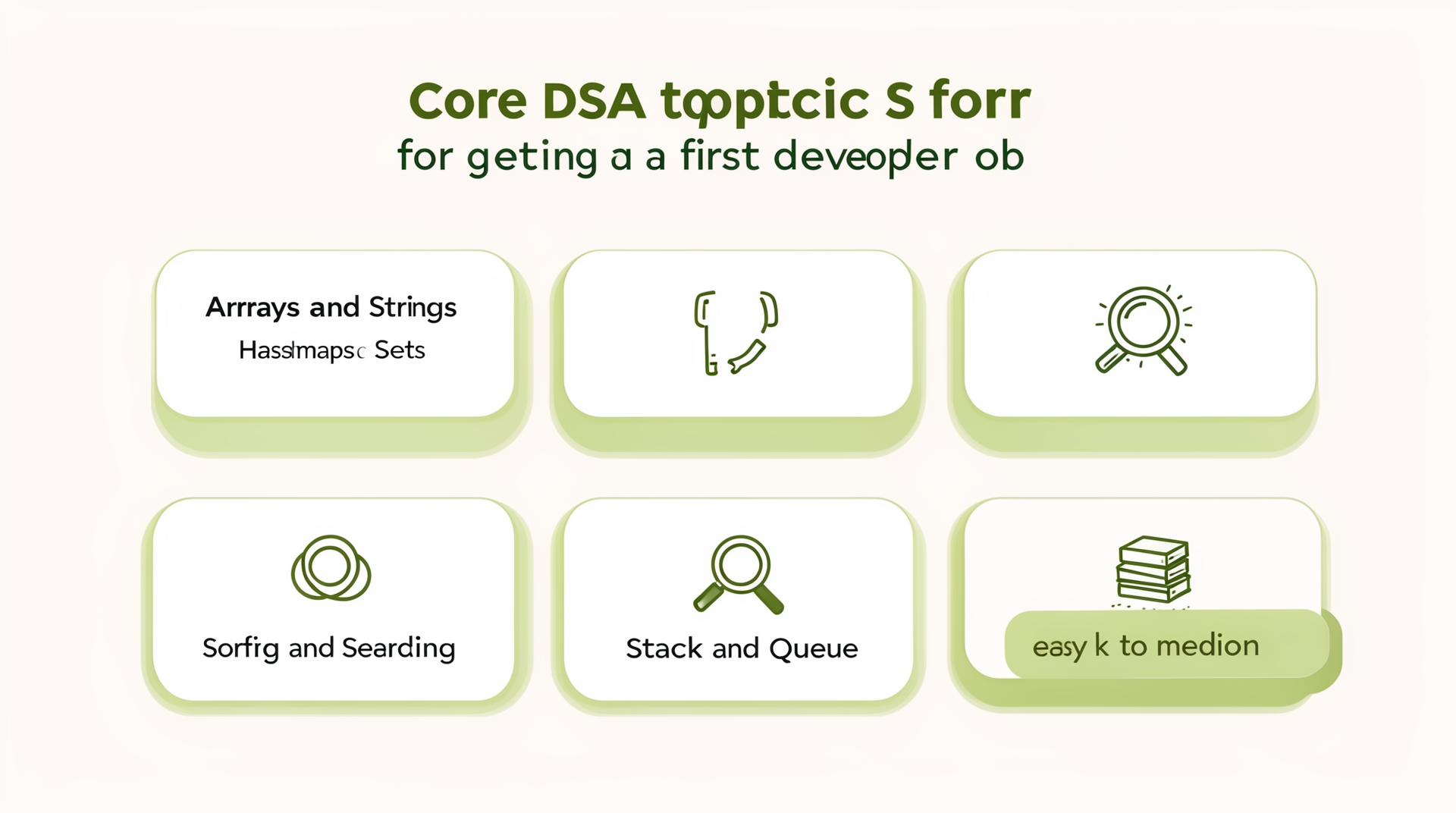
Here is a concrete target list that covers most fresher interviews:
- Arrays and strings: searching, two pointers, sliding window basics.
- Hashmaps and sets: counting, lookups, finding duplicates.
- Recursion: base case, recursive case, simple tree or list walks.
- Basic sorting and searching: knowing when to sort, and binary search.
- Stacks and queues: enough to handle common easy-medium questions.
The free Grind75 list and the NeetCode roadmap both cover exactly this core. You do not need every problem on them. The first 50 to 75, done well and revisited, take most freshers a long way.
One honest confession from my own learning. Early on, I solved problems just to raise my count. I never wrote down why a pattern worked. So I forgot it all within weeks. Solving 30 problems slowly and explaining each one out loud taught me more than 200 rushed ones did.
A simple “is it enough” test
Pick a medium problem you have not seen. Can you reach a working answer in 30 to 40 minutes and explain your steps? If yes, across the five areas above, you are ready for most non-FAANG interviews. That is the bar, not a magic number of problems.
DSA vs projects: where limited hours actually pay off
If you have limited time and want your first job fast, projects usually give a better return than DSA. Projects prove you can build. That is what most startups and service companies want to see.
A clear way to split your hours, depending on your target:
- Targeting service companies or startups: mostly projects, with some basic DSA.
- Targeting product / FAANG-tier: flip it: mostly DSA, with projects alongside, over a longer runway.
- Not sure yet: build one solid project, learn the five core DSA areas, then decide.
The reason projects win for the first job is simple. A recruiter can open your app, click around, and believe you. A LeetCode count is just a number on a screen. For more on where to invest your study hours overall, see my post on how to learn to code in 2026.
Try this now: open a note and write your one target company type. Then plan this week’s hours to match the split above. That single decision saves months of wasted effort.
Frontend roles ask DSA too, for a specific reason
Some frontend roles ask DSA because the company uses one common interview process for all engineers. The filter is about the company, not about whether frontend work truly needs it.
This catches beginners off guard. They assume “I only do UI, so I skip DSA.” Then a product company puts them in the same algorithm round as a backend hire. It feels unfair, and honestly it sometimes is. But it is the reality at many big firms.
Here is the nuance. Smaller and design-led companies often test frontend skills directly, with a real UI task or a take-home build. Large product companies tend to gatekeep every engineer with the same DSA bar. So your DSA need depends on the company size and type, even within frontend.
The official coding interview prep guide explains how these standard rounds are structured, which helps you prepare without guessing.
Starting DSA without burning out
Start small, stay steady, and pick one curated list instead of jumping between ten. Burnout comes from grinding random hard problems with no plan and no review.
A calm routine that works for most students:
- Pick one list (Grind75 or NeetCode) and ignore the rest.
- Solve one or two problems a day, not ten. Consistency beats intensity.
- If you are stuck for 30 minutes, read the solution. Then re-solve it the next day.
- Write one line on why the pattern worked. This is what makes it stick.
- Revisit old problems every week so you do not forget them.
Two problems a day, done with real understanding, adds up to over 700 in a year. You will never need that many for a first job. So the slow pace is not slow at all. It is more than enough, and it protects your motivation.
So should YOU learn DSA right now? (decision guide)
Learn DSA now only as much as your target job needs. The honest verdict is to match your effort to your goal, not to chase DSA because everyone online says you must.
- You want a first job fast, at a service company or startup: learn the five core areas, then pour your time into one strong project.
- You are aiming for a product giant from day one: commit to serious DSA over several months, alongside one good project.
- You feel anxious that AI makes all of this pointless: it does not, but the worry is real. I addressed it in is it worth learning to code now that AI exists.
Remember the 220 solved problems and zero interview calls at the top of this post? That person stopped grinding, built a small full-stack app over three weeks, and kept basic DSA ticking over on the side. Two interview calls within a month. The DSA was never wasted — it was just out of order.
Common questions about DSA and hiring
Do I need DSA to get a developer job?
Not for every job. Service companies and startups often value working projects more than DSA. Product companies like Google or Flipkart require DSA, so you cannot skip it there.
Is DSA required for web developer jobs in India?
For most web developer roles at startups and service firms, only basic DSA is required. Heavy DSA mainly applies to product and FAANG-tier companies, even for frontend roles.
How much DSA is enough for placements?
Enough means the core patterns at easy to medium level: arrays, strings, hashmaps, recursion, and basic sorting and searching. The first 50 to 75 problems on Grind75 or NeetCode cover most fresher interviews.
Should I do DSA or projects first?
For your first job, build a project first. A working app you can demo and explain usually beats a high problem count at startups and service companies. Add deeper DSA later to reach product giants.
Can I get a job without LeetCode?
Yes, many freshers get hired without grinding LeetCode, especially at startups, agencies, and service companies that focus on projects and basics. But product companies will still test you with algorithm rounds.
Write down your one target company type, then plan this week with the project-versus-DSA split that matches it. The grind only pays off when it is pointed at a job that actually tests for it.