IBM Associate System Engineer 2026: Eligibility, Test Pattern, Salary
IBM's Associate System Engineer off-campus drive is open for 2024 and 2025 CS/IT graduates with a confirmed October 14 test date. Here's the eligibility filter, the four-round process, and the real salary estimate of ₹4.5–6.5 LPA.

IBM's Associate System Engineer 2025–26 off-campus drive is open for 2024 and 2025 CS/IT graduates right now, and the real test is whether you clear the eligibility filter before you even touch the code. If you are a 2023 graduate, stop reading — this drive is not for you. IBM's ASE off-campus drive only accepts 2024 and 2025 CS/IT students. IBM shortlists applications on a rolling basis, so an early application has a better chance. This is one of the biggest mass-hiring events for freshers this year, so let me walk you through what the job actually is, who gets in, and what each round really looks like. 'Off-campus' means the drive is open to students from any college, not just through campus placements. (You can verify the drive details on the PlacementDriveInsta drive announcement.)
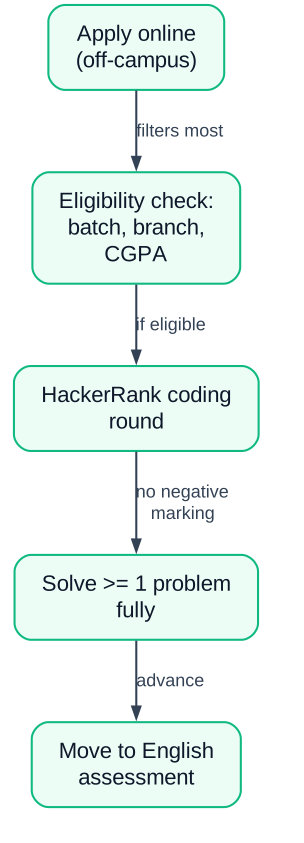
The IBM Associate System Engineer role is a hybrid support-and-development job for recent CS/IT graduates, with a four-round selection process and a salary estimate of ₹4.5–6.5 LPA, and only 2024/2025 batch, CS/IT streams, 6.0 CGPA, no backlogs need apply. If you don't match those filters, your application won't even be considered, no matter how well you code. This is the first and hardest filter, and it's non-negotiable.
What does an IBM Associate System Engineer do?
The ASE role is a hybrid technical support and development position at IBM's Client Innovation Centers, where you work on client-facing software and system maintenance, with Java as the primary language. This is not a pure software engineering role where you build new products from scratch. Instead, you support existing systems, fix issues, and contribute to ongoing client projects under IBM Consulting.
The work model is hybrid, meaning you'll split time between the office and remote work. IBM's Client Innovation Centers are in Bangalore, Hyderabad, Pune, Chennai, Noida, and Gurgaon, so relocation is part of the deal. You may need to move to any of these cities, not just one of your choice. If you're not willing to move, this role is not for you, and the interviewers will ask about it directly.
Think of it as a bridge between a support engineer and a developer. You get IBM's name on your resume, structured training, and exposure to real enterprise clients. But you also get the less glamorous side: maintenance work, on-call responsibilities, and a salary that's solid but not spectacular for a fresher.
Who is eligible for the IBM ASE drive?
Only 2024 and 2025 pass-outs from CS/IT-related branches with a 6.0 CGPA and no active backlogs are eligible, which rules out 2023 and 2026 final-year students and most non-CS engineers. This is the first and hardest filter, and it's non-negotiable.
The exact eligibility criteria from the official off-campus drive announcement (2025 drive for 2024/2025 graduates) are as follows:
- Batch years: Only 2024 and 2025 pass-outs. 2023 graduates and 2026 final-year students are not eligible.
- CGPA: Minimum 6.0 CGPA or 60% aggregate, consistent across all semesters (as per the off-campus drive announcement). A one-semester dip below 6.0 can disqualify you.
- Branches: CS/IT-related only: CSE, IT, AIML, Data Science, Cloud Computing, Big Data, CSBS, IoT, Robotics, AI, Cyber Security, Blockchain.
- Excluded branches: ECE, EEE, Mechanical, Civil are all out. No exceptions.
- Backlogs: No active backlogs. If you have one pending, your application is rejected.
This filter alone removes most applicants. If you're in ECE with a stellar portfolio, this drive is not for you. If you're a 2023 graduate with three years of freelance experience, also not for you. The system is rigid, and there is no appeal process.
How do you apply for IBM Associate System Engineer?
You apply on IBM's entry-level careers page, not on a job portal. Search for "Associate System Engineer" and set the location to India. LinkedIn and Naukri show copies of these jobs, but the application form itself is always on IBM's own site.
The same IBM page offers Job Alerts and a Talent Network. Turn on a job alert for this role. A drive can open and close within days, and the alert email is often your first notice.
After you apply, the process can move fast. In one selected candidate's account on Medium, the application went in on November 29, 2025, the coding test invite came on December 5, and the offer letter arrived on December 24. That is less than four weeks from form to offer, so do not stop preparing while you wait.
Keep these two things ready before you apply:
- An email inbox you check every day. In that same account, the link for the English test stayed valid for only two days.
- Your ID and mark sheets. IBM can ask for background verification documents soon after the interview, so scan them in advance.
Round 1: coding on HackerRank decides most candidates
The first round is a 50–55 minute coding test on HackerRank with two problems, mostly arrays and strings, and you must solve at least one fully to move forward. There is no negative marking in this round, so partial solutions and attempts still count toward your score.
According to the IBM test pattern breakdown, the topics break down roughly as follows:
- Arrays and strings: 60% or more of the questions come from here (per the test pattern breakdown).
- Sorting and searching: expect at least one problem.
- Basic dynamic programming, recursion, and hashmap usage.
Here is the approach that maximizes your chances in 50 minutes:
Read both problems first
Spend the first 3–4 minutes reading both problems. Identify which one is easier and which has clearer constraints. Start with the easier one.
Solve the easy one completely
Your goal is one full, correct solution. A fully accepted solution beats two partial ones. Use brute force if that's what you know; passing all test cases is what matters.
Use the second problem for partial credit
If time remains, write a solution that works for small inputs. Even partially passing test cases is better than a blank editor.
Check edge cases before submitting
Empty arrays, single elements, negative numbers, large values. These are where most candidates lose marks.
The test also uses strict plagiarism detection (per the test pattern breakdown). Some reports suggest that HackerRank monitors tab switches and key-stroke patterns, but this is not confirmed. Avoid switching tabs or searching for solutions, as it may raise flags. Practice solving without looking anything up.
Round 2: English assessment with negative marking
The second round is a 20–30 question English test in 10–30 minutes, with negative marking, covering grammar, vocabulary, and reading comprehension at roughly B2 level. This is the round most candidates underestimate, and the one where guessing can eliminate you.
The test pattern details list these sections:
- Grammar: subject-verb agreement, tenses, articles, prepositions.
- Vocabulary: synonyms, antonyms, word meaning in context.
- Spelling and sentence improvement.
- Reading comprehension passages.
The negative marking is the killer. Every wrong answer costs you marks, so blind guessing is a bad strategy. If you can eliminate two options, you can guess. If you have no idea, skip the question. A blank answer loses nothing; a wrong answer loses marks.
If your English is weak, spend two weeks on basic grammar rules and reading practice. The B2 level is roughly what a confident second-year engineering student has, so this is an achievable bar, not an elite one.
Two sources, two test patterns: the honest mismatch
One source describes a coding-plus-English process while another describes a cognitive game-based assessment before coding, so expect either, and prepare for both by focusing on coding fundamentals and basic aptitude. I recommend you prepare for the version from PlacementPrep.io because it appears more recent, but the common denominator is coding, so focus on that. This is the reality of off-campus hiring: no single authoritative source exists, and IBM's own process varies by campus and by year.
| Process element | PlacementPreparation.io | PlacementDriveInsta |
|---|---|---|
| Round 1 | Coding on HackerRank, 2 problems in 50–55 min | Cognitive game-based assessment |
| Round 2 | English assessment, 20–30 MCQs, negative marking | Coding test on HackerRank |
| Round 3 | Group discussion (campus candidates) | Technical and HR interview combined |
| Round 4 | Combined technical + HR interview, 25–30 min | Not specified separately |
The placementpreparation.io version says the cognitive assessment comes first, followed by coding. The placementdriveinsta.in version says HackerRank coding comes first, then English. Both could be right for different drives, or one could be outdated. Given that, I advise you to prepare for the coding-first pattern, as it is more common in off-campus drives and matches the official announcement link.
What this means for you: prepare for both. Coding fundamentals (arrays, strings, hashmaps, basic DP) are the common denominator in both versions. Add basic aptitude and cognitive puzzle practice, and you cover both scenarios. If you have three weeks, spend two on coding and one on aptitude/English; if you have one week, only coding — that's the common denominator.
Round 3 and 4: group discussion and the combined technical+HR interview
After the online rounds, campus candidates face a group discussion, then a 25–30 minute combined technical and HR interview covering OOP, SQL, your resume, and your willingness to relocate. The PrepInsta breakdown of the IBM recruitment process lists these as the final stages.
For this off-campus drive, the group discussion is not mentioned for off-campus applicants. The interview is the final stage. Since the process varies, the common denominator is coding and English, so focus on those. However, if your campus drive runs in parallel, a GD may appear — here's how to handle it. Topics are usually general: current affairs, technology trends, or a case study. Speak 2–3 times, make one solid point each time, and don't dominate the conversation.
The combined interview covers the following topics:
- OOP: Java is primary, so know classes, objects, inheritance, polymorphism, encapsulation, abstraction. Be ready to write a small class on the spot.
- DBMS and SQL: Second highest salary query, normalization, joins (inner, left, right), ACID properties. These come up in almost every IBM interview.
- Resume projects: Know every line of your resume. They will pick one project and drill into your specific contribution.
- DSA basics: Arrays, linked lists, stacks, queues, time complexity. Nothing advanced, but know the trade-offs.
- HR questions: Self-introduction, why IBM, why this role, and relocation. Relocation willingness is mandatory. Saying "I prefer Bangalore only" might end the interview.
Pros
- IBM's name on your resume opens future doors.
- Structured training and real client exposure.
- Hybrid work model with offices across six cities.
- Stable entry into enterprise consulting.
Cons
- Salary is modest at ₹4.5–6.5 LPA estimate.
- Support and maintenance work, not pure development.
- Relocation is mandatory, not flexible.
- Process is rigid; one wrong guess in English round can eliminate you.
What did real candidates get asked in IBM ASE interviews?
First-hand reports from candidates show a steady pattern. Most questions are about your projects and basic Java or Python with SQL, and a few ask about IBM and your future plans. I read three of these reports, from two selected candidates and one who was not selected. These are the questions they say they faced.
From a 2025 campus candidate's post on LeetCode, who reached the last round but was not selected:
- Java vs Python: what are the key differences?
- Mutable vs immutable types: is a String mutable?
- What are a list, a tuple and a dictionary in Python?
- What types of SQL joins exist, and in what order do several joins run?
- What do you know about IBM, and where do you see yourself in five years?
A selected on-campus candidate on GeeksforGeeks lists these:
- Write the logic to print a pyramid pattern.
- What is a foreign key? How is a linked list different from an array?
- A word puzzle: turn "warm" into "cold" by changing one letter at a time, where every step must be a real word.
- If we give you work outside your favourite area, can you still do it?
The puzzle is not a test of vocabulary. The interviewer wants to hear how you think, so say each attempt out loud, even the wrong ones.
Two surprises appear in these reports. In the LeetCode account, IBM told candidates only one day before the interview that an extra coding and English test would happen in person on campus. In the Medium account, the offline English round asked for typed answers of up to 200 words, with four minutes per question, and it removed more candidates than anyone expected. So practise writing short, clear answers under a timer, not only grammar questions with options.
What happens after you join IBM as an ASE?
Most new ASEs first get training in one technology, and then IBM places them on a client project. One employee on Quora says the next title, System Engineer, came after about one year. Treat that as one person's story: other long-time IBM staff on the same page say a promotion depends heavily on your manager and can take longer.
The waiting time before your first project is called the "bench". You get your salary, but you have no project work yet. One ASE review on AmbitionBox says a project came after two or three months on the bench. Use that time for a certification or a small project of your own, because your skills affect which project you get.
Employee ratings show where the job is strong and where it is weak. On AmbitionBox, Associate Systems Engineers give IBM 4.0 out of 5 overall, across 388 reviews. Company culture and work-life balance get the best scores, 4.2 each. Promotions (3.6) and salary (3.5) get the lowest. The written reviews say it plainly: yearly raises are small, and a promotion is the main way your pay goes up.
Your daily routine depends mostly on your project and your team lead. Reviews and the Prosple listing mention about three office days a week, and some reviewers report long hours on critical client projects. Ask your lead about expected working hours in your first week, so there are no surprises later.
What is the real IBM ASE salary?
Reported pay is lower than most fresher guides suggest. These are the numbers people report:
| What | Amount | Source |
|---|---|---|
| Average yearly pay, October 2026 | About ₹4.3 lakh | Glassdoor |
| Middle half of reported salaries | ₹3.5 lakh to ₹5.1 lakh | Glassdoor |
| Top tenth of reported salaries | About ₹7 lakh | Glassdoor |
| A real 2025 campus offer | ₹4.5 LPA, plus a one-time ₹25 thousand settling allowance | LeetCode report |
| Monthly in-hand pay for a ₹4.5–6.5 LPA package | About ₹30k to ₹42k | Tutorsbot |
Glassdoor's figures come from nearly fifteen hundred salaries that IBM Associate Systems Engineers reported themselves.
Your in-hand pay is less than your CTC divided by 12. CTC (cost to company) also counts the employer's PF share and other items you do not get as cash.
IBM ASE or TCS: which pays more?
It depends on the TCS track. Candidates comparing offers on Reddit put a TCS Digital offer at 7 LPA, above IBM ASE at 4.5 to 5 LPA. Tutorsbot says the IBM package is above the standard fresher offers from TCS Ninja and other large service companies, which pay ₹3–3.6 LPA.
For a first job, compare the project and the training as well as the starting number.
Who should apply for IBM ASE in 2026?
Apply if you are a 2024/2025 CS/IT graduate with a clean 6 CGPA and want a solid first job at a big firm, but know that the salary is modest and the process is competitive. The placementdriveinsta.in breakdown puts the compensation at ₹4.5–6.5 LPA, and you should treat that as an industry estimate, not an official IBM figure.
This role fits you if:
- You are from the 2024 or 2025 batch with a clean 6 CGPA.
- You want a stable entry into enterprise consulting with a global brand.
- You are willing to relocate to any of the six Client Innovation Centers.
- You are comfortable with support and maintenance work, not just greenfield development.
This role does not fit you if you're from a non-CS branch, have an active backlog, or are from the 2023 or 2026 batch. No amount of preparation changes those filters.
The salary is not life-changing, but the experience is. For a fresher, two years at IBM beats two years of random freelance gigs on a resume. If you get in, take it. If you don't, there are other companies hiring freshers in 2026, and the preparation you do here transfers everywhere.
If you are new to the off-campus process, read our complete off-campus placement guide for freshers in India to understand how these drives work and how to track them. And if the coding round is your weak spot, our guide to cracking coding interviews in India covers exactly the array and string patterns IBM tests. For a full picture of what the interviewer expects, see what each fresher interview round really looks like.
Check your eligibility against the four filters (batch, branch, CGPA, backlogs), then spend two weeks on arrays, strings, and basic DP on HackerRank, and apply on IBM's careers portal as soon as you are ready. If you are unsure which pattern to follow, focus on coding since that is the common denominator in both sources.


