Off-Campus Placement in India for Freshers: The 6-Step System
Build an off-campus job-search routine: find drives, plan applications, practise aptitude questions and prepare for interviews. This six-step guide explains the process for Indian freshers.
If your college placement season ended with no offer, you are not alone — 84% of Indian undergraduates are unplaced. But 40% of entry-level hiring now happens off-campus, per the State of Campus Hiring in India report. This post gives the 6-step system to tap that channel in 2026.
Off-campus placement is the primary route now. Your job is to apply to 8-12 drives a week, track every application, and train hardest for the aptitude round.
Why off-campus is the primary route, not the fallback
The campus pipeline is simply too small for the number of students it needs to place. A tier-2 city college typically gets 10-15 companies for placement season, while a metro college gets 80-100, according to the Off Campus Placement 2026 guide. That gap is why relying on campus alone is the riskier bet.
The off-campus channel is picking up the slack. On campus, you compete with your batch for 10-15 seats. Off campus, you compete with the whole country, but for thousands of seats. Companies like TCS and Infosys hire 20,000+ freshers a year through national open drives, per the Off Campus Placement 2026 guide.
Off-campus vs on-campus: what actually differs
Off-campus gives you far wider reach and lower competition per seat, but you trade the structure and trust of a campus drive for a self-managed hunt. That trade is worth it when you understand where each channel wins.
| Factor | On-campus | Off-campus |
|---|---|---|
| Companies available | 10-15 (tier-2) to 80-100 (metro) | Hundreds of national open drives |
| Competition per seat | Limited to your batch | National, but seats are far more numerous |
| Who it favors | Students at top colleges | Students who apply consistently |
| Drive types | Structured, trust-based | Self-managed, requires tracking |
| Prep needed | Aptitude + company-specific prep | Aptitude + higher volume of applications to manage |
The verdict is clear: off-campus equalizes access. With 40% of entry-level hiring now happening off-campus and 84% of students unplaced through campus channels, the channel with more seats is where you belong. The companies hiring through national drives, like TCS and Infosys, hire in the thousands. Your campus might only see a fraction of that.
Where the drives actually live
National open drives from TCS, Infosys, Wipro, Cognizant, Accenture, and HCL are your main hunting ground, and these companies hire 20,000+ freshers a year combined through national drives. That figure comes from the Saarthi guide on off-campus placement. These companies run repeated open drives because their volume demand never stops.
You will not find these drives on one single site. They live in four places:
- Company career portals: TCS careers page (careers.tcs.com) and Infosys careers page (infosys.com/careers) post drives first.
- Placement aggregator sites: Naukri.com and Internshala regularly list off-campus fresher drives.
- Hiring apps: Unstop and HirePro push notifications for new fresher drives — bookmark these.
- College placement WhatsApp groups, which often share off-campus links even for students from other colleges.
Bookmark these. Check them on a fixed schedule, because drives close fast. A drive that opens Monday can close Thursday with a limited application cap.
Set the volume: 8-12 drives a week
Apply to 8-12 drives every week, track each one in a spreadsheet, and follow up after 7-10 days of silence. This is the volume recommendation from the Saarthi off-campus guide. Most students apply to a drive, hear nothing, and move on. The ones who convert treat it like a numbers game with a system.
Find drives
Spend 30 minutes each morning scanning your four channels for new open drives.
Apply
Fill the application fully. A half-filled form is an immediate rejection.
Track
Log every application in a spreadsheet with date, company, role, and status.
Follow up
After 7-10 days of silence, send a short email asking for an update.
Repeat
Every week, reset the cycle. The follow-up from last week feeds into this week.
A spreadsheet is not optional. Without it, you will re-apply to the same drive or forget to follow up — both are silent rejections. If you are not tracking, you are guessing.
The aptitude round is the real filter
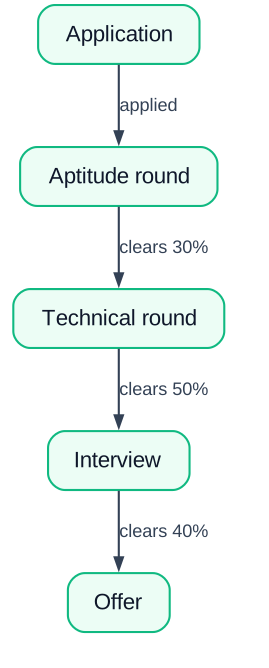
Aptitude rounds eliminate most candidates in mass-hiring drives, so train for speed and accuracy, not deep mastery. The Saarthi guide calls it the most common elimination point in mass-hiring drives. Companies need to filter tens of thousands of applications down to a few hundred interviews, and aptitude is their fastest filter.
Spend most of your time on quantitative topics — percentages, time-and-work, number series, data interpretation — then verbal ability, and a smaller share on coding basics for the preliminary technical screen. Use free resources like IndiaBIX and the aptitude section on Gradeup (now BYJU'S Exam Prep) for daily practice.
For a typical question — 'If A can complete a job in 12 days and B in 18 days, how many days will they take together?' — the fast method is to find the LCM of 12 and 18 (36), then combine rates: A's rate is 3 units/day, B's rate is 2, total 5 units/day, so 36/5 = 7.2 days. Solving slowly with fractions costs time.
Take at least 5 timed practice tests per week, and when you consistently score above the cutoff, you pass into the technical round where the competition is much smaller. Speed matters more than depth. Answering more questions with high accuracy beats answering fewer with perfection.
Beat the CGPA gate before it beats you
Only 21% of companies hire purely on skills, so you need to either clear the CGPA bar or target the skills-first companies that don't have one. The Unstop campus hiring report cites HirePro data showing that 51% of companies still consider CGPA as a filter. That is a lot of gates you have to pass through.
Removing strict CGPA filters can expand the qualified candidate pool by 40-50%, according to the same Unstop report. So the companies are willing to hire more students — the CGPA filter is what stops them. Your job is to find companies that have removed that filter.
Read eligibility criteria for "no CGPA cutoff" or "all branches eligible" and job descriptions that mention a portfolio or GitHub—those are skills-first signals. Search for jobs with "no CGPA cutoff" on Naukri and Internshala to find these companies directly.
If your CGPA is below 7, focus most of your application volume on these skills-first companies. You will have a better chance per application than with a traditional gate keeper.
Turn internships into your full-time offer
Internships are your best entry point, since 78% of organizations run them, but you have to convert because only 16% of organizations convert more than 80% of their interns into full-time employees — the rest convert fewer or none. These figures come from the Unstop Talent Report 2026. Internship programs are everywhere, but a conversion is not automatic. You must actively work for it.
Conversion is a three-step process. First, deliver visible work. Keep a log of what you finished: each bug fixed, each feature shipped. Second, ask for feedback weekly. A short Friday email asking what to improve next week keeps you on their radar. Third, in your final month, ask for a full-time role plainly: "I would like to continue here full-time. What does the process look like?"
Most interns never ask. Managers assume you are leaving unless you state otherwise. Make your intention known early and repeat it.
Related reading: the internship route works best when you treat it as a job hunt, not a learning exercise. Also see the resume guide for freshers if you are still polishing your application materials.
Common mistakes that kill off-campus applications
The biggest mistakes are applying without a tracker, ignoring aptitude prep, and skipping the follow-up email. Each one quietly removes your application from the pool.
The fix for each is mechanical. Use a free spreadsheet template and log every application. Set a calendar reminder to follow up after 10 days. Make a list of 50 companies, not 5. And apply now, not next month.
Your resume matters less than your application volume at this stage. For a stronger resume, see the guide on writing a resume with no experience.
Your next step: run the system for two weeks
Block two hours every evening for 14 days, work the 8-12-per-week cycle, and you will have more interviews in a month than most students get in a semester. The system works because it replaces hope with a schedule. Jot down the job market reality for 2026: the junior developer market has shifted, and volume plus follow-up is how you meet it.
Set up your tracker today. Pick the first 5 drives you can apply to this week. Put two hours on your calendar for each evening. The aptitude prep matters most, so start there first — and if coding basics feel shaky, revisit the question of how much DSA you actually need as part of that prep.
Volume plus follow-up beats perfect applications — 40 applications will get you more calls than 4. Interview prep comes after you get the calls, and you are likely to get calls if you run this system.
Open a spreadsheet tonight, list the first 5 drives you can apply to this week, and set aside two hours each evening for the next 14 days. That is the whole system. Run it, and you will stop guessing — you will know exactly which applications are alive, which are dead, and you will be in front of far more hiring managers than most students.