Zoho Founder's AI Warning: What Software Freshers Must Do in 2026
Zoho's Sridhar Vembu's 'please pray for us' comment signals AI is reshaping software jobs, not ending them. Freshers who build deep domain expertise and use AI as a tool will still find places, but the prep playbook must change now.

Zoho's founder Sridhar Vembu froze pay hikes and told employees "please pray for us." That phrase, from one of India's most respected tech leaders, is not a reason to give up on software jobs. It is a signal to change how freshers prepare.
Vembu's warning is the latest in a series of signals that the software job market is shifting, not ending. According to the Leaders to Watch analysis, active IT openings in India stood at 44,000 in August 2026, only 6% below a year earlier.
Zoho's pay freeze and warning are a sign that routine coding is being automated, but they are not a signal to abandon software careers. Freshers who build deep, specialised skills and treat AI as a tool will still find a place. The market is changing, but it is not closing.
What Zoho's Sridhar Vembu actually said
Zoho skipped its usual pay hikes and cut costs because AI has raised costs and the software business outlook is uncertain. Vembu cancelled appraisals this year, cut the marketing budget, and said "we cannot have our usual pay increase this year," while vowing to avoid mass layoffs (Economic Times). He also said Zoho hasn't grown its employee count for 18 months (India Today).
The cost pressure is real. Vembu cited a "massive four-fold increase in server prices" for data centres and a sharp rise in AI token spending per engineer (Economic Times; India Today cites it as 4-5x). He framed it plainly: "The business outlook for software is uncertain and AI has raised costs dramatically."
Software jobs are shrinking, not vanishing
Entry-level hiring has dropped sharply, but the demand for skilled engineers remains. At the 15 biggest tech firms, entry-level hiring fell 25% from 2023 to 2024, and postings for "junior developer" or "entry-level software engineer" are down about 40% compared to before 2022 (Entrepreneur Loop; see our analysis of the junior developer job market for more). Those are big numbers, and they explain the anxiety freshers feel.
Yet the picture is not uniformly grim. Active IT openings in India stood at 44,000 roles in August 2026 (active = open and being filled now), only 6% below a year earlier, while total tech openings across all industries reached 1,09,000 (total = includes all tech roles across non-tech companies too), up 6% (Leaders to Watch). The contraction is concentrated in routine coding roles, not in the profession as a whole.
What is shrinking
- Entry-level hiring at large tech firms
- Generic "junior developer" postings
- Work that repeats the same patterns
What is stable
- Overall tech openings across industries
- Roles needing domain expertise
- Work that requires judgement
Why AI is raising costs before it raises your salary
AI makes companies spend more on servers and tokens, so the money that used to go to new hires now goes to infrastructure. Vembu said server prices are up 4-5x in a year, and AI token spending per engineer has climbed sharply (India Today). Hosting open-weight models requires expensive GPUs. That money has to come from somewhere.
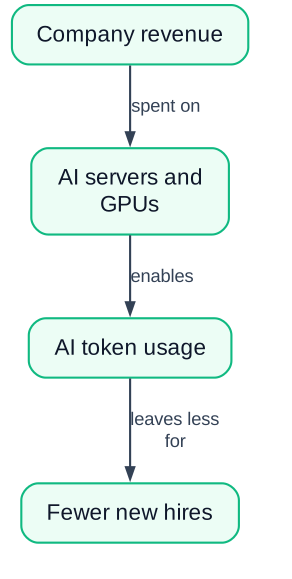
Vembu put it bluntly: money that would go to new employees is going to AI and data centre costs instead (Leaders to Watch). HCLTech made the same trade-off, cutting 3,300 jobs while investing ₹3,500 crore into AI data centres (Leaders to Watch). This is the real story behind the pay freeze.
Company earns revenue
Software products and services bring in money.
AI costs rise
Server prices multiply and token spending per engineer climbs.
Budget gets reallocated
Money moves from hiring and salaries to AI infrastructure.
Hiring slows
Fewer entry-level roles open, and pay hikes get postponed.
The lesson for freshers is uncomfortable but clear. When a company's AI bill doubles, it does not immediately double your salary. The investment comes first, and the payoff comes later, if at all.
The skills that survive automation
Deep, specialised domain expertise is the safest path, not broad, shallow coding skills. Vembu advises aspiring engineers to become "strong domain experts in some specialised domains" (Entrepreneur Loop). A senior Zoho engineer built an advanced security tool in one month with AI, a task that would traditionally take a team of 3-4 engineers a year (Entrepreneur Loop). That is roughly a 12x speedup based on those numbers, and it shows what happens to routine work.
The pattern is consistent. When one engineer with AI can do the work of roughly four, companies hire fewer engineers for that task. But they still need the one engineer who understands the security domain deeply enough to direct the AI and judge its output.
Generalist path
- Easy to start, many tutorials available
- Competes against AI on speed
- Easily replaced by automation
Specialist path
- Harder to enter, needs domain study
- Competes on judgement, not speed
- Harder to replace with AI
Think of security, healthcare, finance, or manufacturing. Each of these fields has rules, regulations, and edge cases that AI does not inherently understand. An engineer who knows the domain can use AI to write the code faster. An engineer who only knows React has no such advantage.
How freshers should prepare now
Build projects that prove you can solve real problems, and learn to use AI as a force multiplier. The old preparation playbook, grinding through tutorials and collecting certificates, is exactly what AI automates. The new playbook is different.
Pick a domain
Choose security, healthcare, finance, or any field you care about. Learn its core problems and vocabulary.
Learn the fundamentals deeply
Understand data structures, algorithms, and system design. AI can write code, but it cannot decide what to build. Build your fundamentals with a structured approach like the one in this guide on cracking coding interviews.
Build a portfolio project that uses AI
Create a tool that solves a real problem in your chosen domain. For healthcare, build a tool that reads a doctor's note and flags missing allergy checks. For finance, build a dashboard that uses an LLM to summarize a company's quarterly report. Use AI to accelerate your work, then document how you directed it. A concrete project matters more than ten certificates.
Practise explaining your work
Interviewers want to see your thinking, not just your output. Write clear READMEs and prepare to walk through your decisions.
Stay updated on industry trends
Follow what companies like Zoho are actually doing. The India Today coverage of Vembu's warning is one data point in a moving market.
This plan is harder than watching tutorials, and that is the point. If it were easy, everyone would do it, and it would not be valuable. The students who follow this path will stand out precisely because most will not.
What this means for your first job
The first job may be harder to get, but it will value judgement and problem-solving over routine coding. The market is genuinely tougher for freshers, and I will not pretend otherwise. Entry-level hiring fell 25% at the biggest firms (Entrepreneur Loop), and Vembu himself admitted "the IT industry, including Zoho, has not created many jobs in recent years" (Leaders to Watch).
But the roles that remain are more interesting and better paid. Companies do not need people to write the same CRUD endpoint for the hundredth time. They need people who understand a business problem, design a solution, and use AI to build it fast. That work is harder to automate because it requires judgement.
Some freshers will still struggle, and that is a fair counterargument. The transition will not be smooth for everyone. But the alternative, giving up on software entirely, ignores the 1,09,000 tech openings that still exist across industries (Leaders to Watch). The door is narrower, but it is open.
Vembu's "please pray for us" is not a eulogy for software careers. It is a warning that the easy path is closing. The students who adapt now, who pick a domain and build something real, will walk through the narrower door. The ones who wait for the old market to return will be waiting a long time.
Pick one domain you care about, build a small project that uses AI to solve a real problem in that domain, and publish it this week. That single step puts you ahead of most of your competition. The market has changed; your preparation must change with it. If you need a starting point, look at the current state of the junior developer job market and the entry-level roles that still exist to anchor your expectations in reality rather than fear.