Impostor Syndrome in Tech: Why Even Senior Developers Feel It (and What to Do)
Even senior developers feel like frauds. Here is why impostor syndrome in tech hits hardest, how AI makes it worse, and a few honest ways to quiet it.
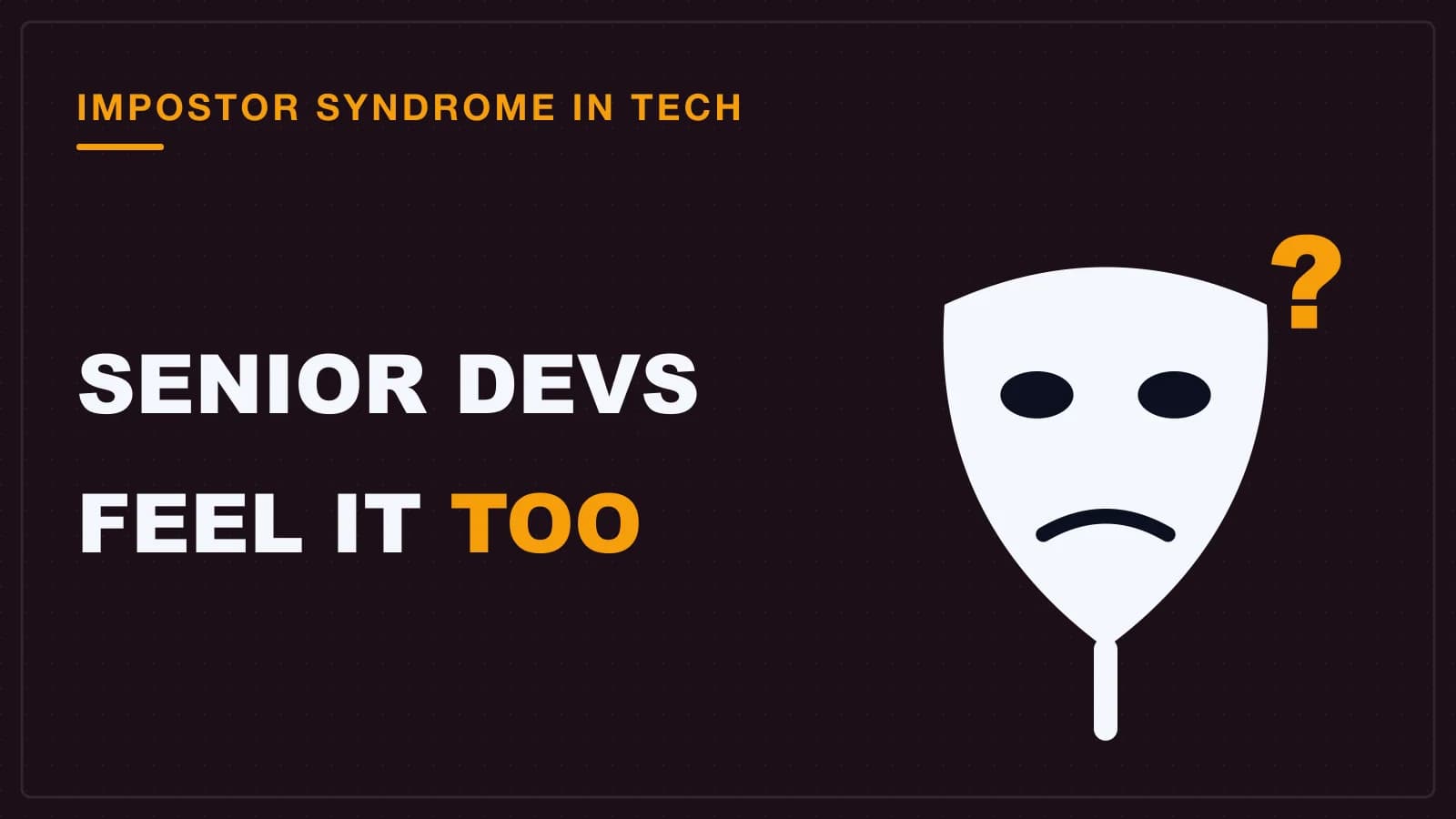
A developer with eight years of experience once told me he still feels sick before opening a pull request. He has shipped code used by lakhs of people. He still thinks someone will read his code and finally figure out he is a fraud. He is not rare. He is the median.
That feeling has a name: impostor syndrome. If it hits you every time you open your editor on a Sunday night, you are not alone. Impostor syndrome in tech is one of the most common feelings in our field, and you are in very good company.
What is impostor syndrome, and why do developers feel it?
Impostor syndrome is the feeling that your success is fake and that you will soon be exposed as a fraud, even when there is real proof you are good. Psychologists Pauline Clance and Suzanne Imes named it in 1978. It is not a disease. It is a thought pattern, and it is very common among developers.
Before we fix anything, I want to say one thing clearly. The feeling is valid. Coding is a field where the unknown grows faster than the known. Every week there is a new tool, a new framework, a new thing everyone “already knows.”
So feeling behind is not a character flaw. It is an honest response to a field that moves fast. Tens of thousands of developers report it. A paper from Pauline Rose Clance, who first named the term, and a later Stack Overflow piece on impostor syndrome both show how common it is.
Why do senior developers feel it too, for a different reason?
Senior developers often feel it more, not less, because the bar they hold for themselves rises faster than their skill. More people now depend on their decisions, and that weight is heavy.
- Here is the part most people get wrong.
- They assume confidence comes with experience.
- It does not work that cleanly.
When you are a junior, “good enough” means your code runs. When you are senior, “good enough” means your design will hold up for three years, in code review, under load, in front of a teammate you respect. The target keeps moving up.
There is also a real effect at play. The more you learn, the more you see how much you do not know. A first-year student thinks a couple of databases exist. A senior knows there are many, and that each one will bite you in a different way.
Confidence does not arrive with the senior title. The job just changes which fear you carry.
Why does everyone look smarter than me?
Yes, it is normal, and the comparison is unfair to you. You are comparing your messy inside to everyone else’s polished outside.
You see your teammate’s clean final commit. You do not see the four hours they spent stuck on a missing semicolon. You see a confident answer in the standup. You do not see the Google search they did two minutes before.
Everyone is fighting their own confusion in private. The ones who look calm have just gotten better at hiding the struggle, or they did the same panicked search you did. This is the trap most learners fall into. They measure their bloopers against everyone else’s highlight reel.
Why does the fear peak right before your first pull request?
The fear peaks before a pull request because that is the first moment another person reads your raw thinking. Code review feels like a test of you, not your code. It is not.
I will be honest about my own first code review. I had built something that worked, and I was proud. Then a reviewer left fourteen comments. My stomach dropped. I read the first three and was sure I would be let go.
Then I actually read them. Twelve were small style notes. Two taught me something I use to this day. None of them said “you are a fraud.” They said “here is a better way.” That reframe took me years to learn, so let me hand it to you early.
- A code review reviews the code, not your worth.
- Comments are a gift of attention. A reviewer who ignores you does not care.
- Every senior you admire got their early work picked apart the same way.
Does AI like Copilot or ChatGPT make it better or worse?
AI tools can do both. They lower the fear of a blank screen, but they add a new doubt: “the AI wrote it, so did I even do anything?”
The classic version of impostor syndrome was about hard work that felt unrewarded. You struggled for hours and still felt like a fake. You might feel both at different times. But a new flavor has appeared with AI tools like Copilot. The new AI-era version is the opposite. The work feels too easy, and the ease itself becomes the doubt.
You ask Copilot, you paste the answer, it works, and a small voice says “that does not count.” But it does count. Knowing what to ask, reading the output, and judging if it is correct is real skill. A beginner cannot do that yet.
The risk is using AI without depending on it too much. If you copy code you cannot read, the doubt is honest, so fix it by understanding the code. Stack Overflow looked at exactly this tension in their piece on whether AI coding tools help or hurt impostor syndrome. I dug into this trade-off more in my post on whether it is worth learning to code with AI around.
How does family and peer comparison make it heavier in India?
Family and peer pressure adds a public scoreboard to a private feeling. “Package kitna hai” turns your growth into a number everyone can compare, no matter what language you say it in.
A batchmate gets placed at a big company. An uncle asks why you are not there yet. A cousin’s salary becomes dinner-table news. None of this measures whether you can actually build software.
Here is what I tell students from this exact pressure. A salary is a snapshot, not a verdict. People grow at different speeds, and the early gap rarely predicts the ten-year result. The slow starter who keeps learning often passes the fast starter who stopped.
If the job market itself is scaring you, that fear is real too, and I wrote about it honestly in my breakdown of the junior developer job market.
How do I actually overcome impostor syndrome in tech?
You manage it with small habits, not one big mindset shift. Name the feeling, keep proof of your wins, and treat asking for help as normal. Here is the routine I give students.
- Name it out loud. Say “this is impostor syndrome, not a fact.” Naming the feeling takes away half its power.
- Keep a win-log. Write down one thing you fixed each day, even a tiny bug. On bad days, read the list. It is hard proof against the voice.
- Normalize Googling and asking. Senior developers search basic syntax daily. Asking a clear question is a sign of skill, not weakness.
- Compare to past you, not to peers. You could not read this code six months ago. That is the only fair scoreboard.
Try this today: open a notes app and write the first line of your win-log right now. One thing you built or fixed this week. Start the proof.
One more honest point. Sometimes the feeling is not coming from you. Sometimes it is structural. A toxic team that mocks questions, a manager who never gives credit, or a job far above your level will make anyone feel like a fraud. That is the environment talking, not your skill. freeCodeCamp’s guide for developers covers more practical tactics, and my guide on how to learn to code in 2026 has the study habits that build real confidence over time.
And if the feeling has stopped being just a feeling — if you have not opened your editor in days and dread has turned into exhaustion — that is a different problem with a different fix. I wrote about it separately in spotting and recovering from coding burnout.
Does it ever fully go away, or does it just get quieter?
Probably not, and a small amount is actually healthy. The honest answer is that the feeling fades but never disappears, even after years.
A little self-doubt keeps you humble. It makes you double-check your work, read the docs, and stay open to feedback. The developers I trust least are the ones with zero doubt.
The goal is not to kill the feeling. The goal is to stop letting it decide what you do. You can feel like a fraud and still open the pull request. You can feel behind and still ship the feature. The feeling can come along for the ride. It just does not get to drive.