Best Free JavaScript Courses for Beginners in India in 2026
As of October 2026, I checked Scaler, freeCodeCamp and Scrimba for what you really get for free. Scaler's course ends with a certificate you can share on LinkedIn, and freeCodeCamp's five projects do more for your resume than any certificate.

As of October 2026, I opened the JavaScript course pages on Scrimba, Scaler and freeCodeCamp. On each one I checked a single thing: what you get without paying anything. Only some of the "free JavaScript course" lists online can say they did the same. Many of them mix in paid Udemy courses that come with a money-back guarantee, and still call them free.
For most students in India, start with Scaler's free JavaScript course, a short 10-hour video course that gets you through the syntax before you take on freeCodeCamp's 300-hour text course. Then build real projects with freeCodeCamp, which is free and has five portfolio projects. Scrimba is a good free option if you prefer to learn by typing code in the lesson. Check every Udemy listing yourself before you trust the word "free".
Keep MDN's JavaScript reference open in another tab while you study. Any course will use words it does not explain well, and MDN explains them in plain terms with small examples.
Scaler free JavaScript course gives an India-friendly certificate
Scaler's beginner course is free, needs no programming background, and ends with a certificate you can share on LinkedIn.
Mrinal Bhattacharya teaches it. The course page lists 10 hours 14 minutes of video across 9 modules and 78 lessons, with 8 coding challenges along the way (Scaler). It is rated 4.8 by more than 1,000 students, and it comes with a Discord community of over 100,000 members (Scaler).
The topic list goes further than most beginner courses. You start with ES6 syntax and the DOM, which is the page structure your code changes. Then you move into object-oriented programming and async code with Promises and async/await. The last modules cover closures and currying. Those two words sound scary, but they come up in interview questions, so meeting them early helps.
A Discord group helps more than it looks. When you are stuck on a closure (a function that remembers the variables around it) at midnight, someone in the community may have solved it already. A pre-recorded video cannot answer back.
Be honest with yourself about the certificate. It shows you finished a course. It does not show you can build something. Our front-end developer fresher salary breakdown for Bangalore covers these roles. Many recruiters for them look at your GitHub as well as your certificates. Treat the Scaler certificate as a line on your LinkedIn, and treat the next course as the place you earn proof.
freeCodeCamp gives you five projects worth showing
freeCodeCamp's free certification takes about 300 hours, which is roughly five months at 2 hours a day, and the five projects you build for it matter more than the certificate itself (freeCodeCamp).
The lessons are text-first. You read a short instruction, write a line of code in the browser editor, and run the tests. There is no teacher on video. Some students love this because they can move at reading speed. Others find it dry after a long day of college.
To earn the certificate, you build these on your own, without step-by-step help:
- Palindrome checker: tells you if a word reads the same backwards.
- Roman numeral converter: turns a normal number into Roman numerals.
- Telephone number validator: checks if a phone number has a valid US format. The format is American, but the regex skill is the same for Indian numbers.
- Cash register: works out the change to give back, coin by coin.
- Pokémon search app: fetches live data from an API and shows it on the page.
The upgraded curriculum adds practice work before those. It has 21 projects in total: 16 guided practice projects and the 5 certification ones (freeCodeCamp). Along the way you meet recursion and regular expressions, plus OOP, localStorage and fetch. According to the same announcement, freeCodeCamp's open curriculum has helped more than 40,000 people get developer jobs (freeCodeCamp).
Of the five, the cash register project is a good test of whether you have learned anything. Getting the change right for every coin forces you to handle edge cases, like a drawer that does not have enough money. That is the kind of thinking an interviewer looks for.
Pros
- Free from start to finish, certificate included.
- Heavy on projects, so you end up with code to show.
- Covers interview topics like recursion and regex.
Cons
- Long, so it needs months of steady work.
- Text-heavy, with no video teacher to keep you going.
Scrimba lets you code inside the lesson
Scrimba's own article says its Learn JavaScript course is the shortest of the free options at 9.4 hours, and that you edit the teacher's code right in the video (Scrimba).
That editing trick is the reason to pick it. You pause the lesson, change a line, and run it. Watching someone else type is passive. Breaking their code yourself is how the idea sticks.
Per Borgen, Scrimba's CEO, teaches it, and the course was built in partnership with Mozilla MDN. It has more than 140 coding challenges and a free completion certificate you can post on LinkedIn (Scrimba). The hackr.io course review confirms the course is free and reports more than 100,000 students.
You build four projects with the teacher:
- A passenger counter app
- A blackjack game
- A Chrome extension
- A mobile app
The Chrome extension is the one to show off. A friend can install it and use it, which makes a better demo than a screenshot.
There is one catch for Indian students. Scrimba works best on a desktop or laptop, not a phone (Scrimba). If you study on your phone during a long bus ride, the in-video editor will frustrate you. Save Scrimba for the hours you can sit at a computer. With practice between lessons, most people take 3 to 6 weeks to finish it (Scrimba).
Udemy free JavaScript courses need a check before you start
Some Udemy listings that look free are paid courses, so open the listing and check the price before you start.
Udemy's own pages did not open for this check, so this post does not name specific free Udemy courses. On any listing, look for Free on the enroll button and confirm the certificate before you put in the hours.
Two paid Udemy courses come up again and again in reviews, and they are worth knowing about for later. Jonas Schmedtmann's Complete JavaScript Course runs 69 hours and has more than 800,000 students (hackr.io). Brad Traversy's Modern JavaScript course runs 21.5 hours (hackr.io). Neither is free. Consider them only after you have finished a free course and know you want more depth.
Comparison table of the three free courses
Putting the three free courses side by side shows that the free certificate, the project count and the time needed differ a lot.
| Course | Hours | Free certificate | Projects | Best for |
|---|---|---|---|---|
| Scaler JavaScript for Beginners | 10h 14m | Yes, shareable on LinkedIn | 8 challenges | Indian students who want a guided video course and a community |
| freeCodeCamp JavaScript Algorithms and Data Structures | About 300 | Yes | 21 (16 practice, 5 certification) | Building a portfolio for placements |
| Scrimba Learn JavaScript | 9.4 | Yes, shareable on LinkedIn | 4 build-along, 140+ challenges | A fast, hands-on start on a laptop |
Do not sort this table by the certificate column, because all three of these courses give one. Sort it by the projects column. freeCodeCamp's five certification projects are the only ones on this list you build alone, without a teacher typing first, and that is the work you can explain in an interview.
Which free JavaScript course should you pick?
On a tight budget in India, take Scaler first because its short video lessons get you through the syntax quickly, then freeCodeCamp for projects, and use Scrimba if you want a quick hands-on start. This post does not cover Hindi or Bengali-language YouTube courses, because none were opened and checked for it.
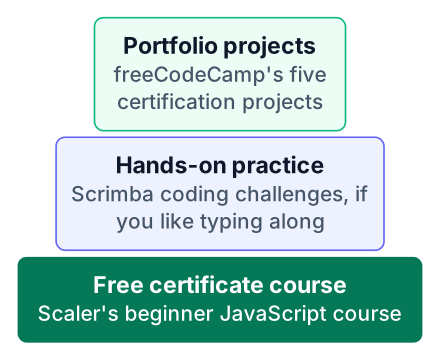
Here is the order to follow:
- Finish Scaler's course. Do one module a day if you can, and post the certificate on LinkedIn when you finish.
- Move to freeCodeCamp. Skip any practice lessons that repeat what Scaler taught, and spend your time on the projects.
- Use Scrimba on laptop days. When a topic like the DOM still feels unclear, its in-video editor is the fastest way to test it.
Say you have a TCS or Infosys campus drive a few months away. You know some C from your first year but have never written JavaScript. Scaler gets you comfortable with the syntax. The freeCodeCamp cash register and Pokémon search app then give you two projects to talk about in the technical round. When the interviewer asks "What have you built?", you open a live link instead of naming a certificate.
Set honest expectations about time. Learning to build working web apps for free usually takes 3 to 6 months of daily practice (Scrimba). Missing a day is fine. Missing a week makes it much harder to get back into the routine. If you want a way to keep notes and quiz yourself on what you learned, our guide to Gemini notebook study tools shows a setup that works for course material.
JavaScript is also a good base for where hiring is going. Many of the skills in our list of skills an AI engineer fresher needs in 2026 assume you can build a simple web front end. That front end is usually what turns an AI script into something people can use.
Open Scaler's free JavaScript course today and finish the first module this week. Once you finish the course, start freeCodeCamp's first JavaScript lessons and work toward the palindrome checker as your first project.