ChatGPT vs Gemini for Medical Students: Which One Prepares You for NEET-PG?
ChatGPT scored 79.4% and Gemini got 54.4% on 160 emergency-medicine MCQs in a published study. Here is how to choose between them for NEET-PG prep, where to trust them, and where your textbook still wins.
Say you are preparing for NEET-PG. You paste the same twenty emergency-medicine MCQs into two free AI chatbots. Researchers gave the same 160 questions to two chatbots. Which one would you trust next to your question bank?
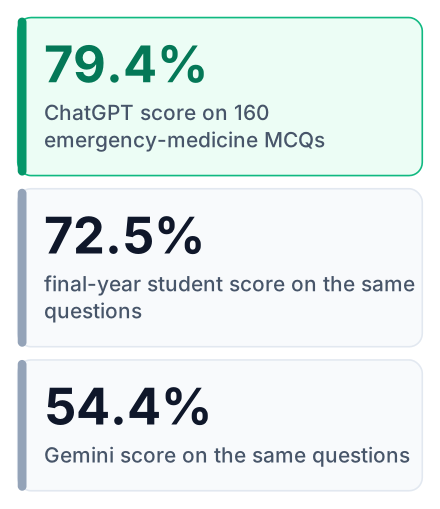
ChatGPT scored higher than Gemini on 160 emergency-medicine MCQs, so it is the safer first choice for practising questions. In the study, ChatGPT got 79.4%, final-year students got 72.5%, and Gemini got 54.4%. The study tested emergency medicine, not NEET-PG. Its model versions are not confirmed, so these scores may not match today's free models. ChatGPT still got about 20 in every 100 wrong, so neither tool was reliable enough to be your only check. Use either one to explain answers, and check every answer against a standard textbook.
ChatGPT vs Gemini at a glance
In the one study we have, ChatGPT led on accuracy, while Gemini's strengths are its Google connection and image tools.
First, the scores from the study. These are the tested models, and their versions are not confirmed.
| Tested in the study (versions not confirmed) | MCQ accuracy |
|---|---|
| ChatGPT | 79.4% |
| Final-year students | 72.5% |
| Gemini | 54.4% |
Next, how the two free plans compare today on the points that matter for exam prep.
| What you care about | ChatGPT (free) | Gemini (free) |
|---|---|---|
| Free-tier model | GPT-5.6 Luna (Dupple) | Gemini 3.6 Flash (Dupple) |
| Free usage limits | Unlimited everyday text chats, 3 image generations a day (Dupple) | Daily chat limit not stated in our source; 15 GB storage (Dupple) |
| Google connectivity | No Google link in our sources | Yes (CNET) |
| Image generation | Yes, within the daily cap above | Yes (CNET) |
The free-plan rows describe the plans as of September 2026. Free plans change often, so open each app and check its own limits page before you plan a month around them.
What the 160-question study tested
Researchers gave ChatGPT, Gemini and final-year emergency-medicine clerkship students the same 160 multiple-choice questions and compared their scores, in a paper published in the International Journal of Emergency Medicine (DOI 10.1186/s12245-025-00949-6).
A clerkship is the hospital rotation where final-year students work on a real ward under supervision. Those students were the human benchmark. They had studied the same subject the questions came from.
The score used is MCQ accuracy: the share of questions answered correctly, out of all the questions asked. One wrong answer costs the same as any other.
Gemini trailed by 25 points, and why that matters
Gemini got 54.4% right, so it was wrong on about 46 of every 100 questions. That is too many to trust without checking, and it sits 25 points below ChatGPT. The gap is ChatGPT's score minus Gemini's in the study, and you can check the results on the journal's own page.
The position of the students matters as much as the gap. ChatGPT finished above people who had just done the rotation. Gemini finished below them. Even so, ChatGPT still got about 20 in every 100 wrong, so it needs checking too. Neither tool was reliable enough to be your only check.
I would still not treat this paper as the final word. It has real limits:
- One subject. Emergency medicine is one part of NEET-PG. Pharmacology or anatomy questions could give a different result.
- One moment in time. Both companies update their models often. The versions tested are likely gone already.
- No NEET-PG paper. The question style of an Indian entrance exam was never tested.
Any single study is a hint, not a verdict. It tells you where to start. It does not tell you to stop checking.
Free-tier limits decide your study hours
A high score only helps if the free plan lets you ask enough questions in a day, and the two free plans work differently, according to Dupple's 2026 free-tools list.
The study's model versions are not confirmed, so the free-tier models named above are not matched to its scores, and today's models may score differently. Treat the accuracy numbers as a direction, and the limits below as your real daily budget.
ChatGPT Free
Pros
- Unlimited everyday text chats on GPT-5.6 Luna (Dupple)
- Better MCQ record in the only study we have
Cons
- Only 3 image generations a day (Dupple)
- Can refuse some sexual-health questions (see the next section)
Gemini Free
Pros
Cons
- Weakest score of the three in the MCQ study
- Our source lists no daily chat limit, so you find the cap only by hitting it
Now picture a normal NEET-PG revision day. You solve about a hundred practice MCQs. For each wrong one, you ask for an explanation. That is a few dozen text questions, plus some follow-ups.
On ChatGPT, text is not the problem, because everyday chat is uncapped. The first limit you hit is images. Ask it to draw the brachial plexus, the coagulation cascade and a cardiac cycle graph, and your daily image allowance is gone before lunch.
For Gemini, storage is not the problem either. A day of text questions uses almost none of it. The unknown is the chat limit itself, which the source does not state. Check the app's own help page before you depend on it for a full day.
If you are weighing a paid upgrade instead, read our breakdown of GPT-6.1 Terra pricing for Indian students and what Gemini 4 Argon changed. Both posts cover the paid side, which this comparison skips.
Use AI to explain, not to give the final answer
The safest use is to attempt a question yourself first, then ask the AI to explain why each option is right or wrong. This keeps your own recall working, and it turns the AI's mistakes into something you catch.
Attempt the MCQ
Solve it on your own, with a timer, the way you would in the exam hall.
Write your answer down
Commit to one option and one line of reasoning before you open any chatbot.
Ask the AI for reasoning
Paste the question and ask why each option is right or wrong. Do not ask only for the correct letter.
Check against your textbook
Open your standard textbook and confirm the explanation. If the two disagree, the textbook wins.
Log the mistake
Note the topic and why you got it wrong. Your error log becomes your revision list.
Step four matters because these tools miss things. In a doctor's 2023 test of an older ChatGPT version on The Conversation, it missed an ectopic pregnancy at first. That is a diagnosis no examiner would forgive.
The same test found two other habits. ChatGPT prefers technical language, which suits a medical student better than a patient. It also refused some sexual-health questions. For gynaecology and obstetrics topics, expect the occasional refusal and go straight to your textbook.
Where Gemini is still worth opening
Gemini fits tasks where you need images or Google-linked tools, rather than exam-style question accuracy. CNET's comparison lists image generation and Google connectivity among its strengths, and it found ChatGPT felt less restrictive.
Two practical uses follow from that. You can turn a page of handwritten notes into a simple diagram to revise from. You can also keep your study material organised in the Google storage you already use.
CNET's review is from 2024, so some details may have changed since. Try these features yourself before you build a routine around them.
Which should you pick for NEET-PG?
Start with ChatGPT for MCQ practice and explanations, add Gemini for images and Google tools, and trust neither without a textbook check. Your choice depends on how you study:
- Heavy MCQ practice: ChatGPT. Uncapped text chat suits long question sessions.
- Visual learner: use both. Ask ChatGPT for the explanation, then make the diagram in Gemini once ChatGPT's daily images run out.
- Tight on time: pick one tool and stop switching. Comparing two answers on every question doubles your work.
No study has measured either tool on NEET-PG questions. So the most useful evidence is the test you run yourself, on questions where you already know the answers.
The real NEET-PG paper has 200 multiple-choice questions across all subjects, set by NBEMS, so your twenty should come from a paper you have already solved. Take twenty of them, paste each one into both free tools, and ask for the answer with reasons. Score each tool one point per question where it picks the right option and its reasoning matches your textbook. An answer with the right letter but wrong reasoning scores zero. Then, if one tool gets three or more questions right than the other, use it for explanations this week. If the gap is smaller, pick either one and stay with it.


