Claude Pro Price in India 2026: ₹2,000 vs $20 and the Real Gap
Claude Pro costs about ₹2,000 a month in India when billed annually, with GST included. The US price of $20 has no tax built in, so India's real premium is only about 5%, not the 24% the sticker numbers suggest.

Say you open Claude's pricing page in India and see ₹2,000 a month for Pro. A friend in the US opens the same page and sees $20. On paper, that looks like India pays about 24% more, a gap of roughly ₹400 a month. But the ₹2,000 includes 18% GST and the $20 does not, so the two numbers are printed on different terms and cannot be compared directly.
Claude Pro costs about ₹2,000 a month in India when billed annually, and about ₹2,399 when billed monthly. Both prices already include 18% GST. The US price of $20 does not include tax, so the real gap is only about 5%. Most students should start on the free tier and pay only when its limits stop them. I could not open Anthropic's India page, so the rupee prices come from two outside reports, and the 5% depends on an assumed ₹95 per dollar rate. Check the checkout screen. These figures come from eCorpIT's breakdown of the India launch and MEXC's country price list.
Claude Free costs ₹0 and has a 5-hour usage window
The free plan has no price, and its limit resets on a rolling 5-hour window, according to Anthropic's official pricing page. So heavy use stops you for a few hours rather than for a month.
"Rolling" means the clock does not reset at midnight. It starts from your first message in a window. If you start chatting in the morning and hit the limit before lunch, you can come back in the afternoon with a fresh allowance.
Free is the baseline for every other plan. Anthropic says Pro gives about 5x the Free usage. That makes the real question simple. Do you often hit the Free limit more than once in a normal week?
For a student doing coursework, the answer is often no. Asking Claude to explain a recursion bug or check a DBMS answer uses a small part of the window. Long chats with pasted code usually use it up much faster, because each reply has to take more earlier text into account.
Claude Pro price in India: ₹2,000 a month billed annually
Pro is ₹2,000 a month when you pay for the year up front and about ₹2,399 when you pay month by month, with GST included in both, as reported by eCorpIT and MEXC.
Anthropic began showing rupee prices on July 13, 2026, per the eCorpIT's write-up of the launch. Note that the rupee prices here come from secondary sources, not Anthropic's own page, so open claude.com/pricing from an Indian connection and compare it with the checkout screen. The ₹2,000 annual figure works out to roughly $21 at about ₹95 per $1. For reference, the US list price is $17 a month billed annually ($200 up front) or $20 billed monthly.
Two things will annoy Indian buyers. First, Claude's rupee plans do not support UPI, so you need a card that works for international digital payments. Second, there is no student discount on paid plans. Both points come from eCorpIT's report.
Annual billing is cheaper per month, but you pay for a full year on day one. That is a big commitment if you have never used Pro. Before you pick, run through these steps.
Use Free for two weeks
Note each day you hit the limit and what you were doing at the time.
Check your card
Confirm your debit or credit card allows international online payments, since UPI is not an option.
Start with one monthly payment
Pay the monthly price once and use Pro for real work, not for testing.
Count the hours saved
At the end of the month, ask whether the extra usage saved time you would otherwise lose waiting.
Switch to annual only after that
If you would happily pay again for the next eleven months, the annual plan makes sense.
Rupee vs dollar prices: the real gap is about 5%
Once you remove the 18% GST built into the rupee price, India pays only about 5% more than the US list price, not the 23-25% the sticker numbers suggest, according to eCorpIT's analysis.
The reason is a difference in how prices are printed. The US pricing page states that its prices do not include tax. US buyers see sales tax added at checkout, and the rate depends on their state. Indian prices already include GST, which applies to foreign digital services, so the rupee figure is the final amount on your bill.
To compare fairly, divide the rupee price by 1.18 to remove the 18% GST. For Pro: ₹2,000 ÷ 1.18 ≈ ₹1,695. In dollars, the roughly $21 India price becomes about $17.80 before tax. Against the US annual price of $17, that is a gap of about 5% (eCorpIT).
| Plan | India price (GST included) | Approx. dollar equivalent | India price without GST | US list price (no tax) | Real gap |
|---|---|---|---|---|---|
| Pro (annual) | ₹2,000/month | ~$21 | ~₹1,695 (~$17.80) | $17/month | ~5% |
| Max 5x (from) | ₹11,999/month | ~$126 | ~₹10,169 (~$107) | $100/month (Max 5x) | ~6% |
| Team standard (monthly billing, from) | ₹2,399/seat/month | ~$25 | ~₹2,033 (~$21.40) | $25/seat (monthly) | about 14% lower |
| Sources: India prices from eCorpIT and MEXC. US prices from claude.com/pricing. Ex-GST columns are each India price divided by 1.18. Dollar figures use about ₹95 per $1. Worked line for Pro: ₹2,000 ÷ 1.18 ≈ ₹1,695, ÷ 95 ≈ $17.80, which is about 5% above $17. | |||||
A small gap remains, and it is real. Currency rounding and local pricing choices explain part of it. It is a modest premium, not the large one the sticker suggests. The Team row goes the other way. ₹2,399 ÷ 1.18 ≈ ₹2,033, and ₹2,033 ÷ 95 ≈ $21.40, against $25 a seat on monthly billing, which is about 14% lower. The sources report this figure without giving a reason, so treat it as unconfirmed and check the checkout screen.
Claude Max starts at ₹11,999 a month
Max is built for people who hit Pro's limits every day, and at ₹11,999 a month it costs about six times Pro's annual price, per MEXC's price list.
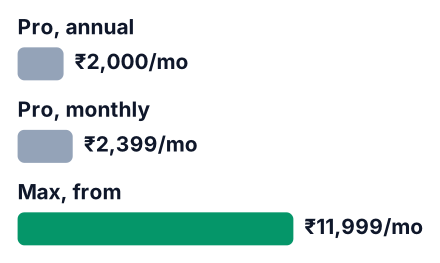
There are two Max tiers. On the official pricing page, Max 5x costs $100 a month and Max 20x costs $200 a month. The names describe usage: 5x or 20x what Pro allows. Both are billed monthly only, so there is no annual discount to soften the price.
Paid plans also carry weekly limits on top of the 5-hour window, Anthropic notes. Even Max is not unlimited. It gives you much more room, but a full week of heavy agent work can still use all of it.
Claude Code, Anthropic's coding tool for the terminal, is included in every paid plan. It shares one usage pool with the chat app (claude.com/pricing). Picture a long Claude Code session refactoring a project. That session eats into the same allowance you use for normal questions. This shared pool is the main reason heavy coders move up to Max.
Who needs Max? Full-time developers who run Claude Code for most of their working day. A student preparing for campus placements at TCS or Infosys does not.
Team and Education plans are not for individual students
Team plans start at ₹2,399 per seat per month and Claude for Education is sold to institutions, so a solo student cannot use either to get a discount (eCorpIT).
On the US pricing page, a Team standard seat costs $20 a month billed annually or $25 billed monthly. Team plans add shared admin controls and central billing. They make sense for a company, not for one person.
A college lab or a startup club might share a Team plan if the department pays. A final-year project group could ask its college about this too. Splitting the cost among friends rarely saves money, though. Each person still needs a paid seat.
Claude for Education is an agreement between Anthropic and a university. You cannot sign up for it on your own. If your college has one, your institution email gets access. If it does not, asking your department is the only route.
Free alternatives to paying for Claude
A student who hits the Free limit can switch to another free chatbot for that session or wait for the 5-hour window to reset, at no cost. Free plans exist on most major assistants, and none of these habits cost a rupee.
- Batch your questions. Write down three or four doubts, then ask them in one message instead of spread across the day.
- Start fresh chats. A new chat for each topic keeps the context short, so each reply uses less of your window.
- Paste only the broken part. Send the function that fails and the error message, not your whole project.
- Use a second assistant. When Claude's window is full, move to another free tool for the rest of that session.
Good second options exist. Grok has a free tier, which I covered in my Grok pricing post for India. For code questions inside a repository, GitHub Copilot on the web is worth a look. Your browser may already have AI features built in, as explained in this guide to browser AI for students.
Payment method matters as well. OpenAI added UPI support when it rolled out rupee pricing for ChatGPT in August, while Claude still has not, per eCorpIT. If you have no international card, that alone may decide which paid tool you can buy.
Is Claude Pro worth it for students?
Pay for Pro only if you hit the Free limit most days and the lost time costs you more than ₹2,000 a month (price source).
My position is firm: most students do not need it. Say you pay ₹2,000 a month for a 10-month academic year. That is ₹20,000 for a tool whose free plan already covers most coursework. Learning to code means you should write and debug most things yourself. A tighter limit pushes you to think before you ask. The counter-argument is fair, though. If you are building a real project with Claude Code every day, waiting hours for a reset can break your focus.
Pros
- About 5x the Free usage, per Anthropic's pricing page.
- Claude Code included, useful for daily project work.
- Monthly billing lets you test it for one month and stop.
Cons
- No student discount and no UPI payments.
- Weekly limits still apply, so it is not unlimited.
- Easy to depend on it too much while you are still learning.
Which should you pick?
- Stay on Free if you use Claude for coursework, exam prep or understanding concepts.
- Try Pro for one month if you are building a project and run Claude Code most days.
- Skip Max unless someone else is paying and you code with it full time.
Is a Claude subscription in India worth the price? Only for heavy daily use. The rupee price is fair once you account for GST, as the table above shows. Fair is not the same as necessary, though. For a typical student, the free tier plus one backup assistant covers the work.
Stay on the free tier for the next two weeks and note each time you hit the limit. If it happens most days, try Pro for one month and check whether it saved you real time.