Frontend, Backend, or Full-Stack: Which Path Should a Beginner Pick First?
Frontend vs backend vs full stack, explained in plain words. A 3-question test to pick your first path, India fresher salary ranges, and why full-stack is a destination, not a starting point.
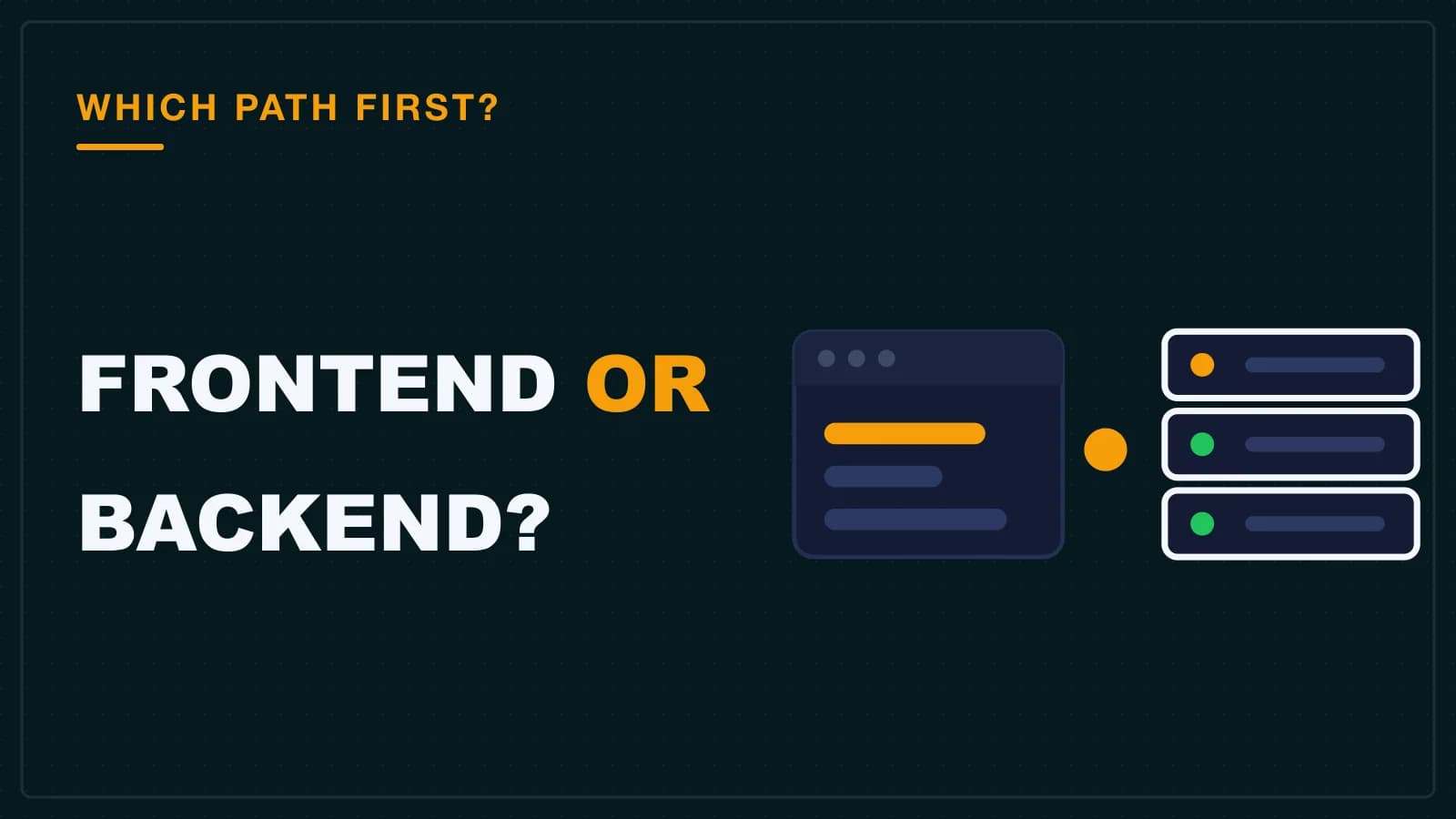
Frontend or backend is the first real decision you face, and it stops more beginners than any actual coding problem does. Not because the choice is hard, but because it feels permanent. It isn’t. The expensive part is not picking wrong — it is spending three weeks reading comparison posts and writing no code at all.
So let me give you the verdict first, then the reasoning.
Frontend, backend, or full-stack: which should a beginner learn first?
Frontend or backend? Most complete beginners should start with frontend, then add backend later to become full-stack. Frontend gives you instant visual feedback, which keeps you motivated early. Backend is a fine first choice if you love logic and data more than visuals. Full-stack is not a starting point. It is where you arrive after you know one side well.
What is frontend, backend, and full-stack — in plain words?
Frontend is what you see. Backend is what you do not see. Full-stack is both.
Think about ordering food on Zomato. The screen with the menu, the buttons, the photos of biryani: that is frontend. It runs in your browser or phone.
When you tap “Place Order”, something has to save your order, charge your payment, and tell the restaurant. That hidden machinery is backend. It lives on a server you never see.
- Frontend developer: builds the part users touch and look at. Tools: HTML, CSS, JavaScript, React.
- Backend developer: builds the logic, the database, and the rules. Tools: Node.js, Python, Java, SQL.
- Full-stack developer: can do both sides. They build the screen and the machinery behind it.
That is the whole map. Every coding tutorial you have seen sits inside one of these three boxes.
It helps to see one request travel the whole way. Follow the arrows: your browser talks to the interface, the interface talks to the API, and only the backend touches the database.
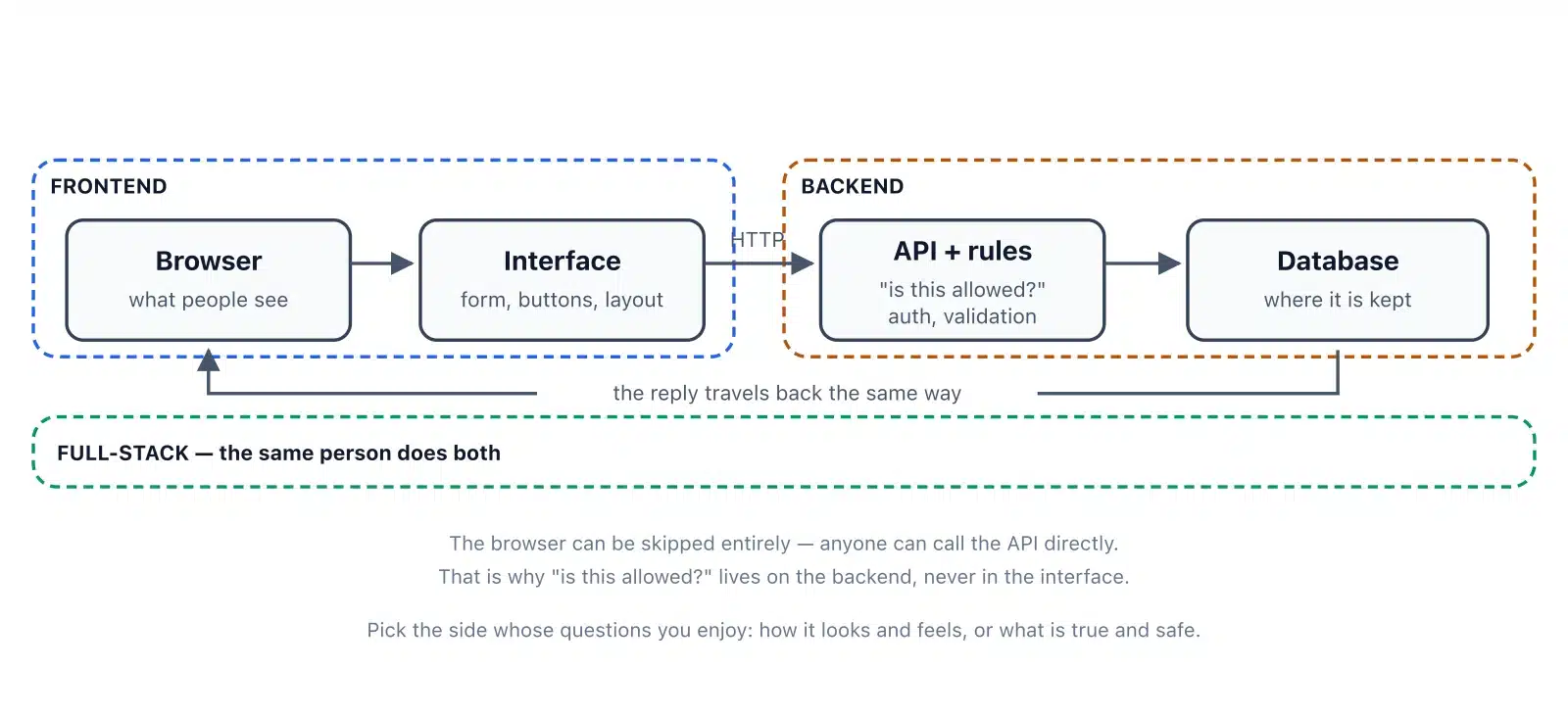
What you actually build on each path
The day-to-day work feels very different on each path. Here is a side-by-side view so you can picture yourself in each one.
| Frontend | Backend | Full-Stack | |
|---|---|---|---|
| You build | Screens, buttons, layouts, animations | Databases, APIs, login systems, payments | Both, end to end |
| Core skills | HTML, CSS, JavaScript, React | A language (Node/Python/Java), SQL, APIs | Frontend + backend together |
| Feedback speed | Instant (you see it change) | Slower (you test with data) | Mixed |
| Good if you like | Design, visuals, quick wins | Logic, data, problem-solving | Owning the whole thing |
| Hardest part | Making it look right everywhere | Keeping data correct and safe | Holding two worlds in your head |
If the frontend column made you smile, that is a signal. If the backend column did, that is a signal too. Hold that feeling. We will use it in the 3-question test below.
Words only take this so far. Here is one small feature — saving a comment — written twice, once for each side. You can run the backend half right now: save it as server.js and run node server.js. There is nothing to install.
// The backend half of one feature: saving a comment.
// No npm install. Run it with:  node server.js
const http = require("http");
const comments = [];  // a real app uses a database
const server = http.createServer((req, res) => {
  res.setHeader("Content-Type", "application/json");
  if (req.method === "GET" && req.url === "/comments") {
    return res.end(JSON.stringify(comments));
  }
  if (req.method === "POST" && req.url === "/comments") {
    let body = "";
    req.on("data", (chunk) => (body += chunk));
    req.on("end", () => {
      const { text } = JSON.parse(body || "{}");
      // This check is the backend's job. The browser cannot be
      // trusted: anyone can skip your frontend and POST directly.
      if (!text || text.trim().length < 2) {
        res.statusCode = 400;
        return res.end(JSON.stringify({ error: "comment too short" }));
      }
      const saved = { id: comments.length + 1, text: text.trim() };
      comments.push(saved);
      res.statusCode = 201;
      res.end(JSON.stringify(saved));
    });
    return;
  }
  res.statusCode = 404;
  res.end(JSON.stringify({ error: "not found" }));
});
server.listen(3000, () => {
  console.log("backend on http://localhost:3000");
});
Now the frontend half of the same feature. Notice how little it decides:
// The frontend half of the SAME feature: it collects input and
// shows the result. It never decides what is allowed to be saved.
async function postComment(text) {
  const res = await fetch("http://localhost:3000/comments", {
    method: "POST",
    headers: { "Content-Type": "application/json" },
    body: JSON.stringify({ text }),
  });
  if (!res.ok) {
    const { error } = await res.json();
    showError(error);              // "comment too short"
    return;
  }
  const saved = await res.json();  // { id: 1, text: "first!" }
  addCommentToPage(saved);
}
With the server running, this is what actually comes back:
$ curl -X POST localhost:3000/comments
    -H 'Content-Type: application/json' -d '{"text":"first!"}'
{"id":1,"text":"first!"}
$ curl -X POST localhost:3000/comments
    -H 'Content-Type: application/json' -d '{"text":"x"}'
{"error":"comment too short"}          # HTTP 400
$ curl localhost:3000/comments
[{"id":1,"text":"first!"}]
Look at the short comment. The frontend could have blocked it, and a good one would, so the person gets told early. But the backend blocks it too, because anyone can skip your page and call the API straight from a terminal, exactly as those commands do. Frontend work is about what someone sees and feels. Backend work is about what is true no matter who is asking. Full-stack means you answer both questions.
Frontend or backend: which is easier for a beginner?
Frontend usually feels easier to start, because you see your code work right away. You change one line, the button turns green, and your brain gets a small reward. That reward keeps beginners going.
Here is what most tutorials skip: “easier to start” is not the same as “easier overall”. Frontend gets hard later, when you fight layouts on ten screen sizes. Backend feels slower at first, because the result is hidden inside data.
So is frontend or backend easier for beginners? For the first month, frontend wins on motivation. After that, the difficulty evens out. Pick the one that keeps you coding, not the one that looks easy on paper.
I will be honest about my own start. I picked backend first because I thought it was more “serious”. I quit twice in two months, because I could not see anything I built. When I switched to frontend, I stopped quitting. The visible progress was the fix.
Where full-stack fits as a first choice
No. Full-stack is a destination, not a starting point. “Full-stack” simply means you learned both sides. Nobody learns both sides at once on day one.
This is where beginners get stuck: they see “full-stack developer” in job ads and think they must learn everything together. So they try React, Node, SQL, and APIs in the same week. They learn nothing well and burn out.
Full-stack is not a course you take. It is a sentence you can honestly say after you have built real things on both sides.
The right path is simple. Learn one side until you can build a working project. Then add the other side. One day you notice you can do both, and now you are full-stack. You did not chase the label. You earned it.
Jobs and pay in India, by path
Both frontend and backend have strong demand in India, and full-stack is increasingly preferred by companies hiring freshers. Backend roles at product firms often pay a little more at the top of the range, but neither path leaves you short of work.
Here are rough fresher ranges. Treat these as ballpark figures, not promises. Your city, your skills, and the company change everything.
- Frontend (fresher): roughly ₹3–6 LPA
- Backend (fresher, product firms): roughly ₹3–12 LPA
- Full-stack (fresher): often a small edge, because you fit more roles
Notice the backend range is wider at the top. That is because backend skills like databases and system design get rewarded more at bigger product companies. But a strong frontend developer at a good firm out-earns a weak backend developer easily.
The pattern that matters: skill level beats path choice for your salary. A great frontend developer earns more than an average backend developer. So do not pick a path only for the salary number. Pick the one you will get good at. For a deeper look at the fresher market, read my breakdown of the junior developer job market in 2026.
If you want a global picture of which tools companies actually use, the Stack Overflow Developer Survey 2025 is the most honest data source out there.
How do you decide which fits YOU? (3-question test)
Stop comparing salary charts. Answer these three questions honestly instead. They take two minutes and they work better than any roadmap.
- Do you want to see things change on screen instantly? If yes, lean frontend.
- Do you enjoy logic, data, and “how does this work under the hood”? If yes, lean backend.
- Do you want the most open doors and you are not sure yet? Start frontend, then add backend to become full-stack.
That third answer is the safe default for most beginners. Frontend first gives you motivation and visible projects. Adding backend later gives you the full-stack range that companies like.
Want the official skill maps for each side? The frontend roadmap and backend roadmap show exactly what to learn, in order. If you are brand new to the web, MDN’s Learn web development guide is the cleanest free starting point.
Try this now: write your three answers in a note on your phone. The path with two or more “yes” leans is your first path. Save it. That note ends the overthinking.
Switching paths later
Yes, you can switch from frontend to backend later, and many developers do. The core skills carry over. Once you know how to code, learning the other side is much faster than your first side was.
One of my students started as a frontend developer. After a year on the job, they wanted bigger challenges, so they learned Node.js and SQL on weekends. Six months later their title was full-stack. They did not restart their career. They added to it.
So please hear this: your first choice is not a life sentence. It is a starting door, not a locked room. The worst choice is not frontend or backend. The worst choice is staying frozen and writing no code at all.
The pick, if you want it in one sentence
Pick frontend first if you are unsure, because the instant feedback keeps you coding long enough to get good. Pick backend first only if logic and data excite you more than visuals. Skip “full-stack first” entirely, because it is a destination you reach later.
Here is the part nobody tells beginners. The path matters far less than the simple act of starting and not stopping. A finished frontend project beats a half-learned full-stack dream every single time.
What this post deliberately does not cover
This post answers one question only: which side to pick. It does not tell you how to learn the side you picked, because that is a different problem with a different answer. So depending on where you are now:
- You picked a path and want a week-by-week plan → How to learn to code in 2026.
- You keep starting tutorials and never finishing anything → Tutorial hell, and how to get out.
- You chose Python rather than JavaScript → the 90-day Python plan.
- You are worried AI makes all of this pointless → Is it worth learning to code now that AI exists?
Whichever you open next, open it today. The decision is made; the only thing left that matters is the first hour of actual code.