Forward Deployed Engineer: What It Means in 2026 and How to Become One
Search "forward deployed engineer" tonight and you will see OpenAI postings, none in India. The work exists in Indian cities under the title Applied AI Engineer, and the skills are trainable now. Here is what the role does, what it pays, and how a fresher builds toward it.

Say you search "forward deployed engineer" on a job site tonight. You find a long list of OpenAI openings, and not one of them is in India. The titles that do have seats in Indian cities are named differently, and the India section below shows which ones to search. The pay figures here are US figures, because I could not find a sourced India number. A route for freshers is at the end. Searches for the term grew from 18,100 in September 2025 to 165,000 in August 2026, according to Szymon Paluch's breakdown of the role.
A forward deployed engineer (FDE) is a software engineer who works inside one customer's systems to build and ship AI applications that run in production. OpenAI explained the role in a post dated 22 October 2026. In India, OpenAI lists these seats under another name, Applied AI Engineer, so a search for "FDE" alone will miss them.
What a forward deployed engineer does day to day
An FDE owns one customer's problem from the first meeting to a working system, instead of building a product for everyone. That is how Szymon Paluch's review of FDE job postings describes the job.
Palantir started the role.
OpenAI's San Francisco posting lists the work in a single line: "own discovery, technical scoping, system design, build, and production rollout." In plain words, you find the problem and decide what to build. Then you design it, write it and keep it running for real users.
Picture a bank whose support team answers the same questions all day. An FDE sits with that team, learns how its ticket system works, and builds an agent that reads those tickets and drafts replies. Then the FDE checks, week after week, that the team really uses it. OpenAI has also published its own explainer of the role.
The FDE work loop: discovery to measured adoption
The job repeats one loop: find the problem, build an agent in the customer's stack, test it with evals, measure real use, then give the patterns back to the lab. Anthropic's FDEs, for example, "work within customer systems to build production applications with Claude," as Paluch quotes from their posting.
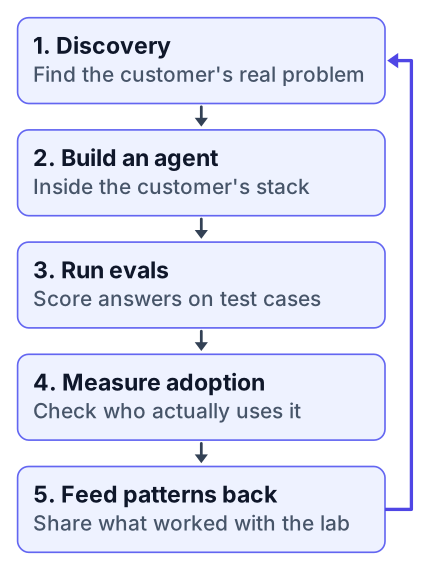
Here is that loop as something you can practise on your own.
Find the problem
Talk to the people who will use the tool. Practise on a task a small shop or college office does by hand, like answering the same fee questions every day.
Build in the customer's stack
Use their data, their logins and their tools, not a clean demo. Practise by connecting your agent to a real spreadsheet or database instead of sample text.
Test it with evals
An eval is a set of test cases that scores whether the agent answers correctly. Run it after every change, the way you run unit tests.
Measure real use
Count how often people open the tool and where they give up. A demo that nobody uses is a failed project, even if it works.
Give the patterns back
Write down what worked so the lab can turn it into a product feature. Practise with a README section called "What I would reuse".
Tutorials teach step three at best. In my opinion, steps two and four are where a weekend demo is easiest to tell from real work. For the wider list of skills around this loop, see the skills an AI engineer fresher needs in 2026.
Search Applied AI Engineer, not only FDE, if you are in India
In one blogger's count, none of OpenAI's 24 FDE-titled postings is in India, but its India openings in Delhi and Mumbai, as well as Bangalore, are titled Applied AI Engineer, according to Paluch's count. The work is close to the same. Only the label changes. Check OpenAI's own careers page for the titles open in your city before you rely on any blog's count.
| Title to search | Who uses it | What to know |
|---|---|---|
| Forward Deployed Engineer | Palantir, OpenAI, Google | The original name, mostly on postings outside India |
| Applied AI Engineer | OpenAI's India offices; Anthropic's team name (Paluch) | The title most likely to show an Indian city |
| Applied AI Architect | Related title on lab careers pages | I could not confirm which labs and cities use it, so check each careers page |
| Frontier Deployed Engineer | Anthropic's Claude Frontier Academy | A training track, not an open job ad |
Demand in India is rising. CIEL HR says FDE hiring in India grew 130% year-over-year, per Paluch. That report gives no absolute counts, so read it as a direction, not a size.
FDE pay: US ranges at Google and OpenAI, plus a Palantir median (not first-job pay)
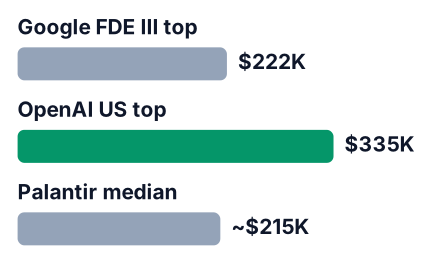
US base pay for FDEs runs from about $102K at Google's entry level, per fde.directory, to $335K at the top of an OpenAI listing, per India Today. These US figures are for engineers with about 4 or more years of experience, not for a first job. I could not find a sourced India pay figure for this role. India pay is not public yet, so check Levels.fyi and Glassdoor for current Applied AI Engineer listings.
| Role and level | US base pay | Source |
|---|---|---|
| Google FDE I | $102K–$145K | fde.directory |
| Google FDE II | $127K–$183K | fde.directory |
| Google FDE III | $153K–$222K | fde.directory |
| Google FDE IV | $207K–$300K | fde.directory |
| OpenAI FDE (US listing) | $198,000–$335,000 | India Today |
The Google listing that India Today reported, $153,000–$222,000, matches the FDE III band. India Today shows it as about ₹1.46–2.12 crore and the OpenAI range as about ₹1.89–3.2 crore. Those are US salaries shown in rupees, not what an Indian office pays.
Base pay is only part of the offer. A 2026 report on about 1,200 FDEs puts frontier-lab mid-level total pay at $300K–$450K and senior pay at $500K+, per fde.directory. Palantir's median sits near $215K in the same report.
For what freshers earn in nearby AI roles in India, read my breakdown of ML engineer fresher salaries in India.
Most FDE jobs ask for 5 years, so plan as a fresher
These roles ask for about 5 years of experience at OpenAI and Google, per Paluch's comparison, so a fresher's goal this year is proof of the skills, not the title. Anthropic asks for 4 years and Ramp for 3. Palantir asks for just 1 year after college, which makes it the nearest door for a recent graduate.
The skills list is clearer than the experience bar. Across 8 FDE postings, 7 ask for LLM or agent experience, 7 name Python and 5 name evals, per Paluch. That tells you where to spend your evenings.
Build now
- One Python agent that calls an LLM and uses a real tool or database
- An eval set that scores its answers, kept in the repo
- A short write-up of the user's problem before the code
- Something deployed that a real person uses, even a college club
Skip for now
- Training your own model from scratch
- Collecting course certificates with no project behind them
- Prompt tricks you never test (see software engineer vs prompt engineer)
- Applying only to listings with the exact FDE title
Start with this step-by-step guide to building an AI agent in Python, then add evals on top. After that, aim for any job where an LLM feature reaches real users. Experience running an LLM feature for real users counts more than the same number of years doing other work.
TCS and Infosys are hiring toward this role too
Indian IT services firms have set their own targets for FDE-style engineers, which gives freshers a nearer door than the labs, as Paluch reports. The TCS COO set a target of "at least 1% of our employee base" in the new operating model. That is about 5,900 of 593,798 people.
Infosys has a similar plan. Its CEO targets "6,000 Frontier Engineers over the next few years," per the same source.
Treat all of this as targets, not confirmed openings. Still, TCS and Infosys hire freshers every year. Joining as a fresher and then moving into one of these teams from inside is one possible plan, though that is my opinion and no source confirms how often it happens.
Claude Frontier Academy is a credential you cannot apply for yet
Anthropic's academy gives a badge path for engineers, but you can only enter by nomination from an employer, per Anthropic's announcement. The company has committed $100M to train 10,000 Frontier Deployed Engineers by the end of 2027.
The first cohorts come from Accenture, Bain, Capgemini, Commonwealth Bank of Australia, Deloitte, McKinsey, Morgan Stanley and Novo Nordisk, per Anthropic. The path has four stages:
- A multi-day in-person program
- The Claude Resident Engineer badge
- A 12-week residency
- The Claude Frontier Deployed Engineer badge, with the first expected in early 2027 (Anthropic)
A fresher cannot apply directly. Joining one of those partner firms, though, is a route that could lead to a nomination later.
Fresher to FDE: a 12-month route
Months 0-3: learn Python and build one agent that uses a real tool or database. Months 3-6: add an eval set of twenty test cases and deploy the agent for a real user. Months 6-12: apply to Palantir, Indian IT services firms and applied AI roles where an LLM feature reaches users. After that first job, move toward Applied AI Engineer or FDE roles with the work you have shipped.
This week, pick one small business problem and build an agent for it. Write twenty test cases that score its answers, and put the results in a public repo. Then set a job alert for "Applied AI Engineer" and "Forward Deployed Engineer".