Software Engineer vs Prompt Engineer for Freshers in 2026
Standalone prompt engineer roles dropped by about 30% between 2024 and 2026, while roles requiring prompt skills tripled. Here's why freshers should build software engineering fundamentals first and layer prompt skills on top, not chase a shrinking title.

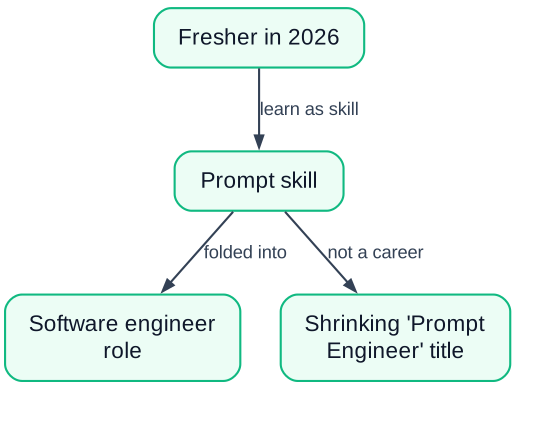
No, you do not need to become a "prompt engineer" to survive AI. Standalone prompt engineer roles dropped by about 30% between 2024 and 2026, while roles requiring prompt skills tripled. The job that pays is software engineer with prompt expertise, not prompt engineer as a title. The 2026 fresher panic says AI turned every engineer into a prompt engineer, but the truth is the opposite: the prompt skill is being folded into broader engineering jobs. What still gets you hired is the ability to verify, judge, and build systems, the skills AI is measurably worst at.
The 2026 debate: software engineer vs prompt engineer for freshers
The debate is real but the framing is wrong: it is not a choice between two career paths, it is a choice between a shrinking title and a growing skill inside a broader role.
Every few weeks another reel tells you that AI has made traditional coding obsolete. The new job, they say, is telling AI what to build. If you are a fresher in India sending out applications, that message lands with force. You are already competing against thousands for every opening. The idea that your entire skill stack is about to be replaced by a text box is terrifying.
The numbers tell a different story. Roles that require prompt engineering skills increased three times between 2024 and 2026, according to pecollective's 2026 guide. At the same time, the standalone "Prompt Engineer" job title decreased by about 30%.
The work moved into wider titles like AI Engineer, LLM Engineer, and AI Solutions Architect. These jobs still require you to understand systems, write code, and debug problems. They just also expect you to know how to work with AI models.
Here is what the panic looks like when you put India's salaries next to global ones:
| Level | India salary (INR) | Global salary (USD) |
|---|---|---|
| Entry / Fresher | ₹3-8 LPA | $90,000-$125,000(pecollective) |
| Junior | ₹5-12 LPA | — |
| Mid-level | ₹8-20 LPA+ | — |
| Senior / AI-focused | ₹15-30 LPA+ | — |
Those Indian figures come from Guvi's 2026 prompt engineer skills guide. The global entry-level figure comes from pecollective. The split matters because the panic you feel is local. A 2025 Stack Overflow retrospective found India had the highest on-site share of developers at 30.5% and the highest share of unhappy developers at 32.7%. You are not imagining the pressure. But the answer is not to abandon engineering.
Prompt engineer is a shrinking title, not a growing career
The standalone "Prompt Engineer" job title decreased by about 30% between 2024 and 2026, even as prompt skills spread into many more roles.
Why did the title shrink? Two reasons. First, writing good prompts became easier as models improved. Second, companies realised that a person who only writes prompts cannot build anything. They need someone who can integrate the model into a product, handle errors, and measure whether the output is correct.
The threefold increase in roles requiring prompt skills shows where the demand actually is. Employers want engineers who can use AI, not people whose only job is talking to it. That is why the title shifted into broader roles.
| Title | What the job actually involves |
|---|---|
| Prompt Engineer | Writes and refines prompts for AI models |
| AI Engineer | Builds systems that use AI models |
| LLM Engineer | Integrates large language models into applications |
| AI Solutions Architect | Designs the overall AI system for a company |
These job descriptions come from pecollective's analysis of the title shift. Notice what the newer titles share: they all assume you can build. Prompt Engineer alone assumes only that you can talk.
What India actually pays for prompt skills in 2026
India's fresher prompt-related roles pay ₹3-8 LPA, junior ₹5-12 LPA, mid ₹8-20 LPA+, senior ₹15-30 LPA+. That is competitive, but only when attached to an engineering role, not as a standalone title.
The Guvi salary breakdown shows prompt engineering is increasingly integrated into broader AI and GenAI roles. The standalone title is becoming rare in Indian job postings too. Employers list "prompt engineering" as a required skill inside AI Engineer or Software Engineer openings.
There is a measurable premium for the skill. AI engineers with prompt expertise earn 15-25% more than those without it. That is the real opportunity: not a new career, but a pay bump inside an existing one.
The other way to read the Indian market is through the Stack Overflow data on developer sentiment. Indian developers are the most on-site and the most unhappy. That combination pushes freshers toward whatever looks like a shortcut. The prompt engineer title looks like a shortcut. The data says it is a detour.
Imagine you have sent 80 applications and heard nothing back. A course promises to make you a certified prompt engineer in four weeks. The title sounds modern. It sounds like the future. But the market is already moving past it. The roles that pay are the ones that ask for engineering fundamentals plus prompt skill.
What the Stack Overflow survey says about AI and your first job
Developers are already using AI daily (73%), but they trust it least with human communication and creative work. That is exactly where you as a junior can still add value. The Stack Overflow 2026 AI survey shows that coding assistants and agents dominate at 66%, beating general chatbots at 63%. Heavy users, people who use AI four or more hours a day, make up 31% of daily users.
Trust follows a pattern. 67% of developers trust AI with familiar code, and 61% use it for debugging and refactoring. But usage collapses when the task involves human communication or creative output. The survey's key line: technologists see AI as "very good at technical problems with checkable answers, and considerably less good at solving the other everyday problems of work."
That sentence is the whole argument for staying in engineering. AI is strong where the answer can be verified. It is weak where the problem involves people and context. Those weak spots are not edge cases. They are most of what a job actually is.
The four skills AI cannot take from you
Verification, judgment, system-building, and communication are the skills AI is worst at, and the ones that make you a real engineer.
What AI does well
- Generating code for familiar patterns
- Debugging and refactoring existing code
- Explaining well-documented concepts
What AI does poorly
- Human communication and collaboration
- Creative problem-solving in new contexts
- Judging which approach is right for the situation
These strengths and weaknesses come from the Stack Overflow 2026 AI survey data on developer trust. The pattern is consistent: the more checkable the answer, the more developers trust AI. The more the task needs judgment, the less they do.
Build your value around AI's weak spots. Here is how:
Verify
Check every line AI writes. Run it, test it, break it. Developers trust AI with familiar code, so your job is to become familiar enough to catch its mistakes.
Judge
Pick the right approach from the options AI gives you. The model lists possibilities. You decide which one fits the constraints of the project.
Build
Integrate the AI output into a working system. A prompt produces text. An engineer produces a product that runs, handles errors, and scales.
Communicate
Developers trust AI least with human communication. Explain what you built, why it matters, and how it fits the team's goals. That skill does not just survive AI. It becomes more valuable. The survey shows usage collapses for human communication.
How to position yourself for your first job in 2026
Learn prompt engineering as a skill layered on software engineering fundamentals, Python, APIs, evaluation, RAG. Do not treat it as a substitute for them.
The skills Guvi lists for AI and GenAI roles are not prompt tricks. They are: LLM fundamentals, Python, API scripting, evaluation metrics, RAG, and automation. Every one of these assumes you can code.
None of that is typing a better prompt. All of it is engineering. Start with core web fundamentals, then layer the AI skills on top.
The market you are entering already reflects this. Roles requiring prompt skills tripled while the standalone title shrank. Employers want the skill, not the label. Build the base first. Read about the junior developer job market in India for 2026 to see what companies actually ask for.
Your next step this week
Your next step this week: open the Stack Overflow 2026 AI survey and read the section on what developers trust AI with. Then pick one small project, a CLI tool or a REST API, and build it using AI as an assistant, not a replacement. Practice verifying every line it writes. That is the skill that gets you hired.
Companies are not looking for someone who can talk to AI. They are looking for someone who can fill real technical roles and use AI to do it faster. If you are worried about software jobs disappearing, the answer is not to switch to a title that is already shrinking. It is to learn the skills that make you harder to replace.
The engineers who survive this shift are the ones who treat AI as a tool, not a career. Learn it well enough to use it without depending on it, and you will be ahead of most applicants.
Your next step this week: open the Stack Overflow 2026 AI survey and read the section on what developers trust AI with. Then pick one small project, a CLI tool or a REST API, and build it using AI as an assistant, not a replacement. Practice verifying every line it writes. That is the skill that gets you hired.


