Gemini 4 Carbon Is Out, But Students Can't Use It Yet
Google launched Gemini 4 Carbon on October 28, 2026, but only security companies get access first. Here's when students can try it, what it costs, and what to learn while you wait.

As of October 28, 2026, Google's announcement page says Gemini 4 Carbon is live. The first people allowed to use it are security teams at a small group of cyber defense companies. Students are not on that list.
You cannot try Gemini 4 Carbon today. Google is releasing it in stages: cyber defenders first, then trusted partners, then developers and consumers. Google gave no date for the wider release. Ars Technica reports it may come "in a couple of weeks" for AI Ultra and Gemini API users, the same path as Gemini 4 Argon.
What Gemini 4 Carbon is built for
Google announced Gemini 4 Carbon as its strongest model, built on Gemini 4 Argon, which came out two weeks earlier.
Google DeepMind's own post names two areas where the model is strongest. The first is security work. The second is long tasks that need many steps in a row, like fixing a bug across several files.
Two frontier models, meaning two of the most capable models a company has, in one month is a fast pace, even for Google. If you started building with Argon, my guide to student projects on Gemini 4 Argon still applies. Carbon sits on top of that model rather than replacing how you call it.
The rollout goes to cyber defenders first
Google is giving the model to a subset of cyber defenders this week, then to trusted partners through the Fairwind Program, and only later to developers and businesses, and then consumers, The Verge reports.
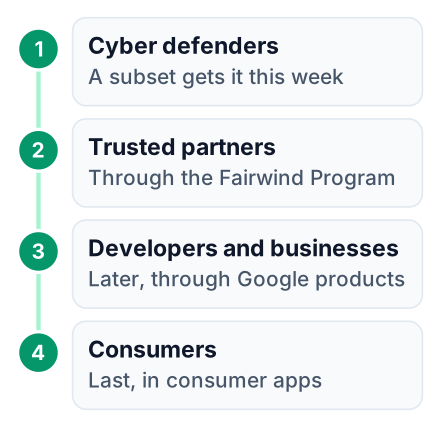
A cyber defender is a person or company whose job is to protect computer systems from attacks. Think of a bank's security team, or a firm that scans other companies' software for holes.
Here is what each stage means for someone outside those teams:
Security companies test it on real systems
They use it on live code, and problems show up before the public sees the model.
Fairwind partners get a wider look
A larger group that Google already trusts tries it in more kinds of work.
Product surfaces open up
This is the stage where students come in, through Google's paid apps and its developer API.
Google also says it is taking part in voluntary pre-release testing with the US government. That means government testers look at the model before the public gets it. It is one more reason the public stage comes last.
Why Google chose security work for the first release
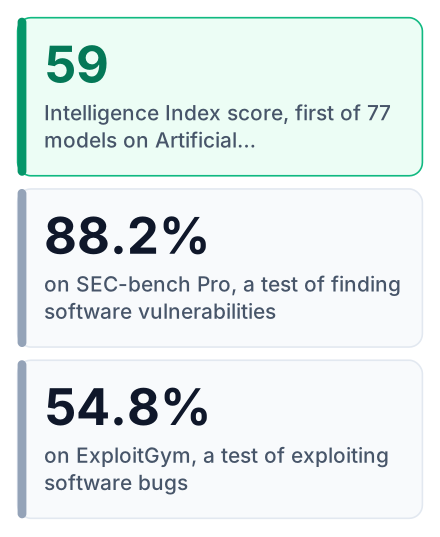
Carbon's biggest gains, according to Google, are in finding, exploiting and fixing software bugs, and a model that can exploit bugs needs careful safety testing before wide release.
A vulnerability is a mistake in code that an attacker can use to break in or steal data. Here are the three scores Google published, with what each one tests:
The middle row explains the slow rollout. A tool that can break into software helps attackers as much as defenders. Giving it to defenders first lets them fix holes before attackers get the same tool. That is my reading of the order, and it matches the stages Google described.
Google also reports more than a 2x improvement in writing secure code over Argon. Its Chrome team says Carbon's patches were 10x better than those from another lab's frontier model, which Google did not name.
Carbon ranks first on the Artificial Analysis leaderboard
Gemini 4 Carbon (High) scores 59 on the Artificial Analysis Intelligence Index, first among 77 models, ahead of Claude Opus 5.5 and GPT-6 Astra, as you can check on the Artificial Analysis leaderboard.
The Verge and Ars Technica report the same ordering.
The leaderboard's cost of $7.76 per benchmark task is the cost of the full test suite, not of one question.
For which Gemini model fits which job, see my comparison of Gemini models for 2026.
What it costs: $2 and $10 per million tokens at first
The introductory API price is $2 per million input tokens and $10 per million output tokens, rising to $4 and $20 after the intro period, which Google declined to give an end date for.
A token is a small piece of text, roughly part of a word. Input tokens are what you send. Output tokens are what the model writes back, and they cost more. Say you send a 1,000-token prompt and get a 500-token reply at the intro price: 1,000 × $2 ÷ 1,000,000 = $0.002 for input, and 500 × $10 ÷ 1,000,000 = $0.005 for output. That is about $0.007 in total, under one cent.
Cached input costs 5% of the normal input price, which is $0.10 per million tokens at the intro rate. Caching means the API stores text you send again and again, such as a long instruction at the top of every request, and charges far less for it. The Verge notes that Argon launched at the same intro price. No source gives a rupee figure, so I am leaving it in dollars.
Pros
- The intro price matches Argon, so a top model costs no extra at first.
- Caching makes repeated instructions very cheap.
Cons
- Both prices double once the intro period ends.
- Nobody outside Google knows when that happens, so a budget can break without warning.
For a price comparison with OpenAI's latest model, see my post on GPT-6.1 Terra pricing for students.
How to get access when the wider release comes
Students will most likely get Carbon through AI Ultra or the Gemini API, the same path Argon took a few weeks ago, based on Ars Technica's reading of the Argon pattern.
Be clear about what that is. It is a reporter's guess from one earlier launch, not a promise from Google. Here is how to be ready on the day it opens:
Watch the official page
Check Google's Carbon announcement page once or twice a week for a wider-release update.
Check the API model list
When Carbon appears in the Gemini API model list, it is open to developers.
Test small and set a spending limit
Send one short prompt first. Set a monthly budget cap in your billing settings before you build anything bigger.
Compare with what you use now
Give the same task to Carbon and your current model. Switch only if the answer is clearly better for your work.
What to learn while you wait
Security-aware coding is where frontier models are heading, so spend the waiting weeks learning to read and review code for bugs yourself.
Say you build a login form for a college project. It works when you type the right password. Have you checked what happens when someone types code into the username box instead of a name? That hole is called SQL injection, and it is the kind of hole Carbon was trained to find. Here is a login query that has it:
query = "SELECT * FROM users WHERE name = '" + username + "'"Paste it into the model you already use with this prompt: "Review this login query for security holes, explain each one, and show a safer version." A good answer says that a username like ' OR '1'='1 changes the meaning of the query, names SQL injection, and fixes it with a parameterised query, where the database receives the username as data and never as part of the command.
Start with CWE, a public list of common software weakness types. Each entry names one kind of mistake, like trusting user input without checking it. Reading a few entries teaches you what to look for in your own code.
- Do: ask the model you already use to review one of your files and explain each problem it finds.
- Do: check its answer against the CWE entry it points to.
- Don't: paste a fix you do not understand. Ask why it works first.
Prompt injection is worth learning too. It is when hidden text in a page or file tricks a model into ignoring your instructions. In one Grey Swan test, where hidden instructions try to trick the model, Ars Technica reports Carbon fell for it 0% of the time, against 8.5% for GPT-6 Astra.
This week, take one login function from your own project, run the review prompt from the example above on it with a model you can already use, and compare the answer with the matching CWE entry for SQL injection.