How to Become a Full Stack Developer After 12th: 4-Year Plan
Your degree name matters less than your employer type. Start with HTML, CSS, and JavaScript in year one, follow roadmap.sh in order, and target a GCC or product company for a higher fresher salary.

Most 12th-standard students spend their first year on one question: "BCA or B.Tech?" Which degree to join and what to learn in which year feels like the biggest decision of your career. The degree matters, but less than you think, and this plan shows what to do with each year of college, semester by semester.
Pick BCA or B.Tech by your 12th stream and family budget, learn skills in the roadmap.sh order alongside your semesters, and choose your target employer type early. The degree name does not set your starting salary. Employer type seems to matter more, though that rests on one salary guide, careerskillguide, so check current offers yourself. A GCC, a Global Capability Centre (an Indian office run by a foreign company), or a product company usually pays a fresher more than an IT services firm. Pay varies by city and college, so treat the figures on this page as ranges.
Choose BCA or B.Tech by your stream and budget
Your 12th stream and your family budget decide the degree, as Sunstone's BCA vs B.Tech comparison shows. The degree name does not decide your skill level. Here is how the two degrees compare.
| Factor | BCA | B.Tech CSE/IT |
|---|---|---|
| Duration | 3 years | 4 years |
| Eligibility | Any stream | PCM in 12th |
| Entrance exam | None | Usually yes |
| Total cost | ₹2.5–4L | ₹5–10L+ |
| Source | Sunstone: IT courses after 12th | |
The choice follows from your situation:
- No PCM in 12th: choose BCA. B.Tech is closed to you, and BCA teaches the same programming basics.
- Tight family budget: choose BCA. You save money and a full year of fees.
- PCM, a budget that fits and a good entrance score: B.Tech opens more campus drives. Either degree can lead to a full stack job.
A full stack developer course after 12th is a supplement to the degree, not a replacement for it. Many employers filter applications by degree first. A course helps you build skills faster, but it will not get you past that filter alone.
BCA ends after three years, so a BCA student should start the job search in year three, not year four. Move the backend and database work into year one and the first half of year two, build the framework project in the second half of year two, and spend year three on applications and interviews. Internships can start in year two or three, and campus drives usually fall in the final year, so ask your placement cell for the dates. The extra year in the plan below is for B.Tech students, or for BCA students who do not get an offer. In that year, build a second project that is harder than your first and apply off-campus with your project links, or consider an MCA. An MCA gives you two more years of study and a postgraduate degree, but it delays your first salary and adds fees, so choose it only if you want the degree itself.
Follow this four-year plan, semester by semester
One table lines up each year of your degree with one skill milestone and ends with the fresher salary band you can aim for, using careerskillguide's fresher salary figures. The skill order comes from roadmap.sh.
The roadmap.sh full stack guide estimates 8–12 months of full-time study for job readiness, and longer for a true beginner. You are studying part-time next to college. That stretches the same work across your degree years, which is why the plan below is paced slowly.
| Year | BCA semesters | B.Tech semesters | Skill milestone | Output |
|---|---|---|---|---|
| Year one | One and two | One and two | HTML and CSS, then JavaScript | A static page and a small JavaScript app |
| Year two | Three and four | Three and four | One backend language and a database | A simple API that saves and reads records |
| Year three | Five and six | Five and six | A full stack framework such as Next.js or Django | One deployed app with a live link |
| Year four | Graduated: skill depth and job search | Seven and eight | Portfolio, applications, first job | A fresher offer |
| Fresher salary target | IT services ₹3.5–5 LPA · Product/startup ₹5–8.5 LPA · GCC ₹6–10 LPA (careerskillguide) | |||
Learn HTML, CSS and JavaScript in year one
Start with HTML and CSS, then JavaScript, because every later skill sits on top of the browser, which is the order roadmap.sh puts first. HTML gives a page its structure. CSS controls how it looks. JavaScript makes it respond when the user clicks or types.
Use semesters one and two for this, at about six hours a week outside class. Plan roughly eight hours a week in year two and ten in year three, then more in your job-search year. A to-do app is a good worked example. It needs three files: index.html for the page, style.css for the styling and app.js for the buttons. Allow one weekend for the page and styling, two weeks for the add and delete buttons, and one more week to put it online:
HTML
Write headings and lists by hand, then add links and forms. Build one static page about yourself.
CSS
Style that page. Learn Flexbox and make the page work on a phone screen.
JavaScript basics
Learn variables and loops, then functions, and practise changing the page when a button is clicked.
First small project
Build a to-do list or a quiz app. Put it online so you can share the link.
The roadmap.sh full stack guide points to free resources for all three. For a structured option, see my list of the best free JavaScript courses for beginners.
Skipping ahead to a framework is the most common way beginners get stuck. Say you start React in your second month. A tutorial tells you to "map over an array", and you do not know what an array is. You copy the code, it breaks, and you cannot tell whether React or JavaScript is the problem. Plain JavaScript first removes that confusion.
Add a backend language and a database in year two
Pick one backend language (Node.js, Python or Java) and connect it to a database so your pages store real data, following the backend step on roadmap.sh. The backend is the code that runs on a server, not in the user's browser. A database is the place where that code saves information, such as users or tasks, so it is still there tomorrow.
Choose one language and stay with it for semesters three and four. When your frontend asks for GET /tasks, the server answers with JSON such as [{"id": 1, "title": "Finish HTML page"}], and your JavaScript turns that into list items. Check your college syllabus first. If it teaches Java or Python, use that language, and your exams and your project work will help each other.
Your year-two target is a small API. An API is a set of web addresses your frontend calls to save and read records. Here is a minimal Node.js route that reads tasks from a PostgreSQL database:
// GET /tasks returns every saved task as JSON
app.get('/tasks', async (req, res) => {
  const { rows } = await pool.query('SELECT id, title FROM tasks');
  res.json(rows);
});
Write the SQL yourself before you try a library that hides it. Knowing what SELECT and INSERT do makes every later bug easier to find.
Build a full stack framework project in year three
A framework such as Next.js or Django lets you ship one complete app that an employer can open in a browser, which is the final build step on roadmap.sh. A framework is a ready-made structure that joins the frontend and the backend to a database in one project.
Use semesters five and six for one app. It needs a login and a database, live at a public link, with the code in a GitHub repository. A recruiter can click the link in a few seconds. Half-built projects give them nothing to click.
One finished project also teaches the hard parts that tutorials skip: deployment, environment settings and fixing bugs that only appear online. Five half-built projects teach you the first week of each skill and nothing past it.
| Framework | Strengths | Trade-off |
|---|---|---|
| Next.js | JavaScript everywhere, so your year-one skills carry over. Fits well if you chose Node.js in year two. Easy to deploy a live link for free. | Many moving parts for a beginner, and the tools change often. |
| Django | Python on the backend, a good match if your college teaches Python. Login and an admin panel come built in. | You still need JavaScript for interactive pages. |
Year three is when internships start for both degrees. Campus drives usually run in the final year, which is semesters seven and eight for B.Tech, so confirm dates with your placement cell. Apply with your project link. My list of companies hiring freshers in 2026 shows where to begin.
Pick your employer type before placement season
Employer type sets your fresher salary, and a startup only beats a services offer if you own production code within the first month, as careerskillguide's fresher comparison argues. Production code is code that real users run every day. Owning it means you write it, ship it and fix it when it breaks.
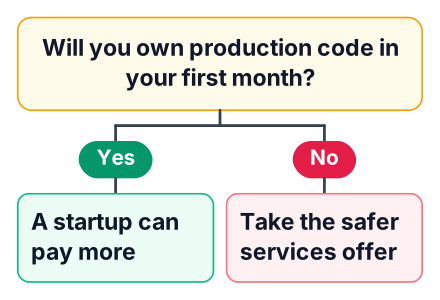
The same source compares a TCS offer of ₹3.8 LPA with a startup offer of ₹6.2 LPA, per careerskillguide. The startup pays more. It is only the better choice if you get real work on the live product from the start. If you will spend months on internal tools nobody uses, the services job with structured training may teach you more.
Look past the first offer, too. The median full stack salary is ₹8.4 LPA across 52,600 AmbitionBox reports, as quoted by careerskillguide. The same page says a React, TypeScript, Node and SQL stack earns a 55–75% premium over jQuery/PHP at 3–5 years. The stack you build in years one to three keeps paying after the first job.
For B.Tech students, this decision falls in semesters seven and eight. BCA students make it in their final year in the same way. If your college is not a top campus, few GCC or product companies will visit it, so plan to apply off-campus. Apply through company careers pages and referrals, and attach your live project link and GitHub repository to every application. Fresher interviews at these employers commonly test programming basics, SQL and how you explain your own project, so be ready to walk through one deployed app, its database and the bugs you fixed. An internship and open-source contributions add proof of skill, and they open doors that campus drives do not. My comparison of a GCC vs an IT services first job goes deeper on that choice, and the front-end fresher salary guide for Bangalore shows how one city changes the picture.
Avoid the common mistakes that stall freshers
Most delays come from switching languages, watching tutorials without building, and not checking an employer's eligibility rules until placement season. Each one has a simple fix:
- Tutorial hopping. Fix: after every tutorial section, build something small without the video open.
- Changing stack every semester. Fix: keep the year-two language until your year-three project is live.
- No deployed project. Fix: put every project online, even a basic one, and add the link to your resume.
- Ignoring eligibility rules. Fix: read a services employer's rules, such as the Infosys eligibility criteria, in year one. Academic gaps are easier to avoid than to explain later.
- Choosing a degree on prestige. Fix: decide on stream and budget. A B.Tech your family struggles to pay for adds stress, not skill.
Your next step is small. This week, check your 12th stream and budget against the BCA vs B.Tech table, pick your degree, and write down how many hours a week you can give HTML and CSS in semester one.