How to Become a Machine Learning Engineer After 12th (2026)
You will almost certainly not be hired as a machine learning engineer straight out of class 12, and that is normal. This guide shows the realistic route: a B.Tech, a first job in a production-data role, and the one skill that raises your pay before graduation.

You will almost certainly not be hired as a machine learning engineer straight out of class 12. You probably won't be hired as one straight out of college either. That is normal, and it is not a failure. This post gives you the route that does work, and explains why your first job should not carry the ML title at all.
Take a 4-year B.Tech after 12th, get a first job in an adjacent production-data role (backend, data or analytics engineering), then move into ML. Before your degree ends, add one skill that raises your pay: MLOps or GenAI.
ML engineer is a second job, not a first one
Hiring data shows that ML engineering is almost never an entry-level title. So your plan after 12th should aim at the second job, not the first.
Here are the numbers. In a study of 13,776 US job postings by Axial Search, entry-level roles were only 3% of ML engineer postings, and even those asked for about 2 years of experience. The median posting asked for about 5 years. The median person entering the role already had 3.7 years of prior experience (Dataquest).
That is US data, but India follows the same pattern. Indian salary data groups entry-level ML engineers as people with 0 to 2 years of experience (OwnYourCareer). Most people in that group got their first experience in a nearby role and then moved across.
A production-data role is a job where you write code that works with real data on live systems used by real people. Backend developer, data engineer and analytics engineer are all examples. You learn how data moves and how it breaks. You also learn how it gets fixed. That is most of what ML engineering involves day to day.
Choose a B.Tech over a B.Sc after 12th
Choosing a 4-year AICTE-recognised B.Tech gives you better campus placement reach and a higher entry salary than a 3-year B.Sc. If you can get a B.Tech seat, take it. Seats usually come through entrance exams such as JEE Main, your state's CET or BITSAT, which generally need Physics, Chemistry and Maths in class 12, so check each exam's eligibility early. If you cannot get a top-tier seat, a solid college with real campus drives plus strong projects still works for this route.
| Point | B.Tech CSE | B.Sc Computer Science |
|---|---|---|
| Duration | 4 years, AICTE-recognised | 3 years |
| Campus drives for ML hiring | Top employers recruit through B.Tech drives | Fewer drives open to you |
| Typical entry salary | ₹6–12 LPA | ₹4–8 LPA |
Source: XIM University, a single university's own comparison, so read the table as one university's view and not a national average. Salaries and drives vary a lot with college tier, which often matters more than B.Tech versus B.Sc, so check the published placement figures of the specific colleges you are considering (for example NIRF data).
The degree matters in hiring. In US data, 79% of ML engineer postings ask for a degree (Dataquest). PhD mentions rise from 28% at mid-level to 33% at Principal level, which means a PhD matters near the top, not at the start. A bachelor's degree plus work you have actually shipped clears the entry bar.
An honest caveat: a B.Sc student can still become an ML engineer. You will need more projects and more off-campus applications, and the route takes longer. Many campus drives list a B.Tech as the eligibility rule, so a B.Tech can remove one obstacle early, but check the eligibility page of each company you care about before you assume it.
If you are still deciding on a stream, my post on becoming a data analyst after 12th commerce covers a nearby route that does not need a B.Tech.
Learn Python, SQL and math basics in your first two years
Python and SQL are the base layer. Math and core ML ideas come after you can write programs that work.
Among US ML engineer postings, 79.4% mention Python (Dataquest). It is the language you will use every day. SQL comes next, because almost every company keeps its data in a database.
Here is the order I would follow:
Python
Write small programs: read a file, clean the data, print a result.
SQL
Learn to select rows from tables, then filter them, and join and group them.
Statistics and linear algebra basics
Mean, variance, probability, vectors and matrices. Learn just enough to follow what a model does.
scikit-learn
Train your first models with the scikit-learn's official getting-started guide, which walks through a first model step by step.
Skip the paid certificates. The top 8 certification names each appear in 0.1% or fewer of postings (Dataquest). Employers barely ask for them. Put that money and time into projects.
For a full list of what freshers are expected to know, read skills required for an AI engineer fresher in 2026.
Build two projects that run in production, not just in a notebook
Employers want proof that you can ship. Deploy two small projects that other people can actually use.
A notebook project shows you can train a model. A deployed project shows you can keep it running. Say you build a model that predicts whether a used phone listing is overpriced. Don't stop at the accuracy score. Put the model behind an API, which is a web address other programs can send data to and get a prediction back. Log every request and track whether its predictions start drifting, meaning the real data slowly stops looking like your training data, so predictions get worse.
That last part matters. Monitoring and observability appear in 38.5% of US ML postings (Dataquest). Few student projects include it, so yours will stand out.
A minimal prediction endpoint with FastAPI, a Python framework for building web APIs, looks like this:
import logging
import joblib
from fastapi import FastAPI
from pydantic import BaseModel
logging.basicConfig(level=logging.INFO)
app = FastAPI()
model = joblib.load("model.joblib")
class Listing(BaseModel):
    price: float
    age_months: float
    storage_gb: float
@app.post("/predict")
def predict(item: Listing):
    features = [[item.price, item.age_months, item.storage_gb]]
    result = model.predict(features)[0]
    logging.info("input=%s prediction=%s", item.model_dump(), result)
    return {"overpriced": bool(result)}
Put both projects on GitHub with a clear README: what the project does, how to run it, and a link to the live version. If a company sends you a take-home task, these projects are your practice. My guide on passing a take-home coding assignment shows how to present that kind of work.
Take an adjacent production-data role first
Aim your campus and off-campus applications at backend, data engineer or analytics roles. Apply at product firms and at IT services firms like TCS and Infosys, then move toward ML from there.
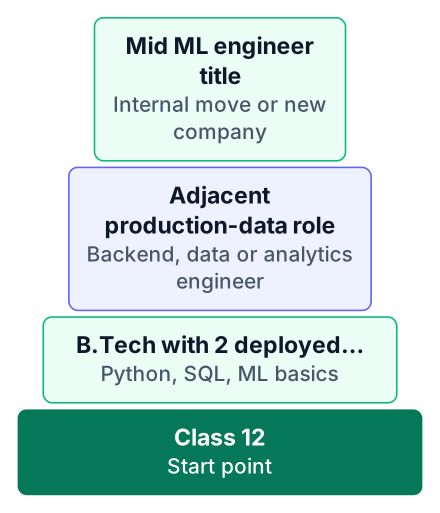
The sequence is deliberate. First the B.Tech. Then an adjacent production-data role. Then either a sideways move into an ML team inside the same company, or an ML engineer title at your next job. In that first role you learn data pipelines and deployment on real systems, which a college lab rarely teaches.
Pros
- You get hired sooner, because far more entry-level roles exist.
- Your experience counts toward the years ML postings ask for.
- Internal moves to ML teams are often easier than outside applications.
Cons
- Your first title will not say "ML".
- You must keep building ML skills outside your daily work.
- Some services roles involve little data work, so choose carefully.
Holding out for an ML title on day one usually means months of applications that go nowhere. For a list of roles freshers can realistically get, see entry-level tech roles for freshers in India in 2026.
Stack MLOps or GenAI before your degree ends
In India, GenAI adds about ₹7L, MLOps about ₹5.5L and PyTorch about ₹4.5L to an ML engineer's pay. These uplifts are reported for people already working as ML engineers, not for fresh graduates, so treat them as a guide to which skill the market rewards later. Pick one of them to add on top of the basics.
| Level | Experience | Salary band |
|---|---|---|
| Entry | 0–2 years | ₹10–18 LPA |
| Mid | 3–5 years | ₹28–42 LPA |
| Senior | 6+ years | ₹42–80 LPA |
| Skill | Pay uplift | Share of job descriptions |
|---|---|---|
| GenAI / LLMs | +₹7L | 42% (OwnYourCareer) |
| PyTorch | +₹4.5L | 58% (OwnYourCareer) |
| MLOps / Kubeflow | +₹5.5L | 28% (OwnYourCareer) |
Source for both tables: OwnYourCareer, ML Engineer Salary India 2026.
The same source reports that MLOps and model-serving skill carries a 15–30% pay premium over backend software engineers at Indian product companies (OwnYourCareer). The US side points the same way, since employers there also ask for the monitoring skills covered earlier (Dataquest).
My pick is MLOps. It is the work of deploying models, watching them and retraining them, and it builds directly on the backend or data job you take first. Deployment and monitoring work also shows up in many backend and data job descriptions, so it helps you in your first job, not only your second. GenAI pays slightly more today and is a fair choice if you would rather work on LLM products, but MLOps fits the second-job route better.
Mistakes that slow this path down
The common mistakes are skipping the degree, chasing certificates, and refusing every job that is not titled ML engineer.
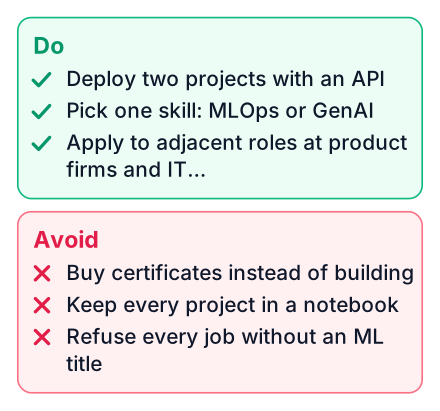
- Don't: buy certificates. Do: build projects.
- Don't: stop at a notebook. Do: deploy the model behind an API with logging.
- Don't: learn many tools at once. Do: learn one tool well, then add the next.
- Don't: wait for the perfect ML offer. Do: take a good data or backend role and move later.
Each fix is small. Together they save you a year or more.
What does an ML engineer earn in India?
Pay rises steeply with experience, from ₹10–18 LPA at entry level to ₹28–42 LPA at mid level, so the second-job route pays off (OwnYourCareer).
Read the entry band carefully: 0–2 years of ML experience is not the same as being a fresher with no experience, and a fresher in a backend or data role may start below it, so compare current backend and data engineer offers on the same site before you rely on it (OwnYourCareer). Most people reach the entry band after time in an adjacent role, not straight from campus.
Treat these as source-reported ranges. A large product company and a small services firm can pay very differently for the same title. Use them to compare offers, not as a promise.
If you are choosing a college, check this week whether the B.Tech colleges on your list run campus drives that hire for data or ML roles, and write down the placement numbers they publish. If you are already in college, start a Python course this week and, once you can write small programs, pick your first small project.


