How to Become a Cloud Engineer After 12th in 2026
You can become a cloud engineer after class 12 by choosing a B.Tech in CSE or IT, learning Linux, networking, Python and SQL in year one, and earning one foundation cloud certificate by year two. Entry-level cloud jobs in India start around ₹4 to ₹8 LPA.

Say you finish class 12 with PCM marks, a laptop and zero coding experience. Many cloud roadmaps open with "learn Kubernetes", a tool for running many app containers at once, which is hard to use when you have never written a line of code. That is a strange place to begin. So what should you learn first, and in what order, to get from a blank laptop to a first cloud job?
Pick a B.Tech in Computer Science or IT, learn Linux and networking first and then Python in year one, and earn one foundation cloud certificate by year two. Then build real projects on one cloud platform. Most freshers in India start at ₹3 to ₹5 LPA according to upGrad, while Polaris Campus puts the range at ₹4 to ₹8 LPA, so treat ₹8 LPA as the top end. You choose one platform and one focus year, not everything at once.
Choose a B.Tech stream that qualifies
PCM in class 12 is the standard eligibility for B.Tech in Computer Science, IT, or a cloud-computing specialisation, and students without PCM can use diploma-to-degree routes. That route means a diploma in engineering first, then a lateral entry into a degree.
These streams qualify:
- B.Tech CSE (Computer Science and Engineering), the most common choice.
- B.Tech IT (Information Technology), with a very similar syllabus.
- CSE with a cloud specialisation, sometimes named "cloud computing" or "cloud and big data".
My view: take a general CSE or IT degree unless the specialised one is at a clearly better college. The cloud part is the easiest piece to learn on your own. Strong programming and networking teaching is harder to replace.
Pros
- A cloud specialisation puts cloud subjects in your timetable from early on.
- You get lab time on cloud tools without arranging it yourself.
- Your degree name tells recruiters your interest at a glance.
Cons
- Compared with general CSE, it is harder to switch to other roles later.
- Some colleges add the label without good teachers or labs behind it.
- Cloud tools change fast, so a syllabus can be out of date by year four.
If you do not get a CSE seat or do not have PCM
The B.Tech route usually runs through entrance exams. JEE Main is the national one, and some states run their own, such as WBJEE in West Bengal, so check each college's admission page for the exam and cut-off it accepts.
If you miss a CSE seat, you still have routes. A BCA or a B.Sc in Computer Science is a three-year degree, and many colleges accept students from any stream, though the rules differ by college. A diploma in engineering followed by lateral entry into a degree is the route Polaris Campus mentions for students without PCM. Whichever you choose, the same basics and the same foundation certificates apply, and projects you can show count the most.
Learn Linux and networking, then Python and SQL, in year one
These four basics matter more than any cloud tool, because every cloud service is built on them. Polaris Campus calls them non-negotiable for the early years of your degree. Most cloud servers are Linux computers on a network, so you need to know both of these.
Here is the order I would learn them in, with one small task each:
Linux and the command line
The command line is where you type commands instead of clicking. Install Ubuntu on a spare laptop or in a virtual machine. Then write a short shell script (a file of commands that runs in one go) that backs up a folder.
Networking basics
An IP address is a computer's number on a network. A subnet is a smaller block of those addresses. DNS turns a name like devhives.in into an IP address. A firewall is a set of rules deciding which traffic gets in. Task: look up a website's IP address from your terminal and trace its route.
Python
Learn one language well, and Python is the most common one in cloud work. Task: write a script that reads a log file and counts the errors in it.
SQL and databases
You use the SQL language to ask a database for the data you want. Task: build a small table of your class marks and write queries for the top scorers.
Do not rush this year. If a later lab breaks, the fix is almost always in one of these four areas.
Pick one cloud platform and one first certificate
The three foundation certificates differ mainly in which kind of employer they point to, so choose by the jobs you want. All three are beginner exams. Polaris Campus says none of them needs prior experience.
| Certificate | Exam cost | Prep time | Prior experience | Employers it points to |
|---|---|---|---|---|
| AWS Certified Cloud Practitioner (CLF-C02) | $100 USD, roughly ₹8,500 to ₹9,000 at recent exchange rates, so check the rate on the day you book (AWS official page) | 4 to 8 weeks (Polaris) | None needed | Broad starter, most job listings |
| Microsoft Azure Fundamentals (AZ-900) | Priced by country and region (Microsoft Learn) | 4 to 8 weeks (Polaris) | None needed | Large enterprises and BFSI companies |
| Google Cloud Digital Leader | Set by Google and varies by country, so confirm the price for India on Google's certification page before you book | 4 to 8 weeks (Polaris) | None needed | Data-heavy and AI-heavy roles |
BFSI means banking, financial services and insurance. Many Indian service companies place freshers on projects for these clients. Microsoft shows the AZ-900 price only after you pick your country, so check it there for India.
For most readers, I would start with AWS. The Cloud Practitioner exam has 65 questions, and the certificate stays valid for 3 years. That covers most of your degree if you take it in year two.
Practise on free AWS labs before you pay for anything
AWS gives free prep through Skill Builder courses, Builder Labs, Cloud Quest and SimuLearn, so you can build hands-on skill before spending on the exam. Skill Builder holds the video courses. Builder Labs and Cloud Quest put you inside a real AWS setup with a task to finish. SimuLearn adds practice with customer-style problems.
Do this in the first half of year two. Once a few labs feel easy, try this on your own account:
- Create an AWS account and set a billing alert first. In the Billing console, create a budget that emails you when spending goes above a small amount.
- Launch one small server. Open EC2 (AWS's virtual server service), pick a Linux image marked free-tier eligible and start it.
- Put a web page on it. Connect from your terminal, install a web server and copy in a simple HTML file.
- Open it in a browser. Allow web traffic in the security group (the server's firewall), then visit its public IP address.
- Shut it down. Terminate the server and check that nothing else is still running.
That last step is the one beginners skip. A server you forgot about keeps charging you while you sleep.
Build real deployments in years two and three
Employers look for projects you deployed yourself, not copies of tutorials. Polaris Campus lists the kinds that count: a multi-tier web app with monitoring, plus Terraform and a CI/CD pipeline. A multi-tier app has its parts on separate layers, like a frontend, a backend and a database.
One project can hold all four ideas. Its parts could look like this:
my-cloud-project/
  app/                       # small Python web app plus a database
  terraform/                 # code that creates the servers and network
  .github/workflows/deploy.yml   # CI/CD: test and deploy on every push
  monitoring/                # alerts when the site goes down
Terraform lets you write your servers as code, so you can delete everything and rebuild it with one command. CI/CD means your code is tested and deployed by itself each time you push a change. If you want a stronger frontend for this app, the full-stack developer roadmap covers that side.
These tools also show where cloud work meets DevOps. Polaris Campus draws the line this way: a cloud engineer designs and manages the infrastructure, while a DevOps engineer automates the deployment pipelines. The tools overlap a lot. If the pipeline part excites you more, read the DevOps engineer path after 12th. If the infrastructure side feels dull, the AI engineer path after 12th without JEE may suit you better.
Most freshers start at ₹3 to ₹5 LPA, and ₹8 LPA is the top end
Most freshers in India start at ₹3 to ₹5 LPA, and product companies can pay up to ₹8 LPA. Polaris Campus gives ₹4 to ₹8 LPA for entry-level cloud engineers, while upGrad gives ₹3 to ₹5 LPA, and I plan around the lower figure. The same source names Bengaluru, Hyderabad and Pune as the highest payers. It puts mid-career pay at ₹15 to ₹32 LPA in product companies.
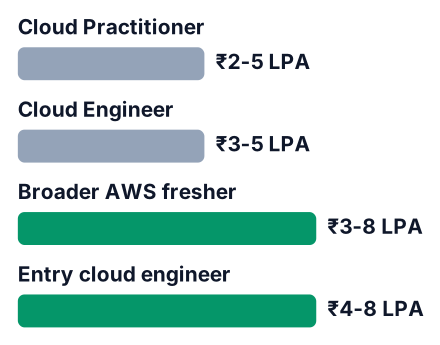
Other sources give lower fresher numbers. Here is what upGrad reports for fresher AWS roles:
| Fresher role | Range (upGrad) |
|---|---|
| Cloud Practitioner | ₹2 to ₹5 LPA |
| Cloud Engineer | ₹3 to ₹5 LPA |
| DevOps Engineer | ₹4 to ₹5 LPA |
| Fresher AWS roles overall | ₹3 to ₹8 LPA |
The sources differ, and I would plan around the lower end. A mass-recruiter campus offer often sits there, while a product company in a metro pays toward the top.
A year-by-year target keeps you on track:
- Year one: the four basics above.
- Year two: your first foundation certificate.
- Year three: one deployed project and an internship.
- Year four: campus placements and off-campus applications.
Common mistakes that slow you down
Most delays come from collecting certificates without building anything, or switching clouds every month. Watch for these:
- Learning three platforms at once. The ideas carry over between clouds, so master one first.
- Skipping Linux and networking. You will pass the beginner exam and then fail the interview questions.
- Memorising exam dumps. Dumps are leaked question sets. They get you a badge you cannot explain.
- Copying tutorials without changing them. Add one feature the tutorial did not have, and write down why.
If you read this far and found the infrastructure side dull, that is useful to know early. The AI engineer path after 12th without JEE may suit you better.
This week, pick one platform (AWS is the simplest start), make a free account with a billing alert, and finish one Skill Builder or Cloud Quest lab. Then write the date you will sit your first foundation exam.


