How to Become a DevOps Engineer After 12th in 2026
You can become a DevOps engineer after 12th without a degree, but not by applying for that title first. Start with Linux, cloud and CI/CD basics, deploy real projects, and enter through an internship, cloud support or a startup.

Say you search for DevOps jobs after 12th and find a page of postings titled "DevOps Engineer." You open the requirements one by one, and the experience line asks for more than you have, posting after posting. That mismatch is the first thing nobody tells a fresher.
You can become a DevOps engineer after 12th without a degree, but not by applying for that title first. Start with Linux and CI/CD basics, then deploy real projects, and enter through an internship or a cloud support role at a startup. Plan on nine to twelve months at about ten hours a week, close to the 9-month phased roadmap in this DEV Community guide.
DevOps is not really an entry-level job
Most postings titled "DevOps Engineer" expect a year or more of development or support work, so freshers rarely get that title as their first job. Anvil Career makes this point plainly in its guide for freshers.
The reason is the work itself. A DevOps engineer keeps software running and ships changes without breaking it. Companies give that job to someone who has already seen servers fail at night. A posting that says "fresher" often wants a developer who also knows servers.
This is good news for you. The DevOps engineer career path is built on skills you can show in public. At a startup, a hiring manager reading your pipeline file cares less about which college you went to.
Learn Linux and networking first
Linux commands and the file system come first, then permissions and basic networking. Together they are the base that every later DevOps tool sits on. The free DevOps roadmap on roadmap.sh starts here too, and it is the map I would follow from day one.
Keep the first six to eight weeks to this list:
- The terminal: move between folders, read log files, and search text with
grep. - Bash scripting: write small scripts that use variables and loops.
- SSH: log in to a remote machine with a key instead of a password.
- DNS: how a name like devhives.in turns into an IP address.
- HTTP and ports: what a web request looks like, and why a server must listen on an open port.
Practise on a real machine, not only in videos. Install Ubuntu in VirtualBox on your laptop, or open a free-tier cloud VM. If your laptop is short on memory, the cloud VM is easier. Break things on purpose: remove a file permission, then work out how to fix it.
Add Git, Docker and CI/CD pipelines
Once you can use Linux, package an app in Docker and make GitHub Actions test and ship it on every push. The DEV Community roadmap for Indian freshers puts Docker in the phase right after Linux.
Git comes first. Learn to commit, make a branch, merge it, and open a pull request. Then write a Dockerfile for a small Node or Python app. It is a short text file: pick a base image, copy your code in, install packages, and set the start command.
The pipeline is where it starts to feel like DevOps. This file, saved as .github/workflows/ci.yml, runs on every push:
name: ci
on: push
jobs:
  build:
    runs-on: ubuntu-latest
    steps:
      - uses: actions/checkout@v4
      - uses: actions/setup-node@v4
        with:
          node-version: 20
      - run: npm ci
      - run: npm test
      - run: docker build -t my-app .
GitHub starts a fresh Ubuntu machine, installs your packages, runs the tests and builds the image. If a test fails, the run stops and you get an email.
Terraform and Kubernetes come after this, not before. Kubernetes runs many containers across many machines. That problem makes little sense until you have run one container yourself.
Deploy two real projects on AWS
In my view, two deployed projects with a public link and a short README prove more to a startup than a list of tools you have only read about. SwitchtoDevOps's India guide notes that startups screen for breadth, and one live project shows breadth in a single link.
Build a small app
A to-do API in Node or Python is enough. The app is not the point, so keep the code simple. If writing the app itself is new to you, the full-stack developer after 12th roadmap covers that part.
Containerise it
Write the Dockerfile and run the container on your own machine until it starts cleanly every time.
Deploy it to AWS with a pipeline
Run it on a small EC2 instance. Extend your GitHub Actions file so a push builds the image and deploys it.
Add basic monitoring
Prometheus collects numbers like request count and memory use. Grafana draws them as graphs. A dashboard screenshot makes the project look like a real system.
Write the README
Say what the app does and how the pipeline works. Add how to run it, and one thing that broke and how you fixed it.
Make the second project different from the first. Add a database, or create the servers with Terraform instead of clicking in the AWS console. Pin both repos on your GitHub profile. On the resume, give each project its name, the live link, and one line about the pipeline.
Pick certifications by cost and real job impact
AWS certifications help a no-degree fresher only a little, so buy the cheapest useful one first and let projects carry the rest. The AWS Certified Cloud Practitioner exam costs $100 and has 65 questions in 90 minutes. AWS says it needs no prior IT experience.
| Certification | Cost | What it covers | Honest fresher job impact |
|---|---|---|---|
| AWS Cloud Practitioner | $100 (AWS) | Cloud basics, core AWS services, billing | Small. Shows you know the words recruiters search for. |
| AWS Solutions Architect Associate | Higher than Cloud Practitioner; check the AWS exam page | Designing systems on AWS | Moderate, but only when projects back it up. |
| CKA (Certified Kubernetes Administrator) | The most expensive of the three | Running Kubernetes clusters by hand | Low before a first job. Useful once you work with Kubernetes daily. |
You pay these fees in US dollars, so you usually need an international debit or credit card, and your bank converts the amount into rupees. Check the live exchange rate and the official exam page for the current price before you book, because the rupee cost changes. My advice: take Cloud Practitioner first. Save the other two for after your first job, or for when an employer asks and offers to pay.
Enter through support, QA or internships, not the DevOps title
The realistic first jobs are Cloud Support Associate, a QA or NOC role you move out of later, or an internship. SwitchtoDevOps lists these routes, plus an internal move once you are inside a company.
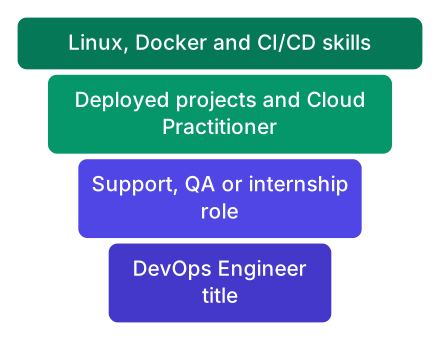
Each route teaches you something different:
- Cloud Support Associate: you debug other people's servers and network problems, and read logs under time pressure.
- QA automation: you write automated tests and run them in pipelines. This is the closest to CI/CD work.
- NOC (network operations centre): you watch alerts and handle outages as they happen.
- Startup internship: you touch a bit of everything, because the team is small.
Pros
- You work on real systems with real users.
- You learn on-call work, which DevOps teams value.
- In my view, the hiring bar is lower for a no-degree fresher here than for a DevOps title.
Cons
- Pay is often lower than a developer role, which is my own read and not a sourced figure.
- Shift work and night rotations are common.
After about a year, start the internal move. Ask the DevOps team for one small pipeline task. Automate a manual step in your own job and show the result to their lead. Internal moves are easier because the team already knows your work.
Target startups before big service companies
Large IT services firms often screen CVs by degree and percentage, while startups and product companies look at what you have built. SwitchtoDevOps's India guide confirms that some service companies still filter on degree at the CV stage.
Some service companies filter on degree at the CV stage. Without a degree, put your effort into referrals and startup job boards, where a person is more likely to open your GitHub link.
Plan around ₹3.5 to 6 LPA as a fresher DevOps salary, which is the range in the SwitchtoDevOps salary guide. The same guide puts product companies higher, at ₹5 to 8 LPA. A DEV Community article gives a wider ₹4 to 8 LPA, so the two overlap. Neither source separates degree and no-degree pay, so treat these as the range for freshers in general.
City changes the figure as well, but be careful with averages. The same salary guide lists an average of ₹9.3 lakh in Bengaluru against ₹7.9 lakh in Chennai. These are city averages, not fresher figures, so do not read them as a first offer. For a sense of how this compares with another track, see the ML engineer fresher salary breakdown.
Mistakes that slow down a fresher
The common mistakes are collecting certificates without projects and starting with Kubernetes. Applying only to roles titled "DevOps Engineer" is the third.
- Certificates without projects. Fix: for every certificate, have one deployed project that uses what it tested.
- Kubernetes first. Fix: run one container on one machine before you learn to run many.
- Searching only one job title. Fix: also search Cloud Support, QA automation, build and release, and SRE intern.
- Reading an average as an offer. The Glassdoor average of ₹9.65 lakh, from 15,085 salaries, mixes in senior engineers (SwitchtoDevOps). Fix: judge an offer against the fresher band above.
- Copying tutorial projects unchanged. Fix: change one real thing and explain why in the README.
If you are still choosing a path, the machine learning engineer after 12th route is the other one I have mapped. DevOps is about infrastructure and shipping code, while ML is about models and maths.
This week, install a Linux virtual machine or open a free cloud VM. Write a ten-command bash script that sets up a small web server. Push it to GitHub, as the first commit of your first project.


