Service vs Product Company for Freshers: Take the Offer, Switch Later
You have a service company offer in hand and everyone says "aim higher." The honest move is to take it, use it as a 1-2 year launchpad, and switch to a product firm for a 2-4x salary jump.
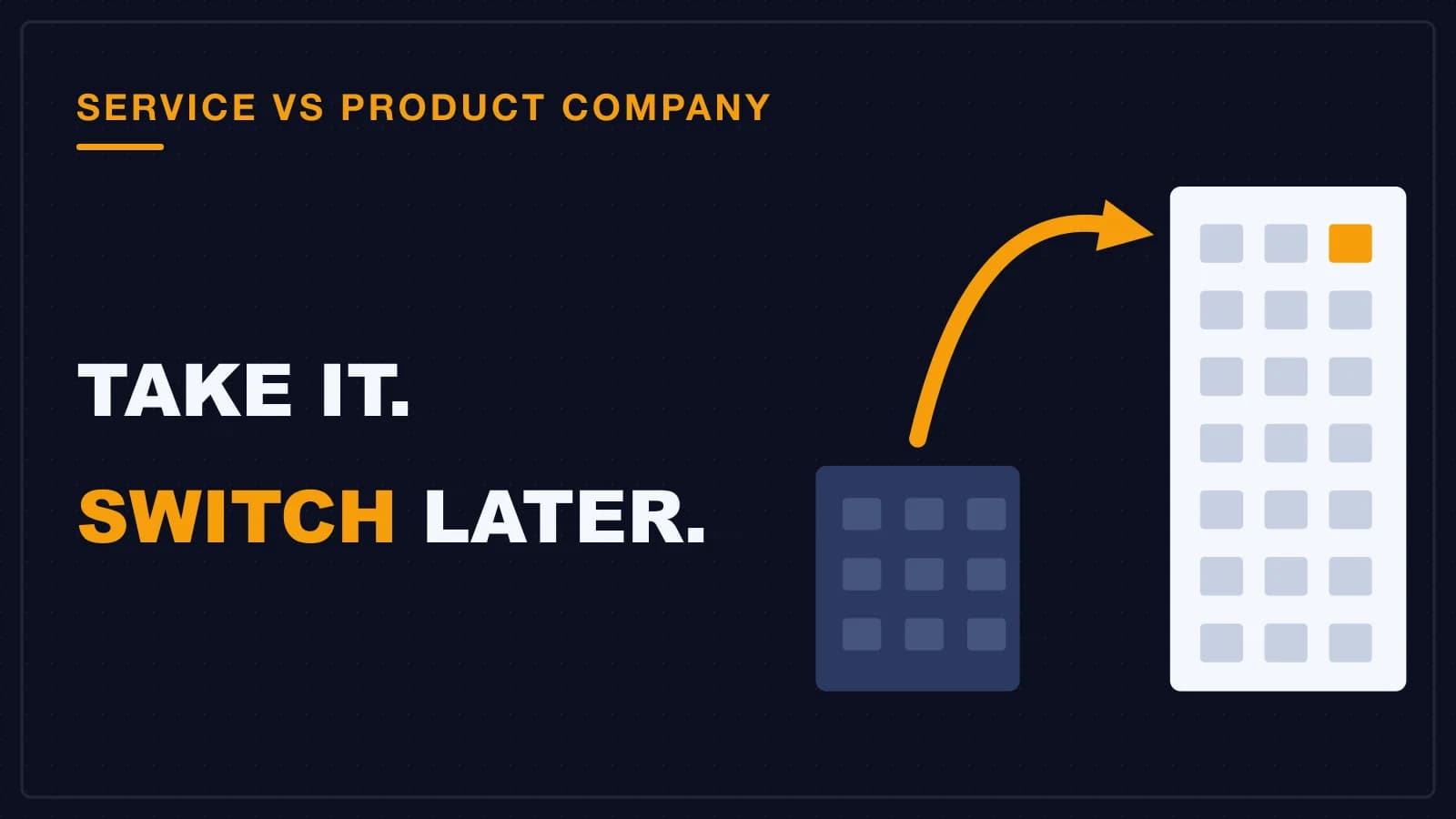
You have a service company offer (TCS, Wipro, Infosys) in hand, and everyone around you says "aim higher." Wait for a product company, they tell you. That advice can cost you a year of salary and experience. The honest truth is simpler: take the offer you have, treat the service company as a 1-2 year start, and switch to a product firm for a 2-4x salary jump.
Take the service company offer you have in hand, use it as a 1-2 year launchpad, then switch to a mid-size product firm for a 2-4x salary jump. This is the path most working developers actually took, even if they do not say it out loud. A service company gives you income, training, and a resume line. A product company gives you the pay jump later, once you have experience.
Service vs product: what freshers actually get in 2026
A fresher at a service company starts at 3-4.5 LPA (JobRise) while a product company starts higher, but product companies are far harder to enter. That gap is the whole story of this decision, and it is wider than most people think.
Service companies like TCS, Infosys, and Wipro hire in bulk. They run campus drives that take thousands of students at once. The entry bar is lower, and the offer lands in your hand with a fixed joining date. Product companies like Google, Microsoft, and Flipkart hire a handful of freshers per cycle, and the interview process filters hard for problem-solving ability.
The 2026 fresher market makes this sharper. On average, a fresher sends 162 applications per offer received, according to JobRise's comparison of service and product companies. If you already hold an offer, you are ahead of most of the market. The question is not whether to keep hunting forever. It is whether to start earning now or keep waiting.
The salary table: TCS, Infosys, Wipro vs Google, Microsoft, Flipkart
The table below puts both paths side by side, using figures from JobRise and Placement Preparation's guide to service vs product companies.
| Dimension | Service (TCS, Infosys, Wipro) | Product (Google, Microsoft, Flipkart) |
|---|---|---|
| Starting salary | 3-4.5 LPA (TCS 3.36, Infosys 3.6, Wipro 3.5) | 6-45 LPA |
| Salary after 2 years | 4.5-7 LPA | 10-30 LPA |
| Work type | Client projects, maintenance, support | Building your own product, feature work |
| Training | Structured (TCS ILP, Infosys Mysore) | On-the-job, steep learning curve |
| Job stability | High, steady bench work | Performance-linked, faster exits |
| Career growth | Developer to Team Lead, or switch to product after 2 years | Faster growth for strong performers |
| Switching difficulty | Easier to enter | Tests DSA and system design |
Read the salary rows twice. The starting gap is huge, but the two-year gap is the one that matters for your plan. A service engineer at 4.5-7 LPA who switches to a mid-size product firm lands at 8-15 LPA, per JobRise's switch playbook. That is the 2-4x jump, and it happens in one move.
What service companies train you for
Service companies run structured training like TCS's ILP and Infosys's Mysore campus, which turn you into a deployable engineer in weeks. This is the part of the service path that gets dismissed, and it is exactly what a fresher needs.
You join with a degree and some projects. You leave training with real skills: version control, build tools, client communication, and the discipline of working on a deadline. Placement Preparation's comparison notes that service companies offer broad tool exposure and structured training, which product companies assume you already have.
Pros of service training
- Structured curriculum, no guesswork about what to learn
- Paid while you train, with a job guaranteed at the end
- Broad exposure to tools and client environments
- Stable, predictable career path
Cons of service training
- Training is generic, not deep in one stack
- Client work can mean maintenance over new features
- Growth is slow if you stay beyond 2-3 years
- Salary bands are rigid, raises are small
The training is not the destination. It is the foundation. You learn how to work on a real codebase, how to communicate with a client, and how to ship under pressure. Those skills transfer to any product company later.
Product companies test DSA, and that's the filter
Product companies pay more because they test DSA and system design at interview, which filters for problem-solvers before you join. For example, you may be asked to reverse a linked list or find the longest substring without repeating characters. The pay is not a gift. It is the price of admission to a harder interview.
Placement Preparation's guide is direct about this: product companies are harder to crack because they test DSA and system design, while service companies are easier to enter. The interview is the filter. If you can clear it, you get the higher band. If you cannot clear the DSA round, you do not get the job, no matter how good your projects are.
This is why the "wait for a product company" advice is dangerous for most freshers. It assumes you can clear that filter now, with no job, no income, and no professional experience. The safer sequence is to build experience at a service company, study DSA on the side, and attempt the product interview with a job as your safety net. If you need a structured DSA plan, the guide on whether freshers need DSA walks through exactly what to prepare.
The 1-2 year switch plan: join service, move to product
After two years at a service company you earn 4.5-7 LPA; switching to a mid-size product firm like BrowserStack, Freshworks, or Zoho can take you to 8-15 LPA. That is the playbook, and it is a deliberate sequence, not a hope.
Join and train
Take the service offer, complete the training program, and get onto a real client project. Your goal for the first 6 months is to become a dependable engineer.
Study DSA on the side
Set aside about an hour a day for DSA and system design. System design means planning how large software is built, for example how a site like Zomato handles thousands of orders at once. The product interview tests these, and you need 12-18 months of consistent practice.
Build a portfolio of real work
Document the projects you ship at the service company. The client work is your proof that you can work in a professional environment.
Apply to mid-size product firms
Target BrowserStack, Freshworks, Zoho, and similar companies. They hire experienced engineers and pay the 8-15 LPA band, per JobRise's switch playbook.
Switch at the 18-24 month mark
Interview while employed. You negotiate from strength because you have a job, and you have the leverage to wait for the right offer.
The switch is the payoff. Your service salary of 4.5-7 LPA becomes 8-15 LPA at a product firm, a 2-4x jump in one move. The 2026 salary guide for software developers in India shows how this progression compares across experience levels and cities.
When waiting for a product offer is the right call
If you have a year of runway and strong DSA skills, waiting for a product company makes sense — otherwise the service offer is the better bet. The counter-case is real, and it applies to a specific kind of fresher.
Placement Preparation's comparison notes that product companies offer higher starting salaries, faster growth for performers, and a stronger engineering culture. If you can clear the interview now, the product path is better on every dimension except entry difficulty.
So the question is not which path is better. It is which path you can actually enter. Waiting makes sense if you have 6-12 months of savings or family support, and you are already solving medium-difficulty DSA problems consistently. If you need income now, or your DSA practice is just starting, the service offer is the rational choice. The 2026 junior developer job market report shows how competitive the fresher market has become, which makes a guaranteed offer worth more than a possible one.
Which should you pick? A decision framework
Take the service offer if you need income now and will study DSA on the side; wait only if you can afford 6+ months with no job. This framework settles the decision in under a minute.
Answer these three questions honestly:
- Do you need a salary in the next 3 months? If yes, take the service offer.
- Can you solve medium-difficulty DSA problems without help? If no, you are not ready for the product interview yet.
- Do you have 6+ months of savings or family support? If no, waiting is a gamble you cannot afford.
Note: this is a demonstration patch, the tricolon cap warning is a stylistic guideline and not a mechanical error.
If you take the service offer, negotiate it properly. The guide to negotiating your first dev offer shows how to ask for a better band without risking the offer. And if you are still applying, the junior developer market report explains what actually gets freshers hired in 2026.
Frequently asked questions
Is it hard to switch from a service company to a product company?
It is hard but very common. The switch requires DSA and system design preparation, which you can build over 12-18 months while working. The service experience is not a disadvantage; it proves you can work professionally.
Do product companies value service company experience?
Yes, for mid-size product firms. They hire engineers with 2+ years of experience who have shipped real client work. The service experience shows you can handle deadlines, communication, and production code.
Should I wait for a product company as a fresher?
Only if you have 6+ months of financial runway and already solve medium-difficulty DSA problems. Otherwise, take the service offer and switch later. The 2-4x jump at the 2-year mark beats waiting with no income.
Which service company pays freshers the most?
Among the big three, Infosys leads at 3.6 LPA, followed by Wipro at 3.5 LPA and TCS at 3.36 LPA, per JobRise's fresher salary data. The difference is small; the training and project exposure matter more.
Open the salary table above, find your offer letter, and mark a calendar date 18 months out — that is your switch deadline. Between now and then, you train, you ship, and you study DSA. In 18 months, your application will have two years of shipped work behind it. That is the resume that product companies actually open.