Python Developer Salary in India (2026): By Experience & Skill
Python developer salary in India in 2026, by experience and by skill, plus city differences and freelance rates, and why data/ML Python pays a premium.
Python is the most common way into a developer career in India, so "what does a python developer actually earn?" is one of the most-asked salary questions of 2026. The honest answer: it depends far more on your skills and your employer than on your years. Here is the breakdown, with real ranges and the one specialisation that reliably pays more.
A caveat first. India salary data is self-reported and varies a lot between sources: Glassdoor puts the overall python developer average near ₹5.8 LPA, while specialist job boards quote much higher senior figures. Treat the numbers below as indicative ranges, not quotes.
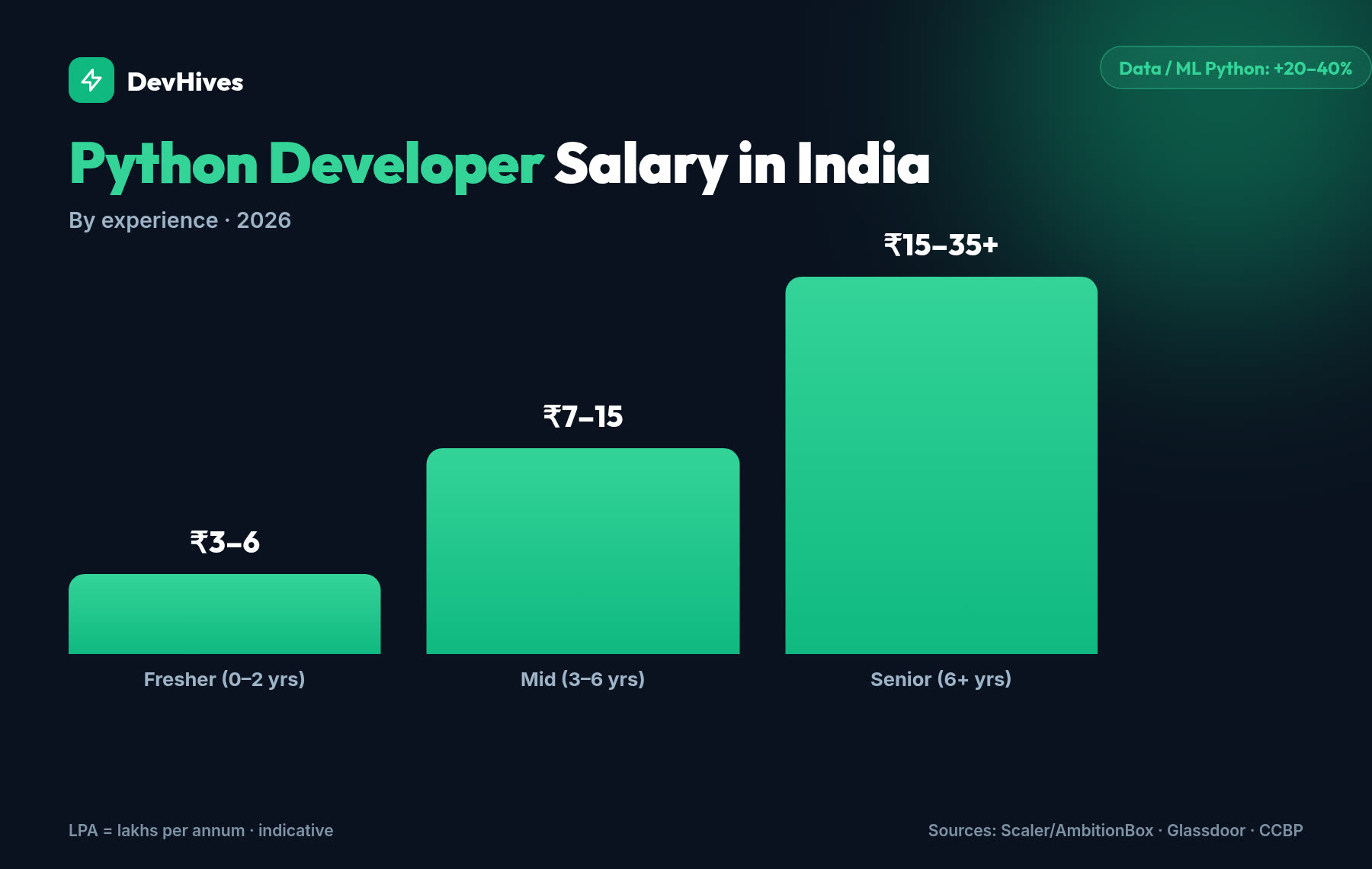
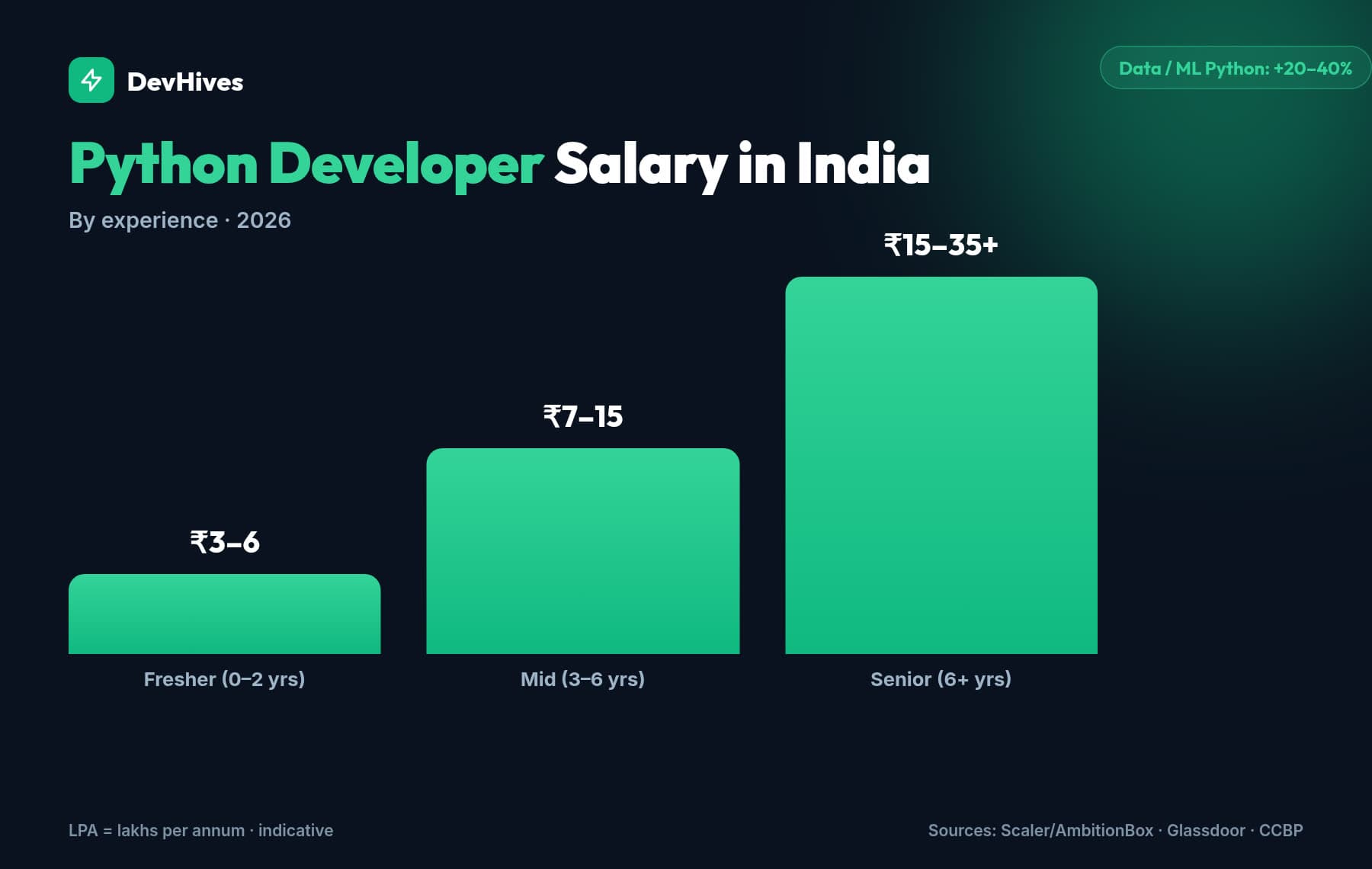
Python developer salary by experience
| Experience | Typical range |
|---|---|
| Fresher (0–2 yrs) | ₹3–6 LPA |
| Mid (3–6 yrs) | ₹7–15 LPA |
| Senior (6+ yrs) | ₹15–35 LPA+ |
Freshers usually start modestly: Scaler, citing AmbitionBox data from September 2026, shows roughly ₹3.1 to 3.4 LPA at 0 to 1 year and ₹4.5 to 4.9 LPA at 1 to 3 years. By the mid band, pay roughly doubles, and senior developers who own design and delivery climb well past it. The wide senior top end reflects data and ML specialists, who pull the average up.
By skill: where python pay really splits
This is the part most salary pages skip. A "python developer" is not one job, and the skill you pair with python decides your band more than your experience does.
| Python track | Pay vs generalist backend |
|---|---|
| General backend (scripts, APIs) | Baseline |
| Django / full-stack python | Slightly higher |
| Data engineering / data science | A clear premium |
| Machine learning / GenAI | Highest |
A python developer who moves into data engineering or ML typically earns 20 to 40 percent more than a generalist backend developer at the same experience. That single pivot is the highest-leverage move in a python career, because it shifts you from a crowded market into a scarce one.
Python developer salary by city
Location still moves the number. Bengaluru leads for python roles, followed by Hyderabad, Pune and the Delhi NCR belt, where product companies and funded startups concentrate. The same title at a Bengaluru product company can pay well above a services-firm role in a smaller city, which is why the ranges above are bands rather than single figures. Remote roles for global teams widen the ceiling further, since they often benchmark pay above the local market. If you are early in your career, optimise first for the kind of company and the scarce skill, not the city, because those compound faster than a one-time location bump.
Freelance and contract python rates
Full-time pay is only half the picture. Independent python work is a real path in 2026, and it is priced differently. One developer rate card for India lists python developers at roughly ₹38,000 to ₹7.1 lakh per month depending on seniority, with junior contractors around ₹4.5 to 11 LPA-equivalent and senior specialists far higher. The spread is huge because freelance rates track proven, in-demand skills almost directly: a contractor who can ship data or ML work commands a multiple of a generalist scripting rate. For many developers, contract work also becomes the bridge that proves those scarce skills before a higher-paid full-time offer.
What else moves the number
Two factors swing pay as much as the band itself. The first is employer type: product companies and funded startups generally pay above IT-services firms for the same title. The second is proof of work: shipped projects and a public portfolio move offers more than a longer CV, because interviewers pay for what you can clearly build.
Is a python career still worth it in 2026?
Short answer: yes, but for a specific reason. Python itself is not where the money is; the doors it opens are. It remains the default language for data, machine learning and GenAI, which are the highest-paying lanes in tech right now, and it is also a comfortable entry point for web and automation work. That combination is rare: few languages are both easy to start with and directly connected to the top of the pay scale.
There is a flip side. “Generalist python developer” is a crowded title, and crowded titles pay at the lower end of every range above. Demand is strong, but it is strongest for people who pair python with something scarce. So the realistic 2026 read is this: learning python is a good decision, and treating it as a launchpad rather than a destination is what turns it into a well-paid one. Start with python, ship real work, then specialise early into the lane whose salary band you actually want.
How to move up a band
The gap between fresher and mid, or mid and senior, is usually one or two concrete skills plus evidence you can apply them. For a python developer the fastest route is to add a scarce, in-demand lane (data, ML or GenAI) and ship two or three real projects a hiring manager can open and run. Structured, project-based learning gets you there faster than passive tutorials, which is the path DevHives is built around.
Key takeaways
- Python freshers in India earn about ₹3–6 LPA; seniors ₹15–35 LPA and up.
- Skill beats years: data and ML python pays a clear premium over generalist backend.
- Employer type, city and shipped projects decide where in the range you land.
- Figures vary by source; verify on Glassdoor or AmbitionBox before negotiating.
Related reading
- Highest-paying tech jobs in India (2026 salary guide)
- How to become an AI engineer after 12th, without JEE
The bottom line
Python opens the door at a modest salary, but the ceiling is set by what you build on top of it. Stay a generalist and pay grows slowly; add a scarce data or ML lane and the same years are worth far more. One practical habit helps at every stage: track your own offers and a primary salary database together, so you always negotiate from current data rather than a year-old blog figure. The numbers here are indicative, so confirm the latest before you act.


