Full Stack Developer Fresher Salary in India (2026)
A full stack developer fresher in India earns ₹3.5–6 LPA in 2026, with Bangalore at the top and Chennai close behind. Here's how city, company type, and skills move your offer.

Two freshers, same degree, same city: one gets ₹3.5 LPA and the other gets ₹6 LPA. I compared four salary pages to see what explains the gap and what number you should expect on your own offer letter. These pages are published guides, so this post is a side-by-side comparison of them, not a new survey. The Microsoft Voluntary Exit Offer news this week does not change fresher pay; more on that near the end.
A full stack developer fresher in India usually earns ₹3.5–6 LPA in 2026. The national band comes from Codegnan and Felix ITs, and Bangalore and Chennai both sit inside it. In these guides, company type (services, product or GCC, a global capability centre: an Indian office that builds software for one foreign parent company) shows a bigger pay gap than city does. Strong DSA and internship records can push offers above the band.
Full stack developer fresher salary in India: the national band
Two salary guides, Codegnan and Felix ITs, place the all-India fresher range at roughly ₹3.5–6 LPA, with averages near ₹4.6 LPA.
LPA means lakh per annum: your yearly pay before tax, counted in lakhs of rupees. A ₹3.5 LPA offer works out to roughly ₹29,000 a month before tax and deductions.
The two guides do not match exactly. Codegnan gives ₹3.5–6 LPA with an average of ₹4.6 LPA. Felix ITs stops lower, at ₹3.5–5.5 LPA. The bottom is the same; only the top end moves.
Each guide collects different data, so a band is safer than one average.
City-wise fresher bands and company types in one table
Putting city and company type in one fresher-only table suggests that, in these guides, company type makes a bigger gap than city. The guides use different methods, so the comparison is rough. I built this table from the guides linked in each row.
| Segment | Fresher range | Average | Source |
|---|---|---|---|
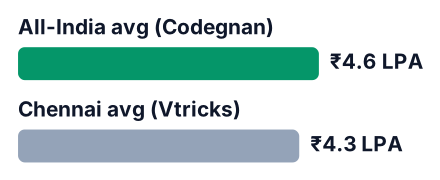
| All-India | ₹3.5–6 LPA | ₹4.6 LPA | Codegnan |
| All-India | ₹3.5–5.5 LPA | Not given | Felix ITs |
| Bangalore | ₹3.5–6 LPA | Not given | upGrad |
| Chennai | ₹3.6–5.6 LPA | ₹4.3 LPA | Vtricks |
| Services companies | ₹3.5–4.5 LPA | Not given | Codegnan |
| Product companies and GCCs | Roughly 25–40% above services | Not given | Codegnan |
These are published guide ranges, not offer letters I have collected. Several of these sites sell courses or hiring services, so their numbers are estimates. Treat them as a map of what is typical, not a promise.
Look at the middle of each city row. The guides use different methods, so this is my own arithmetic, not a published finding. The midpoint of the Bangalore range from upGrad is about ₹4.75 LPA. Chennai's average from Vtricks is ₹4.3 LPA. The cities are less than half a lakh apart in the middle.
Compare that with the company-type rows. Moving from a services firm to a product firm can add a quarter or more to your pay. Moving from Chennai to Bangalore, at the same kind of employer, adds far less.
Bangalore fresher pay reaches the top of the band
Bangalore freshers typically get ₹3.5–6 LPA, and candidates with strong DSA and internships can reach ₹7–8 LPA at mid-tier product firms, according to upGrad's Bangalore salary guide.
That ₹7–8 LPA figure is the best case, not the usual one. It needs two things together: DSA (data structures and algorithms, the problem-solving rounds in most product interviews) and real internship work. Mid-tier product firms are the target here, not the largest names, which run even harder interviews.
You will also see a much bigger Bangalore number online. The same upGrad guide puts the average software engineer salary in Bangalore at ₹9.7 LPA. That average covers every experience level, from day-one freshers to people ten years in. It is not a fresher number, and an HR team will not treat it as one.
So if you search "full stack developer fresher salary in Bangalore" and land on a ₹9–10 LPA headline, check whether it is an all-years average. Most of the time, it is.
Chennai fresher pay and who hires there
Chennai freshers see ₹3.6–5.6 LPA with an average of ₹4.3 LPA, and the employer list mixes services giants with product firms, per Vtricks's Chennai guide.
The Vtricks guide names TCS, Cognizant, Infosys, Zoho, HCL and Freshworks as top employers. The first four, plus HCL, are services companies with large campus drives. Zoho and Freshworks are product companies, and Vtricks says product firms in Chennai pay 20–35% more than services firms.
This mix is useful for a fresher. You can sit for a TCS or Infosys campus placement and still apply to Zoho or Freshworks in the same city. If front-end work interests you more, the Chennai front-end fresher salary breakdown uses the same approach for that role.
One warning, like Bangalore. The average for all software engineers in Chennai is ₹8.3 LPA, according to upGrad. That is an all-years figure. If you search "full stack developer fresher salary in Chennai", the fresher band above is the number to plan with.
Services vs product vs GCC for your first offer
Services firms start freshers at ₹3.5–4.5 LPA, while product companies and GCCs pay roughly 25–40% more for the same role, according to Codegnan.
A GCC is a global capability centre: an India office that builds software for one foreign parent company. It is not a client-services shop. Its only customer is its own company.
Pros
- Services: large campus hiring drives, so more seats for freshers.
- Services: structured training in your first months on the job.
- Product and GCC: higher starting pay for the same role.
- Product and GCC: you usually work on one product for a long time.
Cons
- Services: a lower starting band.
- Services: you may be placed on a project and stack you did not choose.
- Product and GCC: harder DSA and system rounds.
- Product and GCC: fewer fresher seats, often filled off-campus (you apply directly to the company, not through your college).
Codegnan gives 25–40% for product companies and GCCs. Vtricks gives 20–35%, for Chennai only. Both guides agree on about 25–35%, so a premium of about a quarter to a third is a fair working figure for your first offer.
Here is what that means in rupees, using the Codegnan services band. At the bottom, ₹3.5 LPA plus 25–40% gives about ₹4.4–4.9 LPA (my own calculation, not a published figure). At the top, ₹4.5 LPA becomes roughly ₹5.6–6.3 LPA. The gap between the two company types is around one to two lakh a year, before you have written a line of production code.
Full stack hiring is still growing in GCCs, fintech and SaaS
Taggd reports that demand for full stack developers is concentrated in GCCs, fintech, SaaS and internet businesses, with MERN, Java, cloud-native and AI-integrated profiles most sought after.
Those are the places to aim your applications. MERN means MongoDB, Express, React and Node, a JavaScript-only stack. Cloud-native means apps built to run on cloud platforms from the start. AI-integrated roles add model features, like search or chat, to normal web apps. The ML engineer fresher salary post covers the pay side of that work.
The Microsoft news from this week belongs here only as context. The Voluntary Exit Offer is for eligible existing employees. It says nothing about fresher pay or fresher hiring.
An honest caveat. Taggd describes which skills employers want, not how many entry-level seats exist. A company can want MERN developers and still hire only people with two years of experience. Strong demand for a skill improves your chances; it does not guarantee a fresher opening.
Skills that move you up the fresher band
The skills the sources tie to higher offers are DSA and internships, plus a stack that matches what growing employers ask for. These five steps put that into an order.
Pick MERN or Java
Both appear in the highest-demand profiles from Taggd. Choose one and stay with it for your first job hunt.
Build two deployable projects
Put both online with a live link, not only a GitHub repo. A recruiter should be able to click and use them.
Practise DSA every week
upGrad names strong DSA as part of the higher-offer profile. Solve a handful of problems each week rather than studying only the week before placements.
Get an internship
The same upGrad guide pairs internships with DSA. Even a short one gives you real code reviews to talk about.
Apply beyond campus services
Sit for campus drives, but also apply off-campus to product firms and GCCs, where the pay premium is.
If you are still at the start, the full stack roadmap after 12th covers what to learn before these steps make sense.
The most common mistake is judging an offer by CTC alone. CTC (cost to company) is the full yearly package, and it can include variable pay, bonuses and benefits you never receive as cash. Ask for the fixed monthly in-hand amount. Two offers with the same CTC can pay very different salaries each month.
Your next step: pick one target company type this week, services, product or GCC. Find three real fresher openings there and note the skills each one asks for. Then add one missing skill to your learning plan before you apply.