US Green Card Suspension vs Indian Freshers: What Job Seekers Must Know in 2026
The US suspended PERM filings for TCS, Infosys, Wipro and Microsoft, but the six big Indian firms filed under 2% of all PERM applications last year. For Indian freshers, the green-card path was never a near-term payoff — here is what the news actually changes.

You just got a TCS offer and imagined a US green card someday. This week's news might make you think that dream is dead. It isn't — and the numbers show why.
The US suspension of PERM applications for TCS, Infosys, Wipro, HCLTech, Cognizant, Capgemini, Microsoft, and Adobe does not cancel any H-1B visa and barely touches these firms' operations, because they filed fewer than 1,400 of the 117,849 PERM applications last year — under 2% of the national total, according to Department of Labor data cited by India Today. For a fresher holding a service-company offer, the green-card route was never a near-term payoff anyway. The real bottleneck is the roughly one-million-strong Indian green-card backlog, which takes decades to clear.
What the suspension actually does
The US has blocked new PERM filings and frozen pending ones for eight companies. It only blocks the first step for new green cards, which most freshers were years away from anyway.
On October 8, 2026, Vice President JD Vance and Labor Secretary Keith Sonderling announced the move. The suspended companies are Infosys, TCS, Wipro, HCLTech, Cognizant, Capgemini, Microsoft, and Adobe. PERM stands for Permanent Labor Certification, the document an employer needs before sponsoring a worker for an employment-based green card. Labor Secretary Sonderling put it plainly: "We will not accept any new or process any pending permanent labour certifications involving these companies" (India Today).
An initial suspension during a fraud investigation can run up to 180 days, and it can be extended while the investigation remains unresolved (Times of India). The key point: existing H-1B visas are untouched. People already working in the US on one of these visas keep their status.
The numbers the headlines buried
TCS, Infosys, Wipro, HCLTech, Cognizant, and Capgemini filed fewer than 1,400 of 117,849 PERM applications between October 2024 and September 2025 — under 2% of the national total, according to Department of Labor data cited by India Today — while Microsoft alone filed 3,161.
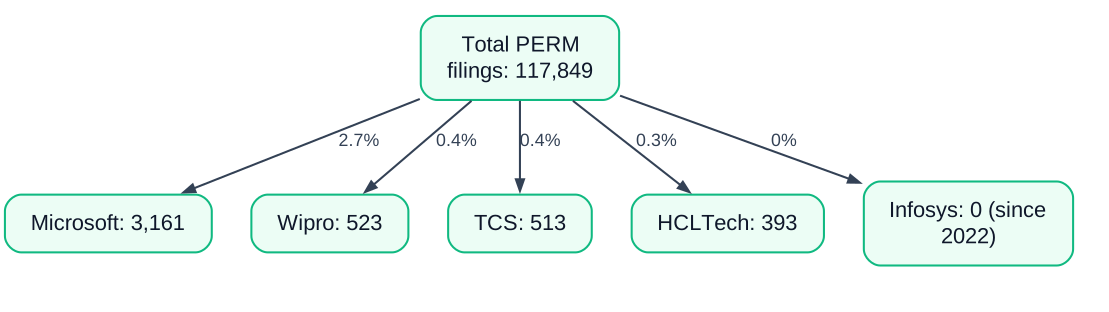
Breaking down the figures from Department of Labor data cited by India Today: Wipro had 523 PERM cases approved in FY2025, TCS 513, and HCLTech 393. Infosys has filed none since 2022. Microsoft, by contrast, had 3,161 approved. Vance also claimed Microsoft laid off 6,000 US workers while getting 6,300 H-1B approvals and roughly 3,000 green cards (India Today). Microsoft disputed this, saying 80% of its approximately 6,000 H-1B applications were extensions for existing employees (Al Jazeera).
| Company | PERM cases approved (FY2025) |
|---|---|
| Microsoft | 3,161 |
| Wipro | 523 |
| TCS | 513 |
| HCLTech | 393 |
| Infosys | None since 2022 |
Source: Department of Labor data cited by India Today.
The political storm is loud. But as an operational event for these firms, this is close to zero. Data for Cognizant and Capgemini not available in the cited source.
TCS says the suspension will not hurt its hiring
TCS, which filed only single-digit PERM applications in two years, says the suspension will not affect its US workforce strategy, and it still plans to hire 15,000 more people in the US over five years. TCS relies on H-1B visas for short-term US roles, not on green cards, which is why their PERM filings were so low.
The company's official statement: "Our PERM applications were in single digits in the last two years and hence we do not expect the suspension... to impact our workforce strategy" (Livemint). TCS currently operates 31 US offices and plans to keep expanding.
This tells you something important about how service companies work. They rely on H-1B visas for short-term talent deployment, not on PERM and green cards. The suspension blocks a long-term path these companies barely used.
Why the green-card path was never a near-term payoff
Even without this suspension, a fresher at TCS or Infosys would not expect a green card for decades, because nearly one million Indians already sit in a backlog that makes up 79% of the total.
Here is the reality: approximately one million Indians on US work visas are stuck in the employment-based green-card backlog, representing 79% of the roughly 1.25 million total backlog (Al Jazeera). Indians are also about 70% of existing H-1B holders. If you are on an H-1B, you can usually stay past six years only if your employer filed a green-card application for you at least a year earlier. That is why the PERM suspension matters for people already in the US, not for freshers.
So when a fresher joins TCS or Infosys dreaming of a US green card, the timeline was never realistic. This week's news only makes official what was already true.
Does this change the value of your first offer?
No — the value of a fresher's first TCS or Infosys offer comes from training, experience, and a stepping stone, not from a green card that was never going to arrive quickly.
Here is a useful distinction. The green-card route and the H-1B route are different things. The suspension affects only PERM filings. It does not affect H-1B applications for jobs at US companies. And the H-1B route remains open: Indians received about 57,000 new H-1B visas approved in FY2026, down 28% from FY2024, but still a large number (India Today). Data also shows that 37% of Indians who got green cards in FY2023 did so through employment-based preferences (India Today), which confirms the route exists. The issue is never whether the path exists. The issue is how long it takes.
Say you join TCS. Your first two years are about training and projects, not visas. Ask the recruiter: how many people moved to the US on H-1B last year? If the answer is vague, that tells you something.
What this means for your long-term plans
If you dream of working in the US, build skills that make you employable directly on H-1B, not on a green card from a service company.
The suspension does not affect H-1B for jobs at US companies. Indians are about 70% of all H-1B holders (India Today), so that route remains open. The realistic path looks like this: gain experience at a service company, build deep technical skills, then move to a US-based product company that sponsors H-1B directly. That is how most Indians reach the US today, and this week's news does not change that.
Also remember the broader context. India's Ministry of External Affairs called Vance's "indentured servants" comment "unwarranted" and "deeply offensive" (Al Jazeera). The rhetoric is heated, but your career decisions should be based on numbers, not headlines.
Before you accept any offer, ask the recruiter two questions: how many people did they move to the US on an H-1B last year, and what does their typical career path look like in the first three years. If their answer is about training and projects, take the offer. If it is about a green card, run.
For more context on choosing your first job, read about service versus product companies for your first dev job and the junior developer job market in India in 2026. If you are still comparing offers, check which companies are hiring freshers in 2026, and understand the notice period and bond in your Indian offer letter before you sign.


