Wipro Hiring Process 2026: All Rounds Explained
Wipro's 2026 fresher hiring has one 128-minute test and two routes. On campus, your coding score decides Velocity at 3.5-4.0 LPA or Turbo at about 7 LPA. Off campus, you apply directly and start as a Trainee at ₹3.0-4.0+ LPA.

Wipro's 2026 fresher hiring has one test and two routes. The on-campus Elite NTH drive can lead to the Turbo Engineer role at a reported 7 LPA, but only if your college is in Turbo's pool of 46 institutes. Off-campus direct applications reportedly start at about ₹3.0–4.0+ LPA as a Trainee. The section that decides your pay is coding: on campus, your score in the 60-minute coding part of the 128-minute test sets your track. Wipro's own early careers page does not confirm these salary figures. They are reported by third-party sites, so confirm them with your placement cell. For Turbo, ask your placement cell: is our college in the Turbo pool? Below, every round is covered in order.
The 2026 fresher process at Wipro runs a 128-minute online test, a technical interview and an HR round. On campus, the Velocity track is reported at about 3.5–4.0 LPA (Final Round AI). Off campus, you apply on careers.wipro.com and usually start as a Trainee at about ₹3.0–4.0+ LPA, with no group discussion in most drives.
Wipro hiring process 2026 at a glance
Both routes end in a technical interview and an HR round. What differs is how you enter and how your salary track is set.
One rule matters more than any test tip. The official Wipro hiring process page says careers.wipro.com is the only place to apply. It also says Wipro never asks for money at any stage. If a "placement agent" asks you to pay for a Wipro offer letter, it is a scam. Close the chat.
If off-campus job hunting is new to you, my off-campus placement guide for Indian freshers covers the basics before you start.
The 128-minute online test, section by section
The test has five sections: Quantitative Aptitude, Logical Reasoning, Verbal Ability, an essay and coding. The essay is 20 minutes. Coding is 60 minutes with two problems. Subtracting those from 128 leaves about 48 minutes for the three aptitude sections together. No section has negative marking, and the sources do not list question counts or cutoffs. These details come from Final Round AI's breakdown of the Wipro process.
This is the main filter in the Wipro hiring process for freshers. On campus, everyone takes it; the off-campus test format is unconfirmed.
| Section | Time | What it tests |
|---|---|---|
| Quantitative Aptitude | Shares the remaining time with the other two aptitude sections | Arithmetic and percentages, plus ratios and time-and-work questions |
| Logical Reasoning | Shares the remaining time | Patterns, number series, simple puzzles |
| Verbal Ability | Shares the remaining time | Grammar, vocabulary, reading comprehension |
| Essay / Written Communication | 20 minutes | One assigned topic; clear structure and correct English |
| Coding | 60 minutes | Two problems in C, C++, Java or Python |
| Whole test | 128 minutes | No negative marking in any section |
No negative marking changes your strategy. A blank answer and a wrong answer both score zero, so never leave a question empty. Guess, mark it, and move on.
Here is how I would spend the time:
- Aptitude sections: do the easy questions first. Skip anything that needs a long calculation, then come back.
- Essay: spend the first few minutes on a plan. Write an opening, two or three short body paragraphs and a closing line. Leave time to check spelling.
- Coding: read both problems before you type. Solve the easier one fully, then try the harder one next. A partial solution that passes some test cases beats a perfect idea with no code.
- Language: use the one you write fastest. Python is fine if it is yours; the test accepts it.
For the full topic list of each section, read my Wipro NLTH syllabus for 2026. This post focuses on the process; that one focuses on what to study.
On-campus Elite NTH: coding score sets your track
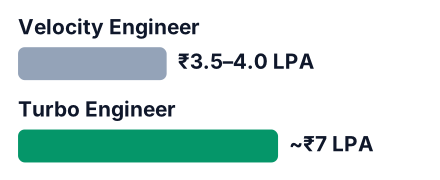
In the on-campus Elite NTH drive, your coding score decides whether you land in Velocity at about 3.5–4.0 LPA or Turbo at about 7 LPA (fresheroffcamp.in, Final Round AI).
NTH stands for National Talent Hunt. "Elite NTH" is the name of Wipro's campus hiring programme for fresh graduates, explained in GUVI's overview of Elite NTH. Your college's placement cell registers the batch, and you take the same online test described above.
The difference is what happens to your score. Aptitude gets you through. Coding decides your pay, and for Turbo your college must also be in the pool described below.
| Track | Approx. salary | Who gets it |
|---|---|---|
| Velocity Engineer | 3.5–4.0 LPA | Candidates who clear the NTH test and interviews |
| Turbo Engineer | About 7 LPA | Top coders on the NTH test; recruited from 46 premier institutes, including IIITs and NITs |
Look at that gap. Turbo pays close to double Velocity, and the deciding factor is roughly one hour of coding. If you have weeks before your drive, put most of your practice into the coding section.
Turbo also has a pool. According to GUVI, Wipro runs it at 46 premier institutes, including IIITs and NITs. If your college is not in that pool, Velocity is the more likely outcome from campus. That is my own reading. The sources do not list the 46 institutes.
WILP (Work Integrated Learning Programme) is a separate work-while-study track with its own process, per Final Round AI.
Off-campus route: apply directly and start as a Trainee
Off campus you apply on the official Wipro careers portal, and the 2026 Trainee drive starts at about ₹3.0–4.0+ LPA. The details below are from freshersdunia.in's listing of the 2026 Trainee drive.
The 2026 drive is for roles in Noida and Gurugram. It accepts the 2024–2026 batches, according to the same listing. Eligible degrees are wider than on campus:
- B.E / B.Tech
- M.E / M.Tech
- BCA and MCA
- B.Sc and B.Com
Typically the off-campus process has four steps (a typical sequence, not an official one):
Resume screening
Apply on careers.wipro.com. Keep your resume to one page and list your projects with the tools you used.
Online aptitude test
The off-campus format is unconfirmed. It is usually an online aptitude test and may differ from the NTH test, so check your invitation email. Practise aptitude and coding under a timer.
Technical interview
CS fundamentals plus questions on your projects.
HR fitment
Relocation, motivation, behaviour questions and document checks.
Plan your money around the Trainee salary. The Turbo path at about 7 LPA is tied to the NTH coding score and the 46-institute pool (GUVI, fresheroffcamp.in). An off-campus application does not put you in that pool.
On-campus vs off-campus: the full comparison
On campus gives you a path to Turbo and may add a group discussion and spoken rounds, while off campus is shorter and usually skips the GD.
| Factor | On campus (Elite NTH) | Off campus (direct) |
|---|---|---|
| How you enter | Through your college placement cell | Apply on careers.wipro.com |
| Eligibility | Varies by college and drive | 2024–2026 batches; B.E/B.Tech, M.E/M.Tech, BCA, MCA, B.Sc, B.Com (2026 Trainee drive) |
| Online test | 128 minutes, five sections | Online aptitude test |
| Group discussion | 15–20 minutes, in some drives only | Usually skipped |
| JAM spoken round | In some drives (varies) | Usually not mentioned |
| SVAR spoken-English test | In some drives (varies) | Usually not mentioned |
| Starting salary | Velocity 3.5–4.0 LPA | Trainee about ₹3.0–4.0+ LPA |
| Turbo access | About 7 LPA for top coders, 46 premier institutes | Not part of the Turbo pool (my reading; not confirmed by a source) |
| Company scale | 230,000+ employees across 65 countries | |
JAM means "Just A Minute": you speak on a topic for one minute. SVAR is an automated spoken-English assessment, where software scores your pronunciation and fluency. Both depend on the drive, which is why the table says "varies".
Pros of on campus
- A real chance at the Turbo track if your coding is strong
- Your placement cell handles scheduling and updates
Cons of on campus
- More rounds in some drives, such as a GD and spoken tests
- Only open if your college hosts Wipro
Pros of off campus
- Open to more degrees, including BCA, B.Sc and B.Com
- A shorter process that usually skips the GD
Cons of off campus
- Plan for the Trainee salary, not Turbo
- You track every update yourself, and fake listings exist
Technical interview: 30–45 minutes on fundamentals and projects
The technical round lasts 30–45 minutes and covers CS fundamentals plus a deep discussion of your own projects.
Expect questions from these areas:
- DSA: arrays and strings, plus linked lists and sorting with when to pick which.
- OOP: classes, inheritance, polymorphism, with a small example in your language.
- DBMS and SQL: joins and keys, plus normalization (splitting tables to stop repeated data).
- Operating systems: processes vs threads, deadlock, memory basics.
- Networks: what happens when you type a URL, TCP vs UDP.
The project discussion is where most freshers lose marks. The interviewer will pick one line of your resume and keep asking "why". Why this database? Why this framework? What broke, and how did you fix it?
Do: explain every file and every choice in plain words. Say "I don't know, but I would check X" when you are stuck.
Don't: list a project you copied from a tutorial and cannot explain. Don't claim tools you have only read about.
My practical tip: pick two projects and explain each one out loud, alone, as if to an interviewer. Record yourself on your phone. You will hear the gaps fast. For how this round compares with other Indian companies, see my post on fresher interview rounds in India.
HR round and document verification
The HR round checks relocation, why you want Wipro and your behaviour in past situations, and ends with document verification (Final Round AI).
Common questions:
- "Are you ready to relocate to any Wipro location?"
- "Why Wipro?"
- "Tell me about a time you handled a conflict in a team."
Answer relocation questions honestly. If you say yes, mean it, because the offer may send you to a new city.
For behaviour questions, use STAR: Situation, Task, Action, Result. Say you led a college project and one teammate stopped replying a week before the deadline. A STAR answer sounds like this:
"In my final-year project, one teammate went silent before submission (Situation). I had to make sure our module still worked (Task). I called him, learned he was stuck on the database part, and split his work between the two of us (Action). We submitted on time, and he handled the testing part (Result)."
Keep it short, specific and about what you did.
Document verification comes at the end. Carry the originals and copies your email asks for. Expect to show mark sheets, a degree or provisional certificate, and a government ID. A missing paper can delay your offer.
Which Wipro route should you pick?
If your college hosts the Wipro drive, take the on-campus route and aim for a high coding score. If not, apply off campus now and prepare the same test.
- Your college hosts the drive: go on campus. Spend most of your prep on coding, since that decides Velocity or Turbo.
- No drive, but your batch is eligible: apply off campus through the Wipro early careers page. Prepare for the same test.
- Your coding is weak right now: apply anyway. Aptitude and a clear essay can still get you through, and you can grow your coding inside the job.
Common mistakes
- Ignoring the essay. It is a scored section. Practise writing a few short essays on general topics under a timer.
- Skipping coding practice. Reading solutions is not the same as writing them. Type every solution yourself.
- Paying for a "guaranteed job". Wipro never charges a fee. Anyone selling a Wipro seat is lying.
Wipro should not be your only target. Infosys hires freshers in the same season, with a different test and its own salary tracks. Read my Infosys hiring process 2026 guide and apply to both.
Your next step: open careers.wipro.com today and check which drive matches your batch and degree. Then do one timed practice round of the NTH coding section.


