Infosys Hiring Process 2026: Tracks, Test Sections, and Salary
Infosys will hire 20,000 campus freshers this year. Here's the full 2026 process: the three channels, SE/SP/PP eligibility bars, exact test sections, interview questions, and background-check pitfalls that can pull your offer.

The 2026 Infosys fresher process runs through three channels: on-campus, off-campus, and referral. All lead to the same aptitude test, technical interview, and HR round. Your track (SE, SP, or PP) sets your eligibility bar and your starting salary, from ₹3.6 LPA to ₹9.5 LPA. Infosys will hire 20,000 campus freshers this year, and its CEO announced salary hikes starting October 2025. This post joins the track-level CTCs, the exact test sections, and the background-check pitfalls into one practical walkthrough.
Infosys hiring 2026: the three channels and how they flow
On-campus, off-campus, and referral drives all feed the same selection sequence. The channel only decides how you get your first interview slot. After that, everyone faces the same aptitude test, technical interview, and HR round.
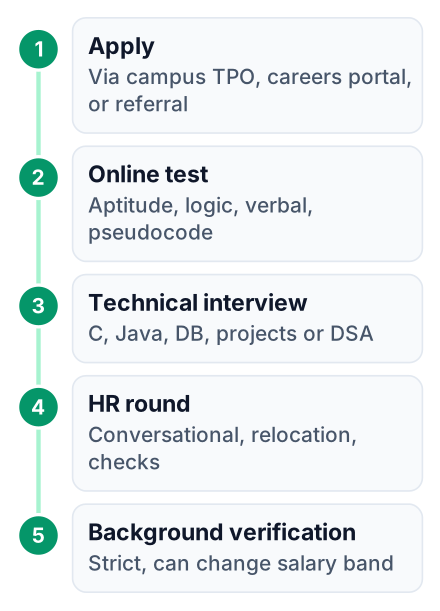
On-campus drives happen through your college's Training and Placement Office (TPO). The window is August to December of your final year. Off-campus drives are published on the Infosys careers portal and are open to applicants from many colleges at once. Referral drives work through an Infosys employee recommending your profile, which often gets you a faster screening slot.
Register
Apply through your TPO for on-campus, or create a profile on the Infosys careers portal for off-campus and referral.
Online aptitude test
Everyone takes the same test: quantitative ability, logical reasoning, verbal ability, pseudocode, and puzzles.
Technical interview
Questions cover C, Java, databases, and your projects. The SP track adds data structures and algorithms problems.
HR round
A conversational round covering relocation, background details, and your understanding of the role.
Background verification
Infosys verifies your graduation date, education gaps, and work history. Mismatches can change your offer.
One important point: the channel you use does not change the difficulty of the test or the interviews. A referral may get your resume seen faster, but you still clear the same bar as everyone else.
Eligibility bars per track: SE, SP, and PP
Your college percentage decides which track you can apply for: 60% for SE, 65% for SP, and around 7.5 CGPA for PP.
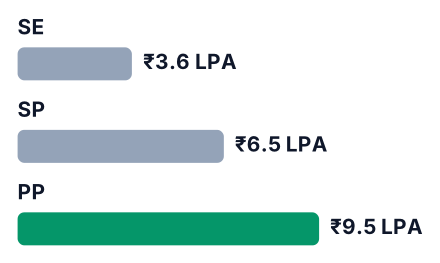
Infosys runs three fresher tracks with different salary bands. The Systems Engineer (SE) track starts at ₹3.6 LPA. The Specialist Programmer (SP) track starts at ₹6.5 LPA. The Power Programmer (PP) track, the most selective, starts at ₹9.5 LPA.
| Track | Minimum CGPA / % | Starting CTC |
|---|---|---|
| Systems Engineer (SE) | 60% or 6.0 CGPA | ₹3.6 LPA |
| Specialist Programmer (SP) | 65% or 6.5 CGPA | ₹6.5 LPA |
| Power Programmer (PP) | 7.5 CGPA (candidate-reported) | ₹9.5 LPA |
Beyond the track bars, Infosys applies universal rules. You need 0 active backlogs, a maximum education gap of 2 years, a full-time degree, and no prior work experience. You must be an Indian citizen, a PIO, or an OCI cardholder.
If you are close to a bar, say at 63%, your SP application will likely not go through. The bars are checked early, before the test, so a strong test score does not rescue an ineligible application. Infosys eligibility criteria lists the exact percentage cut-offs for each track.
The online test: exact sections, timing, and cut-offs
The online test usually has around 60 questions across quantitative, logical, and verbal sections, plus pseudocode, puzzles, and a writing task, with sectional cut-offs. PrepInsta's Infosys page provides further details you can verify.
Candidate-reported 2026 test shapes put the total around 60 questions in roughly 100 minutes (excluding the writing task's separate timer). PrepInsta lists a more detailed breakdown. Mathematical Ability carries 10 questions in 35 minutes, Analytical Reasoning 15 questions in 25 minutes, and Verbal Ability 20 questions in 20 minutes. The test also includes Pseudo Code (5 questions in 10 minutes), Puzzle Solving (4 questions in 10 minutes), and an English Writing section (1 question in 10 minutes). These numbers are candidate-reported and may vary by drive.
| Section | Questions | Time |
|---|---|---|
| Mathematical Ability | 10 | 35 min |
| Analytical Reasoning | 15 | 25 min |
| Verbal Ability | 20 | 20 min |
| Pseudo Code | 5 | 10 min |
| Puzzle Solving | 4 | 10 min |
| English Grammar + Writing | 5 + 1 | 10 + 10 min |
The sectional cut-offs matter more than most applicants expect. A strong score in quantitative reasoning does not cover a weak verbal section. You need to clear each section's bar to move forward.
The pseudocode section trips up the freshers I've seen—it tests reading code, not writing it. Practice with simple loops, conditionals, and recursion problems.
Technical interview: what SE and SP interviews actually ask
SE interviews cover C, Java, databases, and your projects; SP interviews add DSA problems.
For the SE track, interviewers pick from a predictable set. Expect questions on C pointers and memory, Java basics like classes and inheritance, SQL joins and queries, and a walkthrough of any project on your resume. The project discussion is where you can stand out: be ready to explain one design decision and one problem you solved.
SP interviews go deeper. Data structures and algorithms problems appear here, often as a coding question on a shared editor. You should be comfortable with arrays, linked lists, trees, and basic time complexity analysis. Interviewers look for clean logic over perfect syntax.
A common mistake is memorizing answers instead of understanding concepts. If you say you know Java, the interviewer may ask you to explain garbage collection or the difference between an abstract class and an interface. If you cannot, that is worse than saying you are still learning.
HR round and the background verification that follows
The HR round is conversational and covers relocation and background checks, but the verification after it is strict and can change your salary band. The background check is not a formality; it is a critical filter.
HR questions are not technical. Expect questions about why you want to join Infosys, whether you are willing to relocate to Mysore or Bengaluru for training, and how you handle pressure. The relocation question is not a formality: Infosys trains freshers at its Mysore campus, and your willingness to move matters.
The background verification after the HR round is where offers get delayed or withdrawn. Infosys verifies your exact graduation date and checks for continuous education or employment. A mismatch between what you wrote on your application and what your college records show can lower your salary band or end the process entirely.
Do
- State your graduation date exactly as it appears on your degree certificate.
- List every education gap with a clear reason, even a gap of a few months.
- Keep your application details identical across every form you submit.
Don't
- Round your percentage up to the nearest whole number.
- Hide a semester you repeated or a course you failed and cleared.
- Add a fake internship just to fill space on your resume.
Say your degree certificate shows 7.4 CGPA but your application said 7.5. That small difference can drop you to a lower salary band, such as the SE track. The verification team checks records, not intentions, so accuracy beats optimism.
Off-campus vs on-campus: what changes for a 2026 applicant
Off-campus drives often restrict pass-out years (like '2024 or 2025 only'), while on-campus is tied to your college's TPO calendar. Some drives are open to more recent batches, so always verify the year range.
Off-campus applications come with specific filters. A drive may state "2024 or 2025 pass-out only", which means a 2026 graduate cannot apply through that particular posting. You must read the pass-out year range on each posting carefully, because applying to the wrong one wastes a slot. For a reliable breakdown of eligibility, check the official eligibility criteria page.
On-campus drives are more predictable for final-year students. Your TPO announces the drive, collects applications, and shares the test schedule. The August to December window in your final year is when most on-campus activity happens.
InfyTQ certification is a shortlisting signal, especially for the SP track. The Infosys Talent Quest exam, when you clear it, puts your name on a list that recruiters see. It does not guarantee a call, but it improves your chances of being shortlisted when Infosys opens a drive. According to candidate reports, clearing InfyTQ can help your profile stand out in the SP track.
If you missed the on-campus window in your final year, off-campus is still open, but the pass-out year filter is the first thing to check. For a deeper comparison of applying through both channels, see our guide on off-campus placements for freshers in India.
How to apply today and what to prepare first
Apply through your TPO for on-campus, or the Infosys careers portal for off-campus, and start with aptitude practice and one strong project.
Infosys's CEO announced the company will hire 20,000 campus freshers, with salary hikes starting October 2025. That is a real opening, but the application bar is unchanged. Your percentage, backlog count, and test speed decide your result.
Start with a three-part preparation plan. First, check your eligibility against the SE, SP, and PP bars above. Second, take one timed mock test using the PrepInsta section pattern to find your weakest section. Third, write a one-page project story that explains what you built, one technical choice you made, and one bug you fixed.
If you are also applying to other companies, the technical interview topics overlap heavily. Our guide to fresher interview rounds in India and the IBM Associate System Engineer hiring process cover the same C, Java, and database questions. And if you are weighing which track to target, our breakdown of entry-level tech roles for freshers in 2026 puts Infosys's salary bands in context.
Check your percentage and backlog count against the SE bar now. If you clear 60% with zero backlogs, create a PrepInsta account and set a reminder for the next test cycle, then time a full mock test this week. That is the fastest way to know where you stand before the on-campus window opens.


