Skills Required for Data Engineer Fresher: A 6-Stage Roadmap
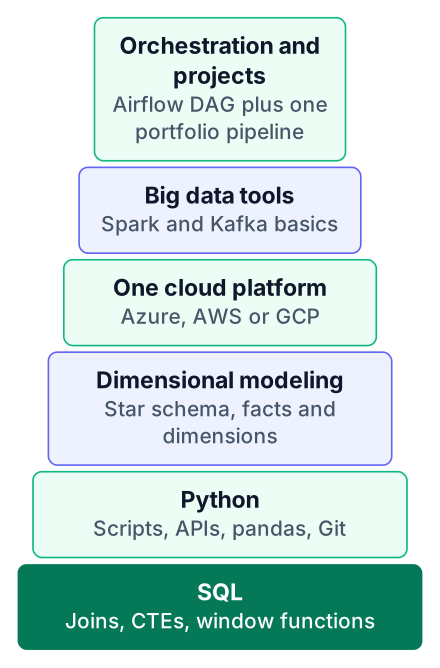
Data engineering for a fresher has a fixed learning order: SQL, Python, data modeling, one cloud, big data, and orchestration. This roadmap lays out what to learn at each stage, how long it takes, and the project that proves you are ready for interviews.

Say you have a B.Tech degree and you have heard of Spark and Kafka, and also Airflow, Snowflake and dbt. You still have no idea which one to open first, because every tool list online throws all the names at you at once. This post gives you the order.
As of October 2026, the DataDriven data engineer roadmap suggests six stages in a set order, and this post follows it. The timings for each stage are my own estimates.
Learn SQL, Python, data modeling, one cloud, big data, then orchestration, and prove each stage with one finished pipeline project. Doing them in this order keeps you from spending months on Spark before you can write a join. Starting from scratch at 10 to 15 focused hours a week, expect roughly 11 to 14 months in total, though your pace will differ. The per-stage spans later in this post are my own estimates at that pace, not DataDriven's figures. A data analyst or software engineer can finish faster.
SQL comes first and decides most interviews
SQL is the most tested skill in data engineering interviews, as the DataDriven roadmap puts it, so it gets your first months and a clear endpoint: window functions and multi-table joins without looking anything up.
The reason is simple. Every warehouse, every BI tool and every pipeline ends up reading or writing tables. For a fresher, that means SQL is the skill you will use on day one, in almost any team.
Your endpoint for this stage is concrete. Take a real dataset and solve problems with joins, GROUP BY, CTEs (named sub-queries you write with WITH) and window functions. A window function calculates something across related rows without collapsing them into one row. Here is the kind of query you should be able to write cold:
-- Running total per customer, and rank of each order within its city
SELECT
  customer_id,
  city,
  order_date,
  amount,
  SUM(amount) OVER (
    PARTITION BY customer_id ORDER BY order_date
  ) AS running_total,
  RANK() OVER (
    PARTITION BY city ORDER BY amount DESC
  ) AS rank_in_city
FROM orders;
If PARTITION BY looks strange, read the PostgreSQL tutorial on window functions. It is short and clear. When you want to see how interviewers push this further, our guide to SQL interview questions on window functions shows the harder versions.
For a fresher with no SQL background, plan on roughly two to three months here. Do not move on until joins feel boring.
Python is the glue around your SQL
Python matters second because you use it to move and clean data, and to schedule jobs, around the SQL you already know, not to build apps, which is how DataDriven frames this stage.
That narrows what you need to learn. Focus on this list:
- Reading and writing files, including CSV and JSON
- Calling APIs with the
requestslibrary - Basic pandas: loading data, filtering and renaming columns, and joining DataFrames
- Writing small functions you can reuse
- Error handling with
tryandexcept, so one bad record does not crash the job - Git, from the first script onwards
Skip web frameworks like Django and Flask for now. Skip advanced object-oriented design too. They are useful later, but they will not help you move data this year.
The endpoint for stage two is one script that pulls data from an API and loads it into a database. This one fetches hourly weather for Kolkata from a free public API and stores it in SQLite:
import requests
import sqlite3
URL = (
    "https://api.open-meteo.com/v1/forecast"
    "?latitude=22.57&longitude=88.36&hourly=temperature_2m"
)
def extract():
    response = requests.get(URL, timeout=30)
    response.raise_for_status()
    data = response.json()["hourly"]
    return list(zip(data["time"], data["temperature_2m"]))
def load(rows):
    conn = sqlite3.connect("weather.db")
    conn.execute(
        "CREATE TABLE IF NOT EXISTS weather (ts TEXT PRIMARY KEY, temp_c REAL)"
    )
    # OR REPLACE lets you run this daily without duplicate rows.
    conn.executemany("INSERT OR REPLACE INTO weather VALUES (?, ?)", rows)
    conn.commit()
    conn.close()
if __name__ == "__main__":
    load(extract())
Push this script to GitHub with a sensible commit message. Make that a habit from the start. Every team you join will review your work through Git, and a clean history shows you already work that way.
Dimensional modeling separates you from other freshers
In my experience many freshers skip data modeling, and I think skipping it is a mistake. Dataquest lists it among the core data engineering skills, which is why I would learn it before touching big data tools.
Dimensional modeling means arranging warehouse tables so business questions are easy and fast to answer. Two kinds of table do most of the work:
- Fact table
- Stores events you can measure, one row per event. Each row holds numbers (amount, quantity) and keys that point to dimensions.
- Dimension table
- Stores the descriptive context of those events: who, what, where, when. Customer names, product categories, city names and calendar dates live here.
Take an Indian e-commerce site. Its raw orders table repeats the customer's city, the product's brand and the seller's state on every row. In a star schema, you split it. A central fact_orders table keeps the order amount, quantity and discount. Around it sit dim_customer, dim_product, dim_seller and dim_date. Drawn on paper, it looks like a star, which is where the name comes from.
Your endpoint here is to design a star schema for a business case and defend each choice. Why is "festival sale" a column in the date dimension and not the fact table? What is the grain, meaning what does one fact row represent? Interviewers ask exactly these questions.
This stage also covers data warehousing basics: how a warehouse differs from the database behind an app, and why it stores history. Add simple data quality rules too. Check that an order ID is never null, that amounts are never negative, and that every product key exists in the product dimension.
Pick one cloud: Azure, AWS or GCP
Learn one cloud well enough to run a small pipeline on it. Employers hire for the concept, and the tool matters less. Dataquest names cloud platforms as a core skill without tying it to one vendor.
Each cloud has the same four building blocks under different names, plus an entry-level certificate; check the current certificate name on the vendor page. Learn the block, and switching later is mostly a matter of new menus.
| Building block | AWS | GCP | Azure |
|---|---|---|---|
| File storage | S3 | Cloud Storage | Blob Storage / Data Lake Storage |
| Warehouse | Redshift | BigQuery | Synapse Analytics or Microsoft Fabric |
| Managed pipeline | Glue | Dataflow | Azure Data Factory |
| Relational database | RDS | Cloud SQL | Azure SQL Database |
| Entry-level data certificate | AWS Certified Data Engineer – Associate | Associate Data Practitioner | Fabric Data Engineer Associate |
The skills required for an Azure data engineer follow directly from the Azure column. You need Azure Data Factory to build pipelines and Blob or Data Lake Storage to land raw files. Add Synapse or Fabric for the warehouse, and Azure SQL for relational data. Put your SQL and Python on top, and you match most Azure job posts.
Which cloud should you pick? Open the job posts you actually want and count. In the posts you check first in your target city, note which cloud shows up most often, whether that is Azure, AWS or GCP. Let the posts decide, not a YouTube poll.
The endpoint for stage four: deploy one pipeline end to end on one free tier. Land a file in storage, transform it, and load it into the warehouse. Then take that cloud's associate-level certificate from the table. It will not get you hired alone, but it gets your resume past filters and proves you finished something structured.
Spark and Kafka for big data, only after the basics
Big data tools are for stage five of your learning, and a fresher needs to understand what they solve, not master them, even though Dataquest includes Spark and Kafka in its list of data engineering skills.
The skills required for a big data engineer come down to two problems. Spark, used through PySpark, splits a large batch job across many machines. You need it when the data no longer fits in one computer's memory. Kafka moves a continuous stream of events, like payments or clicks, from the systems that produce them to the systems that use them. You need it when data must arrive in seconds, not once a night.
Most people make the same mistake by starting here. A Spark job is still mostly SQL logic and table design. If you cannot write a join or pick the grain of a fact table, Spark only makes your errors run on more machines.
Your endpoint: run one PySpark job on a dataset too big for pandas on your laptop. Public taxi trip records or a large open government dataset work well. Write the result back as Parquet files.
Pros
- Appears in many data engineering job posts, so it helps with resume filters.
- PySpark reuses your Python and SQL, so the learning curve is gentler than it looks.
- Teaches you how distributed processing works, which helps with every other big data tool.
Cons
- Most fresher roles do not touch data at huge scale in the first year.
- Setting up clusters burns time and cloud credit that SQL practice would use better.
Orchestration with Airflow is the last stage before interviews
Orchestration is what turns your scripts into a pipeline that runs on a schedule and reports failures, so it comes last, matching the final stage of DataDriven's roadmap.
In Apache Airflow, you describe a pipeline as a DAG, a directed acyclic graph. In plain words, it is a set of tasks with arrows showing which must finish before the next starts. Airflow runs the DAG on a schedule and retries failed tasks. It also shows you which step broke. The official Airflow documentation has a short tutorial that builds your first DAG.
Three related habits belong here. Data quality checks stop bad data before it reaches the warehouse. Data observability means tracking freshness, row counts and failures so you learn about problems before your users do. CI/CD runs your tests automatically each time you push code to GitHub.
The endpoint for stage six: one Airflow DAG that runs your ETL daily, with a test and an alert when it fails. Here is the full order, with an endpoint and a realistic span for each stage if you start from zero:
SQL
Endpoint: joins, CTEs and window functions on a real dataset without looking anything up. About two to three months.
Python
Endpoint: a script that pulls an API and loads a database, tracked in Git. About two months.
Data modeling
Endpoint: a star schema for a business case that you can defend. About two months.
One cloud
Endpoint: one pipeline deployed end to end on a free tier, plus the associate certificate. About two to three months.
Big data
Endpoint: one PySpark job on a dataset too big for pandas. About one to two months.
Orchestration
Endpoint: a daily Airflow DAG with a test and a failure alert. About two months, overlapping with your project.
Those spans add up to about 11 to 14 months, the total from the top of this post, because the Airflow stage overlaps with your project. If you already work as an analyst, stages one and three may take weeks, not months. Our data analyst roadmap covers that path, and many people use it as a step into data engineering.
Projects that prove you are job-ready
One finished pipeline project that uses every stage beats five half-done tutorials, because interviewers ask you to explain your choices, and Dataquest stresses hands-on projects as the way to show these skills.
Here is a project spec you can build:
- Extract: pull data from a public Indian source, such as NPCI's monthly UPI statistics, Indian Railways open data on data.gov.in, or daily weather for a few Indian cities.
- Load: land the raw files in cloud storage, unchanged.
- Model: transform them into a star schema with one fact table and a few dimensions.
- Run: host the warehouse on your chosen cloud.
- Orchestrate: schedule the whole flow in Airflow, with quality checks and an alert.
- Document: write a README with a diagram, the schema, and why you made each choice.
On GitHub, keep the code, the DAG file, SQL models, tests and README in one repository. Pin it to your profile. A recruiter should understand what it does within a minute of opening it.
In campus placements at TCS or Infosys, the first rounds test aptitude and basic coding, so your SQL carries you there. The project matters in the technical interview. Say an interviewer asks, "Why did you split this into a separate dimension?" You should answer from memory, with the trade-off you weighed. Off-campus and at product firms, expect deeper questions on modeling and failures: what happens if the API is down for a day, and how does your DAG recover?
Pay varies a lot by city, employer and skills, so check current fresher offers on live job sites instead of trusting any single range you read. Our data engineer fresher salary guide breaks down where each band comes from.
If you are still choosing between paths, compare this one with our AI engineer fresher roadmap. Data engineers build and run the pipelines that move and store data. AI engineers build products on top of models, and they depend on clean data from people who did the work above.
This week, open a free SQL practice site, load one public dataset, and write ten queries using joins and window functions. Do not install Spark or Airflow until you can finish those ten without looking anything up.


