Skills Required for Data Scientist Fresher in India: 5-Step Plan for 2026
The skills required for a data scientist fresher in India are SQL, statistics, Python with pandas, one clean machine learning model, and a portfolio that proves all three. Learn them in that order over ten weeks and your first offer will follow.

Say you have sent sixty applications for data scientist jobs. You got zero replies, and your GitHub holds only a Titanic notebook. Deep learning looks exciting, but the recruiter's checklist begins with simpler skills.
The skills required for a data scientist fresher in India are SQL, statistics, Python with pandas, one clean machine learning model, and a portfolio that proves all three. Deep learning is not on the first checklist. Ten weeks is a fast study order for someone studying daily; most sources say 6-12 months to be job-ready, so do not judge yourself by week ten. Each skill is one step of the ladder, and pay (quoted in LPA, lakh rupees per year) depends on the type of company you apply to.
SQL comes first
SQL is the first skill to learn because every data job starts with pulling rows out of a database. The nareshit guide to data science skills for freshers puts SQL in the core stack, right next to Python.
You do not need every SQL feature. You need four things you can write without looking them up:
- SELECT with WHERE: pick the columns and rows you want.
- JOIN: combine two tables on a shared column, like a customer ID.
- GROUP BY: count, sum or average per group, such as per city.
- Window functions: rank or compare rows inside a group without collapsing them.
Here is the kind of query an interviewer asks you to write on a shared screen:
SELECT c.city,
       COUNT(o.order_id) AS orders,
       SUM(o.amount)     AS revenue
FROM customers c
JOIN orders o ON o.customer_id = c.customer_id
GROUP BY c.city
ORDER BY revenue DESC;
Read it out loud and it makes sense: join customers to their orders, then total the money per city. Once that feels easy, try RANK() OVER (PARTITION BY city ORDER BY amount DESC) to find the biggest order in each city. Run it on your own dataset and say out loud what each row of the result means.
The "SQL for Data Science" certification on the nareshit list is optional. A query you wrote on a real dataset says more than a certificate does. This rung is weeks one and two of the plan.
Statistics decides if your model can be trusted
Statistics is what lets you say whether a result is real or just luck, and the roadmap.sh AI and Data Scientist roadmap puts it at the very start of the path, before any model. Skip it and you will build models you cannot defend in an interview.
Learn these in plain words first, and the formulas after:
- Mean vs median: the mean is the average; the median is the middle value. One very rich customer pulls the mean up but barely moves the median.
- Distributions: the shape of your data. Is it a bell curve, or bunched up on one side?
- Probability: how likely something is, from zero (never) to one (always).
- Hypothesis testing: a method to check if a difference is bigger than chance would produce.
- Correlation vs cause: two things moving together does not mean one causes the other.
A coin flip shows why this matters. Flip a fair coin ten times and get seven heads. Is the coin broken? Probably not, because short runs swing a lot by chance. A hypothesis test puts a number on "probably not".
The same logic runs real work. Say a shopping site tests a green "Buy" button against a blue one. The green one gets a few more clicks over one weekend. Before anyone repaints the site, you need to say whether that gap is real or noise. Answering that with a hypothesis test instead of a guess is the core of the job.
Roadmap.sh pairs statistics with Python at the start, so learn them side by side. Statistics takes weeks two to four, overlapping with the next rung.
Python with pandas does most of the daily work
Python's data libraries, pandas and NumPy for the data and Matplotlib for charts, are where you clean messy data and find patterns, and all three are listed among the core tools for freshers in the nareshit fresher skills guide. Each library has one main job:
| Library | What it does for you |
|---|---|
| pandas | Loads and cleans tables, then summarises them by group or category |
| NumPy | Fast maths on arrays of numbers; pandas is built on it |
| Matplotlib | Turns your summary into a chart a manager can read |
"Cleaning data" sounds vague until you see the problems. Real files have missing values, where a cell is empty. They have duplicate rows, where the same order appears twice. They have wrong types, where a price is stored as text like "₹ 499" and cannot be added up.
This short script handles all three, then summarises by city:
import pandas as pd
df = pd.read_csv("orders.csv")
df = df.drop_duplicates()
# Turn text prices into numbers; bad values become empty
df["amount"] = pd.to_numeric(df["amount"], errors="coerce")
df["amount"] = df["amount"].fillna(df["amount"].median())
summary = df.groupby("city")["amount"].agg(["count", "mean", "median"])
print(summary)
summary["mean"].plot(kind="bar")
On a small sample file, print(summary) shows one row per city. Your numbers will differ:
         count    mean  median
city
Delhi       42  512.40   480.0
Kolkata     37  455.10   430.0
Pune        29  498.75   470.0
Notice the median for filling gaps. That is your statistics rung doing real work, since one huge order would distort the mean. The official pandas documentation on missing data covers the other choices you have.
If you need practice material, pick a dataset from these Python project ideas for beginners. And if building pipelines excites you more than finding patterns, the data engineer fresher skill tree is a different path with different tools. This rung covers weeks three to six.
One clean machine learning model beats five half-built ones
Scikit-learn with one well-explained model, such as a classifier with a proper train-test split, shows more skill than a pile of copied notebooks. The nareshit guide lists only "basic ML" for freshers, and here is what that covers:
- Regression: predict a number, like next month's sales.
- Classification: predict a label, like "will this customer leave or stay".
- Clustering: group similar rows without labels, like customer types.
- Train-test split: hide some data from the model, then test on it.
- Evaluation metrics: accuracy and precision, plus recall, and when each one lies to you.
- Overfitting: the model memorises the training data and fails on new data.
This library comes before deep learning because every model in it uses the same three steps: create, fit, predict. You learn the ideas without fighting the tool. Most fresher interview problems are tables of rows and columns, and simple models handle those well.
from sklearn.model_selection import train_test_split
from sklearn.linear_model import LogisticRegression
from sklearn.metrics import classification_report
X = df[["tenure", "monthly_bill", "support_calls"]]
y = df["churned"]
X_train, X_test, y_train, y_test = train_test_split(X, y, stratify=y)
model = LogisticRegression()
model.fit(X_train, y_train)
print(classification_report(y_test, model.predict(X_test)))
The interview is about the choices, not the code. Why stratify=y? Because if few customers leave, a random split might put almost none in the test set. Why a report and not only accuracy? Because a model that says "nobody leaves" can still look accurate. The official scikit-learn documentation on cross-validation explains the next step up from a single split.
Skipping deep learning at first is a trade-off, so weigh it honestly:
Pros
- You finish a working, explained model weeks sooner.
- Fresher interviews test the basics you are now strong in.
- Neural networks make far more sense once you understand overfitting.
Cons
- Roles focused on images or text may expect some neural network basics.
- You may feel behind friends posting about large models.
Practise explaining your model with these machine learning interview questions for freshers. This rung covers weeks six to eight.
A portfolio of 3-5 projects proves the other four
A strong project portfolio often outweighs certifications, so the last rung is three to five end-to-end projects on GitHub that a recruiter can open in two minutes, as the BMU guide on becoming a data scientist recommends. "End-to-end" means raw data goes in and a clear answer comes out, all in one repository.
Here is the free ten-week order in one view. The nareshit roadmap spreads the same phases over 6–12 months, so treat ten weeks as the fast version for daily study.
Weeks one and two: SQL
Solve practice problems daily. Finish with joins and one window function.
Weeks two to four: statistics
Work through means and distributions, then run one hypothesis test by hand.
Weeks three to six: Python and pandas
Clean three messy public datasets and chart each one.
Weeks six to eight: one scikit-learn model
Build a classifier, split it properly, and write down every choice.
Weeks eight to ten: portfolio
Turn your work into projects with a README, then start applying.
Pick projects from ideas both guides suggest. BMU names customer churn, sentiment analysis, a recommendation engine and a Power BI or Tableau dashboard. Nareshit adds fraud detection and customer segmentation. Choose ones that use different rungs, so the set shows all your skills, not one skill repeated.
What does a recruiter check? Nareshit lists four things: your GitHub, your problem-solving, the business impact of your work and how well you communicate. "Business impact" means your README says who would use the result. "Churn model" is weak. "Finds customers likely to cancel so the support team can call them first" is strong.
Kaggle helps as public proof, since a competition entry shows you can work on data you did not choose. Certifications like ML Fundamentals or AI for Everyone, both named by nareshit, sit below projects. Add one if you have time left over.
Data scientist, analyst, ML engineer and AI engineer compared
These four roles share SQL and Python but differ in how deep the modelling and engineering work goes, and that changes the skills a fresher needs and the pay. The salary column below only shows figures a source gives; a blank means none of these pages price that role.
| Role | Core fresher skills | India fresher salary |
|---|---|---|
| Data scientist | SQL, statistics, pandas, basic ML, portfolio (nareshit) | ₹11.3–12.5 LPA for 0–3 years of experience, not fresher pay, AmbitionBox data (BMU) |
| Data analyst | SQL, pandas, dashboards in Power BI or Tableau (BMU) | Not priced in these sources |
| ML engineer | Basic ML plus deploying models as working software | See the ML engineer fresher salary breakdown |
| AI engineer | ML plus deployed projects; Kaggle ranking helps (taggd) | Depends on company type; see the next section (taggd) |
Be careful with older salary pages. The InterviewBit data scientist salary page from 2023 gives an average near ₹6.98 LPA and about ₹9.8 LPA in Bangalore. Those figures sit below the 2026 range in the table, so check the year on any salary page before you negotiate with it.
AI/ML fresher pay by company type (the closest data we have)
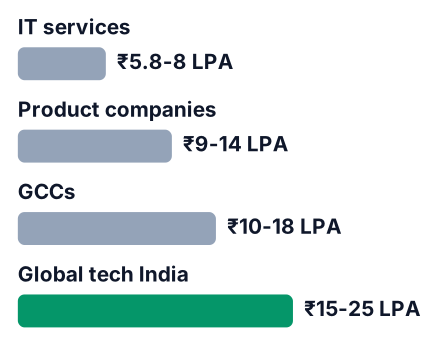
Where you join matters as much as what you know: fresher AI/ML engineer roles pay ₹5.8-8 LPA in IT services and up to ₹18 LPA in a GCC. The sources have no clean fresher data scientist figure, and data scientist pay likely tracks these numbers but does not match exactly, according to taggd's 2026 AI engineer salary report. A GCC (global capability centre) is a foreign company's own office in India, doing its core work here.
| Company type | Examples | Fresher AI/ML pay (taggd) |
|---|---|---|
| IT services | TCS, Infosys, Wipro | ₹5.8–8 LPA |
| Indian product companies | Indian firms that build their own product | ₹9–14 LPA |
| GCCs | A global firm's India office | ₹10–18 LPA |
| Global tech in India | Large global tech firms hiring here | ₹15–25 LPA |
The bars overlap. A strong candidate at a product company can earn what an average one earns at a GCC. Taggd also notes that deployed ML projects and a Kaggle ranking raise fresher offers, which is why rung five pays back directly.
Campus placements at service companies are still a fine first job. Just know the band you are entering, and keep building the portfolio so you can move to a product company or GCC later.
What to do this week
Pick a free SQL practice site such as HackerRank or LeetCode SQL, and one Indian dataset such as a table from data.gov.in, today, and write the first query before you open any deep learning course. Finish one query today and the other four steps will feel easier to start.
Your resume can follow the same five rungs. Give each rung one line, and point each line at proof: a GitHub link for SQL and pandas, a project README for the model. The roadmap.sh data scientist path is a good checklist to match your lines against.
Then put the ten-week order in your calendar and start with week one.