Anthropic Files Its S-1: What the IPO Filing Reveals (2026)
Anthropic filed its S-1 on October 26, 2026, planning to list on Nasdaq under the ticker ANT. The public filing shows revenue grew from $1.2 billion to $16.3 billion in a year, and reveals which products customers pay for most.

Anthropic reported $16.3 billion in revenue for the first half of 2026. In the first half of 2025, it reported $1.2 billion. That jump comes from a document the company filed with the SEC on October 26, 2026, and anyone can read it for free. What is in it, and why should a student learning to code care?
Filed on October 26, 2026, the S-1 for a Nasdaq listing under the ticker ANT shows where the money comes from, where it goes, and how far the company is from a profit. The filing is public, so you can read how the company behind Claude makes money, what it spends and what it fears. For a student, the most useful part is which Claude products customers pay for most.
What Anthropic filed and when
The company plans to list on the Nasdaq Global Select Market, with Goldman Sachs and Morgan Stanley leading the deal, according to Anthropic's own announcement. It has not set a price range or a share count yet. Those two numbers decide what one share will cost, so nobody can tell you that today.
Two terms first. An IPO (initial public offering) is the first time a company sells its shares to the public. An S-1 is the form a US company files with the SEC, the US market regulator, before that sale.
You do not need someone else's summary. The full S-1 sits on the SEC's website, and every claim below links to it or to a news report that read it.
Revenue rose to $16.3 billion in the first half while the operating loss shrank
Revenue rose over the same six months that the operating loss shrank, falling from $2.1 billion to $693 million, TechCrunch reports. Operating loss is the money lost from running the business itself.
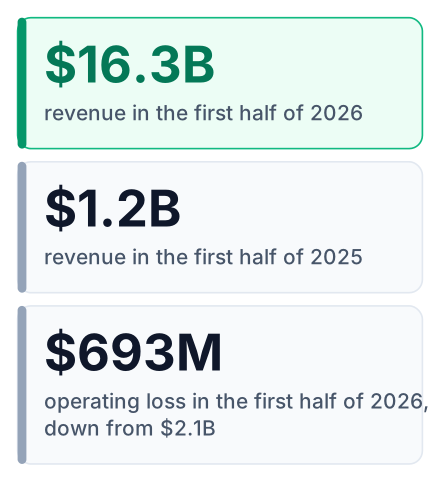
| Headline number | First half 2026 | What it means |
|---|---|---|
| Revenue | $16.3 billion | Money customers paid (TechCrunch) |
| Operating loss | $693 million | Loss from running the business (TechCrunch) |
| Net loss | $80.7 billion | Most is noncash, per the source, so not cash spent (The Verge) |
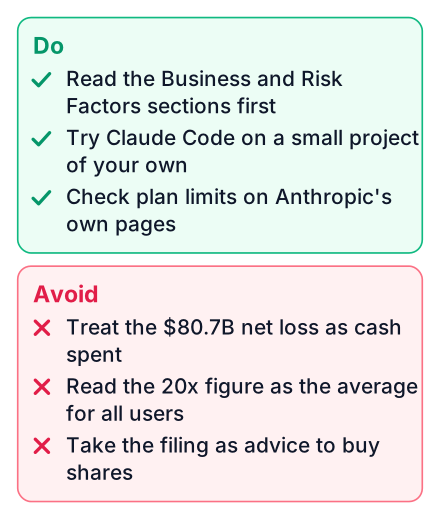
The $80.7 billion net loss looks frightening, so read it carefully. Net loss = operating loss + other charges, so the $693 million operating loss is only a small part of the $80.7 billion. The sources do not give the exact noncash amount. The Verge explains that most of it is noncash accounting charges on convertible debt. Convertible debt is a loan that can turn into shares later. A noncash charge is recorded in the accounts, but no money actually left the company.
These customer counts show who is paying, according to TechCrunch's reading of the filing:
- More than 11,900 customers pay $100,000 or more a year.
- About 1,900 pay $1 million or more.
- About 250 pay $10 million or more.
Claude Code users are among the biggest spenders
TechCrunch found in the filing a gap among Claude Enterprise customers. The top 5% that also use Claude Code spent about 20 times more per month than the average enterprise user who did not use it. Read that comparison carefully. It describes the biggest spenders, not a typical user.
A second figure points the same way. More than half of the customers paying $100,000+ a year now use both the Claude platform and a first-party app such as Claude Code or Cowork, up from about 30% at the end of last year (TechCrunch).
For you, this shows where the company is putting its effort. The filing does not say what entry-level employers will hire for. Learn the API first, because it works with any model, and use Claude Code to build faster. Say you build a small study tracker with the API this month. You are doing a smaller version of what those paying teams do.
Still, betting your skills on one company has a cost. Here is how I weigh it:
Pros
- Your skills match a product that customers clearly pay for.
- Claude Code rewards real projects, which you can show in interviews.
- Skills like writing prompts and building agents carry over to other models.
Cons
- One company sets the prices and the limits you work under.
- A plan change can break a workflow you depend on.
- Your first employer may use OpenAI or Google tools instead.
Compute costs are huge and profit is not promised
Anthropic writes in its S-1 that it "may not achieve or sustain profitability in the future." Meanwhile, it has committed about $3.1 billion a month to SpaceX for Nvidia GPUs, up to $120.5 billion by 2029, The Verge reports.
Compute means the chips and data centres that train and run AI models. SpaceX is one of four large deals:
A public company reports results every quarter, and investors push for better ones. That pressure can lead a company to cut free tiers, tighten usage limits or raise prices. This is a possibility I am pointing out, not a prediction.
My advice is simple. Keep your projects able to switch to another model, and check your plan's limits well before a deadline. Our guide on stretching Claude Pro usage limits covers what to do when you hit them.
New products over defending old ones
Anthropic says it will keep investing in new products, including Applied AI teams and forward-deployed engineers through Ode with Anthropic, TechCrunch reports, and that is Anthropic's own plan, not a guarantee about what employers will hire for.
A forward-deployed engineer works inside a customer's company and builds with the product there. Our FDE role guide explains what that job looks like day to day.
Here is my own reading, and it is an inference from the filing, not a hiring forecast. The useful entry-level skills sit close to the customer:
- Calling the Claude API from your own code and handling its errors.
- Building agents that take steps on their own, like the one in our Claude Duet guide.
- Explaining a technical result to a person who does not code.
What the filing tells a job-seeker, and what it does not
The filing shows what customers pay for. It does not list entry-level openings or the skills they require. To test the idea yourself, open the S-1 on EDGAR, search for "forward-deployed" and "Applied AI", and count how often each phrase appears and in what context. A few mentions in a long document is a weak signal, while many mentions tied to hiring plans is a stronger one. Write the counts down before you decide what to learn.
Who controls Anthropic, and the odd risk factors
Seven co-founders hold 50.1% of the voting power through a Founder LLC, and a Long-Term Benefit Trust can elect and remove the directors who form the board majority, according to the S-1.
In short, the founders and a trust keep control of the board, so outside shareholders get less say. Anthropic is also a Delaware public benefit corporation, which is a company legally allowed to weigh a public purpose alongside profit.
Most of the attention went to the risk factors. The Verge and TechCrunch flagged these warnings:
- AI could develop "forms of sentience."
- AI could cause "catastrophic" harm that insurers could not cover.
- Governments could bring in AI-specific taxes.
- Copyright disputes could cost the company.
- Anthropic depends on cloud partners who also compete with it.
Only OpenAI and Google are named as direct competitors in the filing. For more strange findings, The Verge's list of five weird details is worth ten minutes.
Read the S-1 and try Claude Code this week
Anyone can read the filing, free on SEC EDGAR, and you can open its Business and Risk Factors sections today, then use Claude's free or Pro tier and Claude Code to see the product behind the numbers. EDGAR opens the same way in Kolkata or Kansas, and so do these tools.
Open the filing
Load the S-1 on EDGAR and use your browser's find tool to jump between sections.
Read Business
Note which products the company describes first and at greatest length.
Read Risk Factors
Search the S-1 for the heading "Risk Factors", pick two risks and write one plain sentence about each in your own words.
Build with Claude Code
Make one small project of your own. Our auto mode setup guide helps if you want longer tasks.
One clear line: the S-1 is not investment advice, and this post does not tell anyone to buy shares. Before you quote any Claude plan limit, check it on Anthropic's own pages, because those limits change.


