Accenture Custom Software Engineer Interview Questions (2026)
Accenture's 2026 Custom Software Engineer hiring has three steps: an online assessment, a 45-60 minute technical interview, and an HR round. For the SAP ABAP role, the technical panel tests internal tables, SELECT statements, enhancements and S/4HANA basics.

This guide covers the SAP ABAP skill of Accenture's Custom Software Engineer role; other skills, such as Cloud Contact Center or Aveva PI, ask different things. One small detail sinks many ABAP answers: a SELECT FOR ALL ENTRIES on an empty driver table reads the whole database table, and the panel likes to test it. The process has three steps. One small blog says the third, the HR round, is where strong freshers lose the offer, but it gives no numbers, so treat it as one opinion.
Accenture's 2026 Custom Software Engineer hiring has three steps: an online assessment, a 45-60 minute technical interview, and an HR round. For the SAP ABAP role, the technical panel tests internal tables, SELECT statements, enhancements and S/4HANA basics. For each topic, give the steps you would take and the object names, not claims, and plan one week of practice.
Read the role and its must-have skill first
Each Custom Software Engineering Associate post is tied to one must-have skill, and that skill decides which project team you join and what you get asked, according to FreshersHunt's 2026 summary of the listings.
The role is open to freshers and to candidates with up to 2 years of experience. You also need 15 years of full-time education (eligibility details).
FreshersHunt also lists Cloud Contact Center and Aveva PI openings. Neither is an ABAP post. That is the point of reading the skill line first.
The panel in any Accenture custom software engineer interview probes the skill printed on the posting. Apply for the Aveva PI role, and your technical questions will be about that platform. Apply for the SAP ABAP version, which the rest of this guide covers, and you get ABAP. Copy the must-have line into your notes before you open a single tutorial.
Clear the online assessment and skill screen
Your first filter is an online test on HackerEarth or Accenture's own portal, covering logical reasoning and basic programming, as described in this 2026 interview guide. Some posts add a section on your platform domain.
Online assessment
Timed reasoning questions and small coding tasks. Speed matters more than depth here.
Technical interview
A senior SAP developer or architect asks concept questions, then gives you scenarios to talk through.
HR round
Your project, your notice period and your expected pay. Prepare it like a technical round.
Most lists of Accenture CSE interview questions online mix the test with the interview. Keep them apart, because they need different practice.
For reasoning, do short timed sets every day instead of reading theory. You get faster only by doing questions against a clock.
The coding tasks at this stage are basic programming: loops, string handling, arrays. They do not test ABAP depth. A fresher who writes clean code in one language can clear them. Practise in a plain editor with no autocomplete, and test the edge cases before you submit. The habits in our guide on passing a take-home coding assignment carry over directly.
If you are applying to other service companies in parallel, their tests differ. See the Infosys hiring process for 2026 and the Wipro hiring process for 2026.
Answer the technical round question by question
The questions below come from Mock-Mate's list, and the weak and strong answers are the author's suggestions. Use one pattern for each answer: define it, then name one risk. That pattern comes from the 30 questions Mock-Mate collected for this role. The same page warns that "I have done enhancements" with no steps fails the panel.
| Question | Weak answer | Strong answer |
|---|---|---|
| Standard vs sorted vs hashed internal tables: when do you pick each? | "Hashed is the fastest." | Standard for small lists you loop over. Sorted when you read by key and need the order. Hashed for single reads on a unique key in large data. Trade-off: hashed tables have no index access. |
| Field symbols vs work areas | "Field symbols are like pointers." | A work area copies the row. A field symbol points at the row, so a change applies without MODIFY. Risk: using it before it is assigned causes a short dump, which means the program crashes with an error. |
| Why is SELECT inside LOOP bad? | "It is slow." | Each loop pass makes one database trip. Read all the rows once with a JOIN or FOR ALL ENTRIES, then use READ TABLE inside the loop. |
| The SY-SUBRC checking bug | "I always check SY-SUBRC." | Check it right after the statement it belongs to. Any later statement overwrites it. See the code below. |
| User exits vs BAdIs | "I have done enhancements." | User exits are older hooks in SAP's own includes. BAdIs are object-oriented and allow more than one implementation. Steps: find the definition in SE18 and create the implementation in SE19. Code the method, activate it and test it. Then release the transport, which is the package that moves your change to another system. |
| BAPI vs RFC vs IDoc | "All three send data." | RFC is the remote call mechanism. A BAPI is a business function module called over RFC, usually synchronous, which means the caller waits for the answer. An IDoc is an asynchronous document, which means it is sent now and processed later, for message exchange with other systems. |
| Check table vs value table | "They are the same." | A check table enforces the foreign-key check on a field. A value table sits on the domain and only proposes the check table when you define the foreign key. |
| Transparent vs pooled and cluster tables in S/4HANA | A long history lecture. | A transparent table maps one-to-one to a database table. In S/4HANA, pooled and cluster tables were converted to transparent ones, so say that first. |
| A production report shows wrong totals for one company code. How do you debug it? | "I would debug it in production." | Reproduce it in a test system with that company code. Set a watchpoint on the total. Check the WHERE clause, the currency conversion and missing master data for that code. Never change production data while testing. |
| CDS views, code pushdown and AMDP | "CDS is the new way." | Code pushdown means doing calculations in the database instead of in ABAP. CDS views define joins and aggregations there. AMDP (ABAP managed database procedure) lets you write SQLScript, the database's own language, inside an ABAP class method when CDS cannot express the logic. |
| "How will you prepare for AI-assisted ABAP development?" | "AI will write the code for me." | Say you would review every generated line against the same checks in this table: SY-SUBRC, SELECT placement, table type. Then say you keep unit tests so mistakes surface early. |
Here is the SY-SUBRC row as code. Without the check, a missing customer leaves the field symbol unassigned, and the next line dumps.
READ TABLE lt_customers ASSIGNING FIELD-SYMBOL(<ls_customer>)
  WITH KEY kunnr = lv_kunnr.
IF sy-subrc = 0.            " check immediately, before any other statement
  <ls_customer>-status = 'A'.
ELSE.
  " customer not found: log it instead of dumping
ENDIF.
SAP's own ABAP Keyword Documentation, which you can search by statement name on the SAP Help Portal, covers every statement above. Use it to check syntax, not to memorise it.
Avoid the empty FOR ALL ENTRIES driver-table trap
If the driver table is empty, SELECT FOR ALL ENTRIES ignores the WHERE condition and fetches the whole database table, a trap Mock-Mate lists for this role.
" Unsafe: if lt_orders is empty, this reads every row of VBAP
SELECT vbeln, posnr, matnr
  FROM vbap
  FOR ALL ENTRIES IN @lt_orders
  WHERE vbeln = @lt_orders-vbeln
  INTO TABLE @DATA(lt_items).
" Safe: remove duplicates, then guard the SELECT
SORT lt_orders BY vbeln.
DELETE ADJACENT DUPLICATES FROM lt_orders COMPARING vbeln.
IF lt_orders IS NOT INITIAL.
  SELECT vbeln, posnr, matnr
    FROM vbap
    FOR ALL ENTRIES IN @lt_orders
    WHERE vbeln = @lt_orders-vbeln
    INTO TABLE @DATA(lt_items_safe).
ENDIF.
Removing duplicates matters too. Repeated keys in the driver table send the same condition to the database more than once and waste time.
Know the difficulty data and the salary band
Glassdoor data for this exact role shows a middling difficulty, and the pay is a band, not a fixed number. Mock-Mate's summary of Glassdoor reviews for Accenture SAP ABAP Developer gives a difficulty of 3.1 out of 5, 53% positive experiences, and about 14 days from interview to hire.
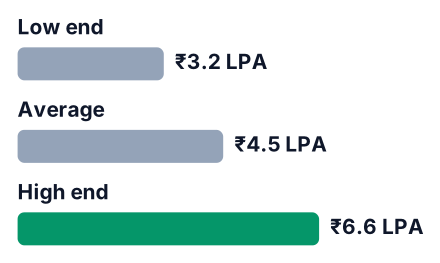
Accenture does not publish pay. FreshersHunt reports AmbitionBox data for the Associate or Software Engineer title of ₹3.2 to 6.6 LPA, averaging about ₹4.5 LPA. I could not check the figure at AmbitionBox, so treat it as a rough guide.
Read that band carefully. It covers the general Associate title across many teams, not this posting. It is not a promised offer. Use it to sanity-check your expected CTC answer, and nothing more.
Prepare for the HR round, the last step before the offer
The HR round checks whether you can explain your own work clearly and talk about notice period and pay without surprises, according to PlacementDriveInsta's 2026 guide. Reported questions include explaining your project in 3 minutes, your notice period and your expected CTC.
Say you spent months on ABAP and answered every technical question well. Then HR asks about your final-year project, and you talk for ten minutes about tools without saying what problem it solved. Or you quote a CTC far above the band with no reason. HR reads both as a risk: you may be hard to place on a client team, or you may reject the offer anyway.
Do
- Open your project answer with the problem, then your part in it.
- Give your notice period as a date you can keep.
- Answer expected CTC with a range inside the band, and say you are open to the standard offer.
- Ask one question about the project team or training.
Don't
- List technologies without saying what they did.
- Claim team work as yours alone.
- Change your notice period between rounds.
- Treat HR as small talk before the offer letter.
For the project answer itself, our guide to explaining your project in a live demo walks through the structure.
Follow a one-week prep plan
Seven days is enough to cover the tested topics if you spend the last two on speaking aloud and rest, following the plan in this guide.
Days one and two: internal tables, selects, field symbols
Write small programs for each table type. Run a SELECT with and without the empty-table guard.
Day three: enhancements and OOP
Implement one BAdI end to end in a sandbox. Write down every transaction you used.
Day four: S/4HANA, CDS, performance
Build one CDS view. Trace a slow SELECT with ST05 and note what you changed.
Day five: your project explanation
Write it out in full, then practise it aloud until it fits the time limit.
Day six: scenarios and HR
Talk through the wrong-totals debugging case. Rehearse your notice period and CTC answers.
Day seven: revision and rest
Read your notes once. Sleep early.
Common mistakes that cost freshers the offer
Most failed answers are vague claims, such as saying you did enhancements without naming one step or object, a pattern Mock-Mate flags for this panel.
- Vague project claims. Fix: name the object, the transaction and the transport for one real change.
- Forgetting the empty-table check. Fix: say the guard out loud whenever you mention FOR ALL ENTRIES.
- Ignoring SY-SUBRC. Fix: in every code answer, write the check on the line after the READ or SELECT.
- Skipping S/4HANA basics. Fix: learn what code pushdown means and when AMDP beats CDS.
- Treating HR as a formality. Fix: rehearse it as seriously as the ABAP round.
Today, open your Accenture posting and copy the must-have skill into your notes. Then write your three-minute project explanation on paper, say it aloud once and time it. Tomorrow, start day one of the plan with internal tables.