Unpaid Internship Worth It in India? A Legal & Honest Answer
An unpaid internship in India is worth it only when it is short-term, learning-focused, and linked to your studies. Learn the legal reality, red flags, and a 5-question test to decide before you say yes.

If you are a fresher in India staring at an unpaid internship offer, you have probably been told two opposite things: that it is a scam that exploits students, and that it is the only way to get your first break. The honest answer: it's legal in some cases, illegal in others, and worth it only when the trade is fair. For example, managing a startup's social media for six months unpaid is not an internship — it's free work.
An unpaid internship in India is worth it only when it meets three tests: it is short-term, learning-focused, and linked to your studies. If you are doing real work that an employee would do, the law may treat you as an employee and order the company to pay you. So before you accept, check these four things: duration, mentor, output, and what you'll give up. Then ask the company directly: are you hiring me as an intern or as an employee? If they expect the same hours and output as a paid employee, but they do not pay, that is a red flag. The level of output they demand should match the level of training they provide. A fair unpaid internship teaches you and allows you to make mistakes. An unfair one expects you to know everything and deliver like a full-time worker.
What the law in India actually says about unpaid internships
India has no single Interns Act, so the label "intern" does not decide your rights; courts look at the real work you do. The law treats your situation by what you actually perform, not by what your offer letter calls you.
This matters because it works in both directions. An unpaid internship is allowed when it is short-term, learning-focused, and study-linked. But if an unpaid intern does regular-employee work, an authority can treat them as an employee and order wages, according to Offrd's internship compliance guide. The label protects no one.
Intern vs statutory apprentice vs workman: a legal comparison table
Under the Apprentices Act 1961, a statutory apprentice must be paid the minimum stipend under Rule 11 of the Apprenticeship Rules 1992, but an unpaid intern doing study-linked work may legally receive no stipend. The difference depends on which legal category you fall into.
Here is how the three categories compare, based on Nityaved's guide to intern legal rights and Offrd's compliance guide.
| Category | Legal basis | Pay position | Reality test |
|---|---|---|---|
| Intern | No single statute; contract-based | May be unpaid if study-linked | Courts look at actual work done |
| Statutory Apprentice | Apprentices Act 1961 | Must be paid minimum stipend | Registered under Rule 11 |
| Workman | Industrial law | Must be paid minimum wages | Regular employee-type duties |
The practical takeaway is simple. If you are learning and your output is a byproduct, unpaid can be legal. If you are producing client deliverables and the company profits from your work, you are probably doing an employee's job.
Article 23 and the forced labour trap
Extracting productive commercial labour without fair pay under economic duress — meaning you accept because you have no money and no other option — is forced labour under Article 23, as the Supreme Court held in PUDR v. Union of India (1982). This is the constitutional line that separates a learning arrangement from exploitation.
Article 23 bans forced labour, and the Supreme Court read it broadly. The Nityaved analysis of the PUDR case explains that when someone works under the compulsion of poverty or need, and the employer takes work without fair compensation, that is forced labour. Economic duress counts as duress.
When does this apply to you? If you accept an unpaid internship because you have no other option, and the company assigns you productive work that earns it money, the arrangement looks like forced labour. The company may argue you agreed voluntarily, but the court's test is whether you had a real choice.
The honest framing is this. Taking an unpaid internship because it teaches you something is a choice. Taking one because you are desperate and the work benefits the company is closer to exploitation.
Red flags that turn unpaid into exploitation
The constitutional line from Article 23 — no forced labour under economic duress — leads to practical red flags. An unpaid internship is a red flag when it is long-term, involves regular employee work, has no named mentor, and demands output with no learning or demo value. These are the signs that your learning is not the point, according to Offrd's compliance guide.
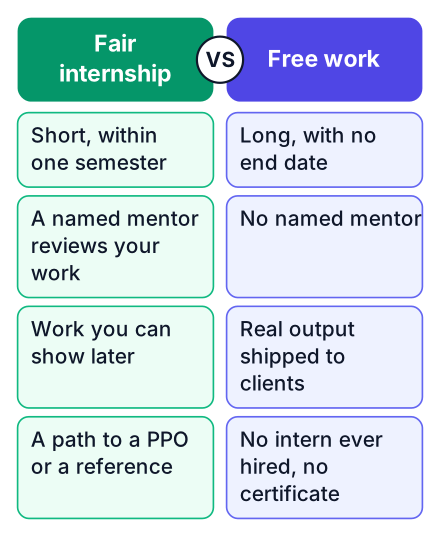
Watch for these specific patterns, and also check the level of output they expect from you. If the company treats you like a full employee from day one, but does not pay you, that is not an internship. It is unpaid work. Ask for a list of tasks you will do. If most tasks are routine work that a paid employee would do, and you get no training, then the company is using you as free labour.
Watch for these specific patterns:
- Duration longer than a semester. A multi-month unpaid run with no end date is a red flag.
- No structured learning plan. If the company cannot describe what you will learn, you are cheap labour. A good internship has a plan for your growth, with clear tasks that start easy and become harder as you learn.
- No named mentor. Someone must be responsible for your growth.
- Real output for clients. If your work ships to customers, you are doing an employee's job. Even if the work is simple, if it is work the company would otherwise pay someone to do, you are being used as an unpaid employee.
- No certificate or reference. If they will not vouch for you later, the internship has no value.
- No PPO conversion history. Ask how many interns became employees. If the answer is zero, factor that in.
- A fee to join. If the company asks you to pay for "training", "registration" or a "guaranteed placement", walk away. Wisdomland's red-flag list also notes that a real employer never charges you for the chance to work.
A single red flag is a warning. Two or more is a strong reason to walk away.
The PM Internship Scheme: a paid alternative to consider
The PM Internship Scheme offers ₹5,000 per month assistance (₹4,500 from the government and ₹500 from the company) plus a one-time ₹6,000 incidentals grant, across the top 500 companies, as per Nityaved's guide. This changes the comparison for a fresher considering an unpaid offer, because a paid alternative exists at scale.
The Nityaved guide to the PM Internship Scheme notes that it targets the top 500 companies in India. The government pays most of the stipend through direct bank transfer, and the company contributes the rest through CSR funds.
For a fresher, this is significant. You can get a paid, structured internship with a large company instead of an unpaid one with a startup that may not survive. Check the eligibility criteria and application windows on the official portal before the next cycle closes.
A 5-question framework to decide before you say yes
Before you accept, also ask: what level of output is expected? Is this the same as a paid employee? The 5-question test below helps you check this. Use it to see if the internship is a learning opportunity or just free work.
Ask these five questions before accepting an unpaid internship: Is it short and study-linked? Is there a named mentor? Can you show what you built? Is there a PPO or reference path? What is the opportunity cost? These questions are an illustrative framework, not legal advice, based on Saarthi's analysis of unpaid internships.
Is it short and study-linked?
If the internship fits within a semester and connects to your coursework, unpaid is more defensible. Long and unrelated means your labour, not your learning, is the product. Also check: does the work match your current skill level? If they expect you to know everything without training, that is not a study-linked internship.
Is there a named mentor?
A real person who reviews your work and teaches you is the core benefit of an internship. No named mentor means you are unsupervised labour. This also tells you whether the company sees you as a learner or just as an extra worker.
Can you show what you built?
Your output must be something you can show: code on GitHub, a campaign you designed, a report you wrote. If you cannot show it later, the internship has no portfolio value.
Is there a PPO or reference path?
Ask how many past interns became employees or got strong referrals. A clear path to a job makes unpaid work an investment. No path makes it a donation.
What is the opportunity cost?
Add up the commute, the hours, and the projects you will not build. A 6-month unpaid internship that blocks your own portfolio work is expensive.
Write the answers down. If the offer fails on two or more questions, it is probably not worth it. Also, if the company expects you to produce the same output as a paid employee but does not pay you, treat that as a clear fail. You are not an employee; you are an intern. Your main job is to learn.
How common are unpaid internships in India?
Unpaid internships are common in India, so an offer with no stipend does not prove the company is bad. Wisdomland's summary of Internshala data gives these approximate figures:
| What was measured | Figure |
|---|---|
| Internship listings with no stipend | about 35% |
| Listings that pay less than ₹3,000 a month | about 25% |
| Average stipend across all sectors | about ₹8,000 a month |
| Internships that turn into a pre-placement offer (PPO) | about 22% |
Source: Wisdomland, based on Internshala's Internship Trends and 2025 sector reports. Real pay changes a lot from one company or city to another.
Your field matters more than these averages. Saarthi's FAQ says unpaid internships are normal in journalism, media, NGOs, early-stage startups and law. At established tech and finance companies, a paid internship is the standard, even when the stipend is small. So if a well-known software company offers you zero stipend, look at that offer more carefully than you would at an NGO's.
Unpaid internship vs paid internship vs staying home to build skills
A paid internship almost always beats an unpaid one, but a specific unpaid offer can beat a random paid one if it gives you a named mentor, real project work, and a clear path to a job. The comparison depends on the specific offer in front of you.
Paid internship
- Income while you learn
- Structured environment
- Formal hiring process
Unpaid internship
- No income for months
- Often unstructured
- May be grunt work, not learning
Staying home has its own trade-off. You lose the network and the structure, but you keep full control of your time and your portfolio. This matters when the market for junior roles is tight, as I discussed in the junior developer job market for 2026.
Say a two-month unpaid internship at a small studio where a senior dev reviews your code everyday. That can beat a paid chat-support role. The deciding factor is what you build. A specific unpaid internship at a company that mentors you and gives you demo-able work can be worth more than a paid role where you file spreadsheets all day. But a generic unpaid internship where you do errands is worse than staying home and shipping your own projects. For more on building a portfolio that gets you interviews, see how to get your first software internship.
How do you ask for a stipend after an unpaid offer?
You can ask, and a polite question rarely costs you the offer. Saarthi's guide says the first offer is not always final, and it calls "Is there a stipend for this role?" a normal interview question. Ask it after you have shown real interest in the work.
If the company refuses a stipend, try one of these smaller requests:
- An allowance instead of a salary. Ask for money for travel, mobile data or software tools. Some companies that refuse a "stipend" agree to a small reimbursement.
- A review after four to six weeks. Ask: "Can we discuss a stipend after the first month, based on my results?" It costs the company nothing today, and you get to prove your value first.
- Non-cash terms in writing. If the company has no money for a stipend, ask for a recommendation letter, a LinkedIn recommendation from a named senior person, or a PPO discussion, all confirmed by email before day one.
Do not threaten to leave unless you already hold a better offer. Indian startups and small companies usually react better to a direct, polite request than to pressure.
Does an unpaid internship count for college credit and placements?
In most cases, yes to both. The same Saarthi FAQ explains that college credit depends on the learning outcomes and the duration your college approves, not on pay. Talk to your internship coordinator before you start, so your paperwork matches what your department needs.
For placements, recruiters care about the work, not the stipend. An unpaid internship counts as real experience when you can describe your tasks and your results. Keep a weekly log of what you did and what changed because of it. That log becomes your resume points and your interview stories.
How to accept or decline without burning bridges
If you decline, do it politely, professionally, and with a clear reason, so you keep the relationship for future referrals. A short, honest message works better than silence.
If you are declining an unpaid offer, say this in your own words: thank them for the opportunity, explain that you need to focus on a paid position or your final-year projects, and ask to stay in touch on LinkedIn. You do not need to criticise the offer or lecture them about labour law. A brief note is enough.
If you accept, set expectations in writing. Ask for a clear scope of work, a named mentor, and a defined end date. An email that confirms these points protects you later if the arrangement drifts into full-time work without pay.
If you have an unpaid offer in hand, use this template: "Thank you for the opportunity. I've decided to focus on a paid role and my final-year projects. I'd love to stay in touch on LinkedIn." This polite decline keeps that recruiter as a possible source of referrals when you apply for paid roles later. For more on networking, see how many applications a fresher really needs for that first dev job.
Take the 5-question test and write the answers for your current offer. Then, if it fails the test, send a polite decline and apply for the PM Internship Scheme before the next cycle closes. If it passes, accept it, document the scope, and make sure you can show what you built. Also read the off-campus placement guide for Indian freshers to plan the next route, and check software developer salary trends in India for 2026 so you know what a fair paid offer looks like later.