AI Engineer Starting Salary in 2026: India vs US for Freshers
An AI engineer fresher in India starts at ₹5-9 LPA, while US entry-level base pay runs $115,000-$135,000. Company type, city, and work rights set the real number — here's how to judge any offer.

Say you hold three offer letters, and all three carry the same job title: AI engineer. The first comes from an IT services firm in India at ₹5.8 LPA. The second is from FAANG India at ₹15 LPA or more. The third is from a US employer, with a base near $115,000.
Same title, very different numbers. The job title hides what sets the pay: the type of company, the city, and how much of the offer is base salary. These ranges come from one India blog post and one US vendor blog post, not from government data, so treat them as rough guides.
An AI engineer fresher in India typically starts at ₹5-9 LPA, while a US entry-level AI engineer gets a base of roughly $115,000-$135,000. In India the company type matters most: IT services pay the least, and product companies pay more, while GCCs and FAANG India pay the most. In the US, the city and the type of employer set the band. Each figure comes from its own country's source.
Fresher, mid and senior AI engineer pay in India and the US, side by side
The US entry band of $115,000-$135,000 is small next to the senior US average of $285,385, so most of the pay growth happens after the first job. Uvik puts the 90th percentile for senior US AI engineers at $473,615. That means one senior engineer in ten earns that much or more.
Here is the entry-level comparison, limited to the stage where both pages give a figure. India figures are in LPA: lakh rupees per year, where one lakh is a hundred thousand rupees.
| Career stage | India | United States |
|---|---|---|
| Fresher / entry-level | ₹5-9 LPA | Base about $115,000-$135,000, up to about $178,000 in high-cost markets |
Uvik's own estimate puts Indian AI pay at about $17K-$30K a year in US dollars. I did not convert rupees to dollars myself, because exchange rates move and living costs differ between the two countries. The dollar range is Uvik's estimate, not mine.
The second table shows what a fresher gets by type of employer:
| Employer type | Fresher pay | Source |
|---|---|---|
| IT services, India | ₹5.8-8 LPA | ShiftToTech |
| Product company, India (strong portfolio) | ₹8-12 LPA | ShiftToTech |
| FAANG India | ₹15 LPA+ | ShiftToTech |
| US market, entry-level base | $115,000-$135,000 | Uvik |
Want to see how AI compares with other tech roles in India? Read my guide to the highest-paying tech jobs in India.
IT services firms pay the lowest AI engineer starting salary in India
Freshers at IT services companies such as TCS and Infosys, and also Wipro, start at about ₹5.8-8 LPA, the bottom of the India fresher range.
This is still the most common first AI job for an Indian fresher. Services firms hire in large batches through campus drives, and they train new hires before putting them on projects. You do not need a famous college or a long GitHub history to get in.
Consulting firms are the next step up. Deloitte, McKinsey and Accenture pay AI freshers about ₹8-14 LPA. The work is client-facing, so communication skills matter as much as code.
Say you have a services offer in hand and two product-company interviews still running. In my opinion, not from the sources, I would accept the services offer, unless it carries a service bond or a long lock-in period. Keep interviewing, and build projects on weekends. A real job on your CV tends to make the next application stronger, because a recruiter can see work experience, while waiting with no offer leaves a gap to explain.
Product companies, GCCs and FAANG India pay more, if you can get in
A strong GitHub portfolio can move a fresher to ₹8-12 LPA at a product company, and IIT or NIT graduates reach ₹15 LPA or more at FAANG India. Above services, the fresher bands by company type look like this:
- Indian unicorns (startups valued at over a billion dollars): ₹10-20 LPA
- GCCs such as Microsoft, Google and Amazon India: ₹10-22 LPA
- AI-first startups: ₹12 LPA and up, plus ESOPs. ESOPs are shares in the company you get over time, worth money only if the company grows or sells.
Think of a GCC, or global capability centre, as a foreign company's own office in India. It does work for its parent company, not for outside clients. That is why GCC pay sits closer to product companies than to services firms.
These offices filter hard. Most hire from top colleges or from people who already have a visible project record. If you want pay figures for machine learning roles only, and not the wider AI engineer title, my machine learning engineer starting salary post goes deeper on ML roles alone.
City differences in India: Bangalore, Hyderabad and Pune
Pune pays less than Bangalore but may be an easier city for a first job, with about 4.5 applicants per role against 11 in Bangalore. The city averages from the same source:
- Bangalore: ₹12.67 LPA
- Hyderabad: ₹11-13 LPA
- Pune: ₹10 LPA
These are averages across all experience levels, not fresher offers. Do not expect a Bangalore offer at that number in your first year.
The trade-off is simple. Bangalore has more AI jobs and more people chasing each one. Pune pays less, but your application faces fewer competitors. For a first job, fewer competitors may be worth more than a higher city average you may not reach, though the applicant count is one undated figure from the source.
US entry-level AI engineer pay: why the average figures disagree
US salary sites report averages from $116,949 to $211,000, so judge a fresher offer against the entry-level band, not the site average. Uvik collects the figures from four sites:
- ZipRecruiter: $116,949 average base
- Glassdoor: $140,678 average base, from 955 salaries
- Built In: $184,757 average base
- Levels.fyi: $211,000 median total compensation
Part of the gap is what each site counts. Base pay is the fixed salary in your offer letter. Total compensation adds bonuses and stock, which can be large at big tech firms. Levels.fyi reports the second kind, so its number will always look higher.
Each site also draws from a different crowd. A site full of big-tech engineers reports more than one that collects postings from smaller companies. Compare your offer with the entry band in the first table, not with any of these four.
At entry level, Uvik puts the US AI premium over regular software roles at only about 6%. It widens sharply with seniority: across all levels, AI roles pay about 67% more. In plain terms: your first US AI job pays a little more than a regular developer job, and the real gap opens up years later.
Which skills move you into the higher AI engineer salary band?
GenAI and LLM skills carry a 25-40% pay premium in India, and a public project portfolio is what separates the ₹8-12 LPA offers from the ₹5-8 LPA ones. The same source says AI roles pay 30-50% more than general software engineering in India. Picking AI over plain web development already moves you up.
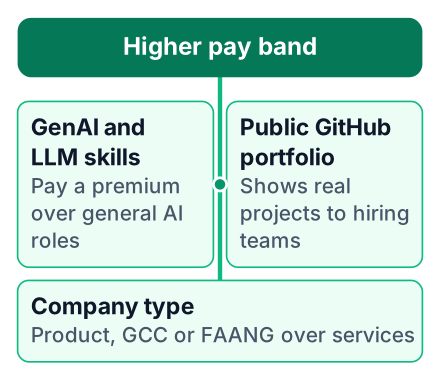
These are the skills that show up in better AI engineer offers, and this is the order I would learn them in, from Python to a live project you can show:
Write solid Python
Functions, files, and working with data. The free official Python tutorial is enough to start, and about 20 hours on it is a fair first block.
Learn machine learning basics
Train a simple model, split data into training and test sets, and explain why a model is wrong.
Build one LLM app
For example, a chatbot that answers questions from your college notes. Call a model through its API and handle bad answers.
Deploy it and publish the code
Put it online with a live link and a clear README on GitHub. A recruiter can open it in a minute.
The skills overlap a lot with data science. My post on skills a data scientist fresher needs covers the Python and statistics side in more detail.
In the US, GenAI and LLM engineers earn $200K-$400K or more. That is not an entry-level figure. It is what experienced specialists earn, so do not use it to judge your first offer.
Who should aim for the India market and who for the US market
Pick by what you can reach in the next 12 months, because the highest India bands depend on your college and portfolio and the US band depends on where you can work. A US offer is only real if you have the right to work there. An FAANG India offer is only realistic if your college or your projects open that door.
Pros
- India: many entry points across cities and company types, with fresher pay from ₹5 LPA to ₹15 LPA and above.
- India: a services job is reachable without a top college, and you can switch later.
- US: a much higher starting base, about $115,000-$135,000, and more in high-cost cities.
Cons
- India: the top bands are narrow and filter hard on college and portfolio.
- India: city averages run above what freshers are actually offered.
- US: the AI premium over regular software jobs is small at entry level, and work rights limit who can apply.
Say you are a final-year student in Pune with a services offer and one half-finished project. Take the offer, finish the project, and deploy it. Then apply to product companies and GCCs in your own city, where fewer people compete for each role.
Now say you are a computer science senior in Texas with a regular software internship behind you. Your first AI offer will not pay much more than a normal developer job. Take the role that lets you ship real LLM features, because the pay gap grows with experience. If you are in India and still in school, start with how to become an AI engineer after 12th without JEE.
Pick your target market, then check any offer you have against the matching band in the first table. Your first action: build the LLM app this month, for example a chatbot over your own college notes. Plan about 40 hours, deploy it with a live link, and put the code on GitHub with a clear README.