How to Write a Career Objective for a Resume, With Fresher Examples
Two guides say a career objective should run 2-3 sentences, about 30-50 words. This guide adds a one-sentence simplification for freshers with one degree and one project, plus 12 examples for developer, data, QA and AI roles.
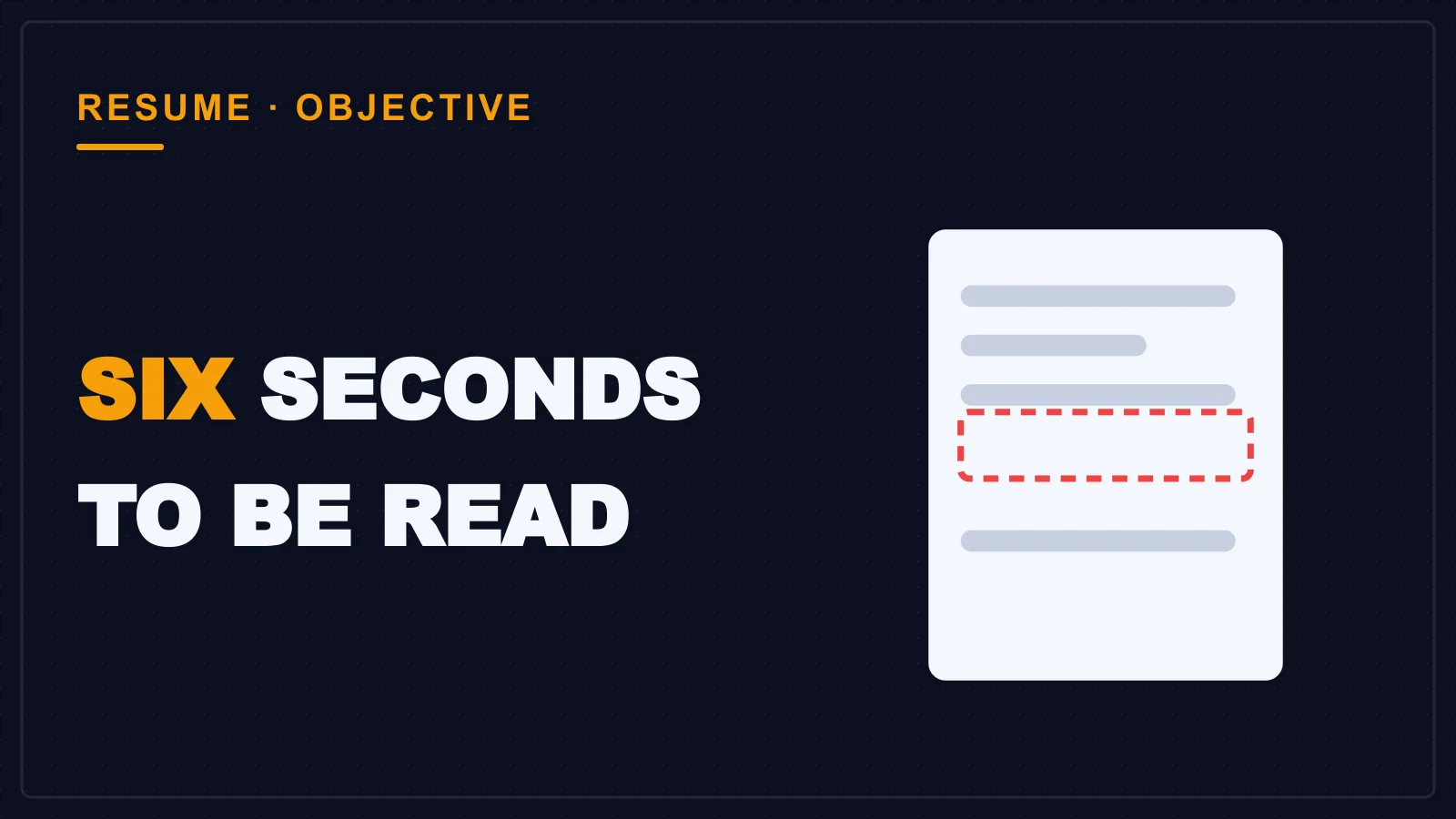
Both Digital Vidya and Leverage Edu say a career objective should run two or three sentences; the Digital Vidya FAQ puts that at about 30-50 words. That is the advice to start from. This guide adds a one-sentence simplification for a fresher who has only a degree and a project, not a claim that it performs better.
Here is a weak version of one fresher's line: "Seeking a challenging position in a reputed organisation where I can grow my skills." It says what the writer wants and nothing the company can use. The four-step ladder below turns that line into a strong one, so you can follow each change instead of only seeing the finished sentence.
What a recruiter matches in the first pass
Recruiters check for the job title and the tools the posting names before they read the prose. That is why the first line needs both. Name the role you want and the main skill you bring.
The 3-part pattern for a career objective
The guides overlap on role, skills, value. Leverage Edu also asks for enthusiasm, and it suggests finding your skills in your education; internships; projects; extracurricular activities. Start with who you are. Add two or three hard skills from the posting, using those sources if you have no formal work experience. Then finish with the value you offer. Keep that order: the role and skills are what a reader looks for, and the value explains why they matter here.
Here is the pattern as a fill-in line:
[Who you are] + [two or three hard skills] + [the value you offer]
Filling it in takes four moves.
-
Open the job post
Read the title and the requirements section. Underline every tool, language or skill it names.
-
Pick the title and two or three skills
Choose skills you actually have and can talk about in an interview. Skip the rest, even if the posting asks for them.
-
Write the value as a result
Finish with what the company gets: faster releases and cleaner data, with fewer bugs reaching users.
-
Read it aloud
If it sounds like a list of tags, rewrite it. A person reads this line after the software does.
Rewrite a weak objective in four steps
Most guides show a bad line and a good line, but not the steps between them, so the good line looks as if it came from nowhere. Take the weak line from the opening and rebuild it in four steps.
| Step | The line | What changed |
|---|---|---|
| Weak line | Seeking a challenging position in a reputed organisation where I can grow my skills. | A wish, with no role, no skill and no value. |
| Add the role | Seeking a Software Engineer Trainee role in a reputed organisation where I can grow my skills. | A reader now knows which job you want. |
| Add the skills | MCA graduate skilled in Java and MySQL, seeking a Software Engineer Trainee role. | The reader sees a match between you and the posting. |
| Add the value | MCA graduate skilled in Java and MySQL, ready to build and maintain backend modules for your client projects as a Software Engineer Trainee. | The reader sees what the company gets, not what you want. |
Each step adds one of the three parts and removes a little filler. None adds a sentence. The last line is the strong example from the opening, so you can see exactly how it was built. A one-line objective is shorter than the guides' range but still holds all three parts. The same ladder works on any generic line that you find in a template. Name the role, add the skills, then add the value.
Software developer objectives for freshers
For developer roles, the skill slot is where most freshers waste space. "Hardworking" and "quick learner" are not skills an ATS (the software many companies use to scan resumes for keywords) can match or an interviewer can test. Name a language, a framework or a database you have used. Tie it to the kind of work the posting describes.
- Java backend: "Computer science graduate skilled in Java and Spring Boot, ready to build and test REST APIs for your backend team as a Java Backend Developer."
- Python: "B.Tech IT fresher who built a library-management web app with Python and Flask, aiming to ship reliable features as a Python Developer."
- MERN stack: "Final-year CSE student who built a job-board app with MongoDB, Express, React and Node.js. Now ready to take features from database to screen as a Software Engineer Trainee."
The first line is short because the role is common and the skills are enough. The second names a project because a fresher's project is the closest thing to experience. The third uses two sentences to separate the project from the fit, which is the form to copy when both need room.
No project yet? Name your coursework or a small practice build, but claim only what you can show in an interview. For example: "BCA graduate who completed Java and database coursework and built a small library-search practice app, ready to fix bugs and write small backend features as a Software Engineer Trainee." Replace the degree, the coursework and the value with your own.
The job title in quotes in these examples is a placeholder, so use the title on your posting. If you name data structures at the top, expect questions; my list of DSA interview questions for freshers covers what comes up. For the section under your objective, see skills for a fresher resume.
Data analyst and data science objectives
Data roles reward a different kind of value clause. The company is not buying an interest in data; it is buying a faster or better decision. Say which decision your work supports.
- Data analyst: "Statistics graduate skilled in SQL and Power BI, ready to turn sales data into dashboards your managers can act on as a Data Analyst."
- Business analyst: "BBA graduate strong in advanced Excel and pivot tables, aiming to find cost and revenue patterns that guide business decisions as a Business Analyst."
- Junior data scientist: "Mathematics postgraduate who built a churn model (it predicts which customers will stop using a service) with Python and scikit-learn. Ready to turn that model into a prediction the customer team can use to keep customers as a Junior Data Scientist."
Compare the first two value clauses: dashboards for managers, cost patterns for the business. That is the part to rewrite for each posting, because it shows which problem you understand. The third names a model and a team, which is the level a data hiring manager looks for.
"Passionate about data" fails all three. It describes your feelings rather than the company's decision.
QA and software testing objectives
Testing postings split into manual and automation. The two sets of words are not interchangeable. A manual QA posting wants test cases, regression testing (re-checking old features after a change) and JIRA (a bug-tracking tool). An automation posting wants a framework such as TestNG, plus Selenium and a programming language. Pick the set that matches the posting before you write the line.
| Slot | Manual tester wording | Automation tester wording |
|---|---|---|
| Job title | QA Tester, Manual Test Engineer | Automation Test Engineer, SDET (software developer in test) |
| Skills to mirror | test cases, regression testing, JIRA | Selenium, Java or Python, TestNG |
| Value phrase | catch bugs before release | cut repeat testing time with scripts |
- Manual QA tester: "B.Sc. Computer Science graduate skilled in writing test cases and regression testing, ready to catch bugs before they reach your users as a QA Tester."
- Selenium automation tester: "Testing fresher skilled in Selenium WebDriver and Java, aiming to replace slow manual checks with reliable scripts as an Automation Test Engineer."
- API tester: "IT graduate who tested REST APIs with Postman during a college project. Ready to find broken endpoints before the frontend team does as an API Tester."
The manual and automation examples use different words on purpose. Sending the manual line to an automation posting loses the match before a person reads it. The API line uses two sentences to fit a project in. That is often necessary, because formal testing experience is rare.
For performance and mobile roles, change the skill slot. JMeter suits load testing; Appium suits Android. The value clause stays the same.
AI and machine learning objectives
AI is the category where a vague line does the most damage. Many freshers write "interested in AI" with nothing behind it, and a recruiter has no way to tell those applicants apart. Name the library and the kind of model or tool you built, and claim only a project you can explain when asked.
- ML engineer trainee: "CSE graduate who built a loan-default classifier with scikit-learn and pandas, ready to turn models into working features as an ML Engineer Trainee."
- AI engineer: "Developer fresher who built a document question-answering tool with Python and an LLM API, aiming to add useful AI features to your products for an AI Engineer role."
- MLOps beginner: "IT graduate skilled in Docker and MLflow, ready to move models from notebooks into stable production as a Junior MLOps Engineer."
The first line names a model type and its tools; the second names a kind of application. Both give an interviewer something to ask about, which is the point. "Passionate about AI" gives them nothing. If you have no model of your own, a course project you can explain still beats a label.
Objective mistakes that weaken a fresher's first line
In my view, four common mistakes weaken a fresher's objective: it describes what the candidate wants, it runs past three sentences, it leaves out the job title, or it repeats a template the recruiter has already read.
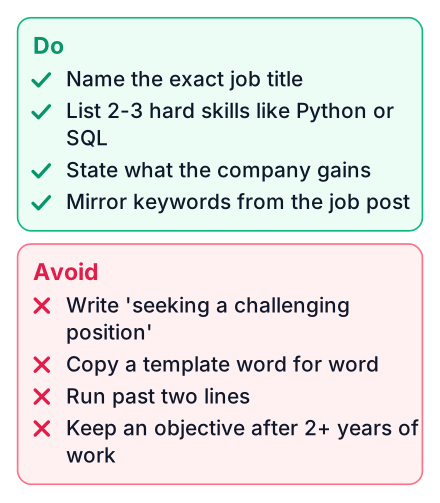
- Do put the posting's job title in the line, word for word.
- Do choose hard skills a filter can match, such as SQL or Selenium, over soft words such as "dedicated".
- Do end with what the company gets from hiring you.
- Don't copy any example word for word, including the ones in this guide. Swap in your own project and degree.
- Don't keep an objective once you have two or more years of experience, as Digital Vidya advises. Switch to a professional summary that leads with achievements.
A five-minute test before you send
You do not need a recruiter to tell you whether the line works. Run these checks on the exact text you plan to paste.
-
Read only the first five words. Do they name the role or a skill? If not, the reader has to wait for the point.
-
Cover the rest of the resume. Can a stranger say what job you want and what you can do with it? If not, the line is too vague.
-
Search the posting for your skills. If a skill in your line is not in the posting, ask whether it earns its place.
-
Count the sentences. More than three means you are writing a summary, not an objective.
The test takes less time than rereading the whole resume, and it catches the failure the examples can only show: a line that is short, specific and still about the wrong job.
Which objective should you pick?
These examples are my own illustrations, not taken from the two guides, so test each one against a real posting before you use it. Match the example to the job title on the posting, then replace its skills and value with your own. You do not need a different objective for every application, but do swap in each posting's exact title and main tools. The categories below are a starting point, not a rule; a "Software Engineer" posting at a data company may want the data section's value clause.
- Developer, SDE or trainee: start from the software developer section.
- Analyst, BI or data engineering: start from the data section.
- QA, tester or SDET: use the testing section, and pick the manual or automation words from its table.
- ML, AI or MLOps: use the AI section, and name a project you can explain.
Open one posting you plan to apply to today. Copy its title and two skills, fill in the three-part pattern, and put the result at the top of your resume. Run the five-minute test above before you send it, and be ready to explain in an interview every skill you named in that line.


