TCS Q2 Results 2026: AI Hiring, Fresher Offers, And What It Means For You
TCS reported strong Q2 FY27 numbers with net profit up 15%, but the reporting for freshers points to selective, demand-driven hiring. 25,000 offers exist, yet about 12,000 cuts in FY26 indicate that performance and AI skills may influence outcomes for candidates, though individual results can vary.

On October 8, 2026, TCS reported its September quarter results. Net profit rose 15% year-on-year to Rs 13,884 crore (up 4% quarter-on-quarter). A year of AI-panic headlines had predicted doom for IT services, yet TCS also onboarded 10,000 campus graduates in that single quarter, according to The Hindu BusinessLine's live coverage. That contradiction is worth a calm look.
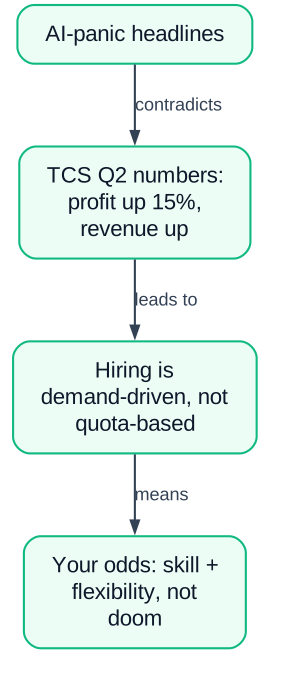
TCS's Q2 FY27 numbers show IT services demand is still alive, but hiring is now driven by actual project demand, not by bulk campus targets. The 25,000 FY27 fresher offers and 10,000 quarterly onboardings indicate that your placement odds depend on your skills and flexibility, not on a fixed quota. These numbers are based on the latest reports, but hiring is dynamic and can change with business conditions.
TCS Q2 FY27 numbers are strong, but hiring is demand-driven
The headline numbers are genuinely good. Net profit came in at Rs 13,884 crore, up 15% year-on-year and 4% quarter-on-quarter. Revenue reached Rs 73,188 crore, an 11% jump from last year. Operating margin held at 24%. All three beat what analysts expected, per Forbes India's report on the results.
The company that many predicted AI would weaken just posted double-digit profit growth. That does not make AI a non-issue, but it does not match the collapse story.
But here is the part that matters for you. Hiring is now project-driven. TCS is no longer hiring against a fixed annual campus target. It hires when a project needs people. That shift changes how you should prepare.
The headline numbers are genuinely good. Net profit came in at Rs 13,884 crore, up 15% year-on-year and 4% quarter-on-quarter. Revenue reached Rs 73,188 crore, an 11% jump from last year. Operating margin held at 24%. All three beat what analysts expected, per Forbes India's report on the results.
The company that AI was supposed to kill just posted double-digit profit growth. The collapse narrative is not visible in this quarter's numbers.
But here is the part that matters for you. Hiring is now project-driven. TCS is no longer hiring against a fixed annual campus target. It hires when a project needs people. That shift changes how you should prepare.
Headcount rose by 4,258, but that is not a fresher quota
A net headcount increase is healthy, but it includes experienced hires and attrition replacement, not just freshers.
TCS ended the quarter with 598,056 employees, a net addition of 4,258 people. That is the highest headcount in five quarters, per CNBC TV18. Attrition also improved, falling to 13.3% from 13.6% a quarter earlier, as CNBC TV18 reported.
| The number | What it actually means for you |
|---|---|
| Headcount up 4,258 | Projects exist. Hiring is on an on-demand basis, not a fixed quota. |
| Attrition down to 13.3% | Fewer seats are opening from people leaving. Competition for each seat stays tough. |
| 25,000 FY27 fresher offers | Commitment to campus hiring exists, but read the next row. |
| ~12,000 FY26 job cuts | They will trim where demand is weak. Performance matters. These cuts were announced in April 2026, before Q2 results — a policy signal, not a surprise. |
| AI is now 10% of revenue | AI skills are a requirement, not a threat to your job. |
25,000 fresher offers in FY27, after 12,000 cuts in FY26
The 25,000 offers show commitment, but the 12,000 cuts show they will hire only where demand exists.
For the current financial year, TCS has already made 25,000 fresher offers, per the CEO, as reported by BusinessToday. That is a real number and a real commitment. But note that in the same report, TCS announced job cuts of about 2% of its workforce, impacting roughly 12,000 employees over FY26. Both facts are true at the same time.
Here is the honest read. TCS is not abandoning campus hiring. It is also not carrying people who are not billable. The CEO said: "We have made 25,000 offers for freshers in FY27. Clarity on demand will lead to more hiring." That is not a quota.
It is a promise that the number can grow if clients keep spending. That suggests your offer letter depends on you being a safe bet for a future project, not on the company hitting a headcount target.
The lesson is uncomfortable but clear. In FY26, TCS cut roughly 12,000 people, as per BusinessToday. You cannot rely on being part of a big batch. You have to justify your own seat.
10,000 campus graduates onboarded in one quarter, but training takes 9 months
Onboarding is real, but you will not join a project immediately; expect a 9-month training lag.
In Q2 alone, as of October 8, 2026, TCS onboarded 10,000 campus graduates, according to The Hindu BusinessLine's live coverage.
Now the part nobody tells you in placement season. From the same BusinessToday report, a fresher typically spends about nine months in training before joining a project. You are not earning a project salary on day one. You are a learner for most of your first year.
The CEO himself said freshers need about nine months of training before they start on projects. That is a public, official statement, not a rumour. Still, your exact schedule depends on your role, so ask HR or check your offer letter.
Plan your finances around that. If you have a family depending on your income quickly, this lag matters. The training period is not wasted, but it is also not billable. Budget for nine months of a training stipend before you see project pay.
AI is now 10% of TCS revenue, but it is a skills list, not a threat
TCS's $3.1 billion annualised AI revenue means AI skills are in demand, not that services jobs are vanishing.
Here is the number that should reshape your preparation. TCS's annualised AI revenue is now $3.1 billion, crossing 10% of total revenue, as The Economic Times reported in its live blog. That is not a side experiment. That is a core business line.
The company is also investing heavily in making its workforce AI-capable. Learning hours jumped 17% to 17.1 million in the quarter, and the CHRO explicitly talked about upskilling and AI skills, per CNBC TV18.
So consider this. This is my reading of the data: TCS is not replacing engineers with AI. It is replacing engineers without AI skills with engineers who have them. This is a practical inference from the company's AI investment, not a direct quote. If you do not know how to use AI tools in your workflow, you are competing against candidates who do.
Start with the basics. Here is a short list of AI-adjacent skills to build: prompt engineering, reviewing and critiquing AI-written code, understanding model limitations, and using GitHub Copilot in a real project. These are the skills your first project manager will test, whether they say so or not.
Why the AI-collapse story is wrong, and partly right
The AI narrative exaggerates doom, but discretionary spending — money clients spend on optional projects, not on essentials — pressure is real, and you should read both.
Let me give the pessimistic view its due. Executives on the earnings call said discretionary spending is still under pressure. They also said demand has not materially changed since Q1, per The Hindu BusinessLine. That is not a boom. Clients are still cautious about signing new projects.
That is the real risk in this market. It is not that all IT jobs vanish. It is that clients take longer to approve budgets, which means fewer new projects, which means slower hiring.
But the collapse narrative is overblown. Look at the growth by sector. Banking and financial services, manufacturing, and technology and services were among the top-growing verticals, per The Economic Times. Multiple sectors are growing. The demand is not gone; it is just selective.
A balanced view helps you more than panic or denial. The market is not collapsing, but it is also not absorbing everyone who applies. Zoho's Vembu has made similar points about which software jobs are actually at risk. The junior developer market in India for 2026 is competitive, but not closed.
What the numbers mean for your placement odds
Your odds depend on your demonstrable skills and willingness to join a training cohort, not on the macro narrative.
So where does this leave you? With a clear set of actions, not vague anxiety. The actions below are practical steps, but they are not a guarantee of a job offer.
Build AI-adjacent skills now
Take one real project from your computer science course and redo it with AI assistance. Compare the output to what you would have written alone. Write down what you had to correct. That correction log is what you will discuss in the interview.
Prepare for the assessment tests seriously
Coding, aptitude, communication. These are the filters before the interview. TCS uses its own assessment (NQT) — check the official page for the current format, so time yourself on HackerRank or LeetCode problems.
Accept the 9-month training reality
Plan your finances and expectations around a training period, not a project salary.
Apply across multiple domains
Do not fixate on one company or one role. Several companies are hiring freshers in India this year, not just TCS.
Consider service vs product companies
The skill requirements differ. Knowing the difference helps you target your preparation.
Here is the final thought. The AI-collapse headline is satisfying to read and terrifying to share. But the actual data from TCS tells a more boring and more useful story. IT services demand is holding up. Hiring is slower and more selective. Your place in that system depends on what you can do, not on the macro narrative.
Start by writing down three things you have built or fixed that you can explain in two minutes each, and update your resume to show any AI coursework. Then check TCS's official site for the current assessment schedule.