Gemini 4 Hydrogen: Google's Budget Model That Doubles Your Coding Power for the Same Price
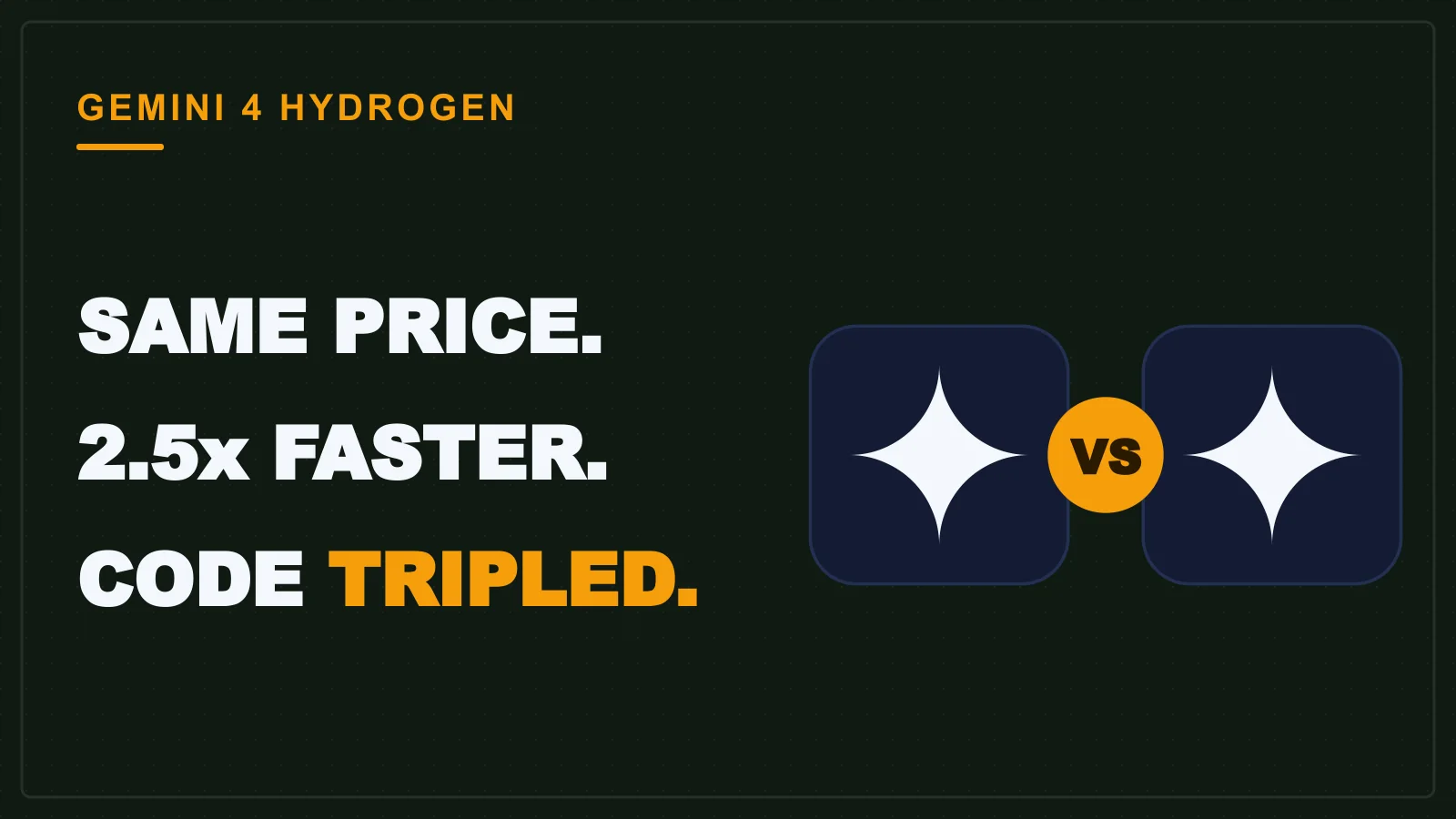
Google launched Gemini 4 Hydrogen on 12 Nov 2026. It costs the same as 3.8 Flash, runs 2.5x faster, and its Terminal-Bench 4.1 coding score more than tripled (57% vs 18.2%). Here's how students can switch to it, with free access in Google Search, while the Gemini app and AI Studio free tiers still
Google replaced its budget AI model on 12 Nov 2026, and the new one costs exactly the same. If you are learning to build with AI, or already pay for it, this changes which model you should use — here's what changed and how to switch. Gemini Decisions API is one example of a workflow that benefits from a faster, cheaper model.
Gemini 4 Hydrogen is Google's new budget AI model, launched 12 Nov 2026. It costs the same as the old 3.8 Flash ($1.50 in / $7.50 out per million tokens) but runs 2.5x faster and scores much higher on coding tests. For most student work, it is strong enough for everyday coding, so you usually do not need to pay for the premium models.
If you have been building projects on Google's API, this is the update you have been waiting for. Even if you have never tried a Gemini model, this is a good time to start, because the budget option is now strong enough for real coding work. Here is everything a student needs to know before switching.
What Gemini 4 Hydrogen is
Gemini 4 Hydrogen replaces 3.8 Flash as the budget option in the Gemini 4 family, sitting below the premium Carbon and Argon models. The announcement on the official Google blog confirms it is rolling out globally the same day across the Gemini API, AI Studio, Android Studio, the Gemini app, Google Search, Antigravity, and Gemini in Google Sheets.
Hydrogen offers four thinking levels: low, medium, high (the default), and a new xhigh tier. The low tier is designed for simple tasks where speed matters most, while xhigh dedicates more time to complex reasoning. You pick the level based on how hard the problem is, which means you do not pay for deep thinking on trivial requests. The immediate rollout across all products means you can start using it today without waiting for a staged release.
The price stays at $1.50 per million tokens
Hydrogen keeps the exact same price as 3.8 Flash: $1.50 per million input tokens and $7.50 per million output tokens. Ars Technica confirms the price is unchanged and that Hydrogen replaces 3.8 Flash across Google's products, with access beginning immediately rather than being staged like Carbon and Argon. The rate is flat across the full 1M-token context window, so you do not pay extra for longer inputs.
| Spec | Gemini 4 Hydrogen | Gemini 3.8 Flash |
|---|---|---|
| Input price (per 1M tokens) | $1.50 | $1.50 |
| Output price (per 1M tokens) | $7.50 | $7.50 |
| Context window | 1M tokens | 1M tokens |
| Speed at high thinking | 2.5x faster | baseline |
| Terminal-Bench 4.1 coding score | 57% | 18.2% |
Switching costs nothing on the API. If your code already calls the Gemini endpoint, changing the model name to Hydrogen gives you the performance upgrade at the same rate. There is no migration fee and no new billing setup. For a student tracking every dollar, this is the rare model update that does not force a budget rethink.
How much faster and smarter it is
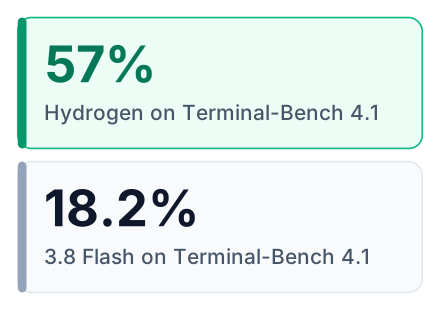
The official announcement reports that Hydrogen is 2.5x faster than 3.8 Flash, with the Terminal-Bench 4.1 score jumping from 18.2% on 3.8 Flash to 57% on Hydrogen. Official announcement On the Artificial Analysis Intelligence Index, Hydrogen scores 51 at the high thinking level, beating Gemini 4 Argon's 50, and reaches 54 at xhigh, both as published by Artificial Analysis.
What improved
- 2.5x faster at high thinking level (source)
- Coding score more than tripled (57% vs 18.2%) (source)
- Beats Argon on the Intelligence Index (51 vs 50) (Artificial Analysis)
- Ranks #5 on Agent Arena live benchmark (source)
What stayed the same
- Price per token
- 1M-token context window
- Four thinking levels (with xhigh added) — see official announcement
On the same leaderboard, Hydrogen at low thinking scores 27 and costs $0.29 per task, medium scores 41 at $0.80, high scores 51 at $1.87, and xhigh scores 54 at $3.16.
The low tier is the third-fastest model on the leaderboard, behind GPT-6 Luna and GPT-6.1 Terra. For comparison, 3.8 Flash scores 31 on the same index at $7.77 per task (as of the Nov 12, 2026 leaderboard), which makes Hydrogen both cheaper and smarter at every level. Check the Artificial Analysis leaderboard.
Where Hydrogen is available, and what is actually free
Google Search gives everyone Hydrogen for free. The Gemini app and AI Studio only give Hydrogen to paid Pro/Ultra subscribers — free users there still get the older 3.5 Flash-Lite. To test Hydrogen free, use Google Search or pay for a month of Pro.
For Antigravity, Google's agentic coding tool, Hydrogen is available on the paid AI Pro and Ultra plans. This is the place to go if you want Hydrogen working on real codebases with file access and terminal commands. The free options cover experimentation and small projects well enough for most coursework and side projects.
What to route to Hydrogen vs Carbon or Argon
Use Hydrogen for everyday coding, tests, and first prototypes; save Carbon or Argon for deep architecture or hardest bugs. Ars Technica notes that Carbon and Argon currently cost $2/$10 per million tokens but are rising to $4/$20 next month. That price jump on the premium models makes Hydrogen the clear budget workhorse to build on now.
For everyday work, Hydrogen is built for writing code, running tests, and verifying changes — the tasks that fill a student's day. The premium models earn their higher price only when you need deep architectural reasoning, debugging the most stubborn concurrency issues, or a security review of critical code. Those moments are rare in coursework, so most students will never miss the premium tier.
How to switch today
To switch, just select Hydrogen in AI Studio or the Gemini API, or rely on auto-select in the Gemini app. No code changes are required, just a setting update. The steps take under a minute, and the exact model name is in Google's API docs (linked in the Check-it-yourself box).
Open AI Studio
Go to the model picker in the top of the page and choose Gemini 4 Hydrogen from the list.
Update your API calls
If you already use the Gemini API, update the model name to the Hydrogen model identifier listed in the official Gemini API docs. The endpoint and request format stay the same.
Use the Gemini app
Leave auto-select on. The app routes to Hydrogen when it is the best fit for your question.
The API documentation on the Google blog confirms the model name and the fact that access started immediately on launch day. If you use a wrapper like OpenRouter, the listing shows the same $1.5 in / $7.5 out pricing with the full 1,048,576-token context, so your existing setup works unchanged.
Open AI Studio right now, pick Gemini 4 Hydrogen, and paste one of your current homework problems into it. Compare the answer with what you got from 3.8 Flash, and see the difference for yourself.