Gemini 4 Carbon is now public: test it on OpenRouter before the price doubles
Gemini 4 Carbon is now available to everyone on OpenRouter at an introductory price of $2/$10 per million tokens. That price doubles on December 1, so this month is the window to test it on three small projects that make the paid API worth it.
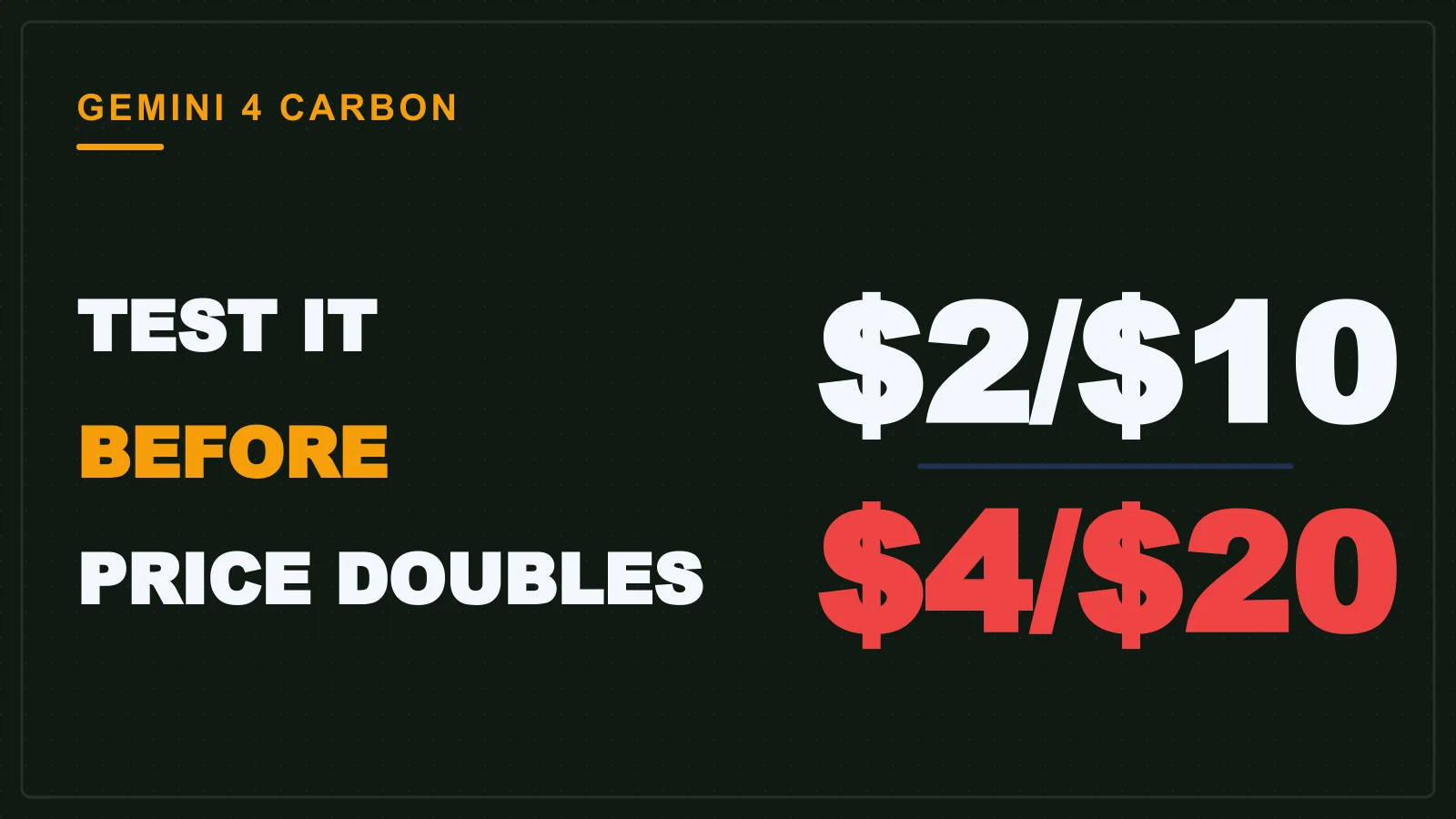
The price doubles on December 1. You have three weeks to test Gemini 4 Carbon at $2 per million input tokens on OpenRouter. It was previously locked to cybersecurity defenders through the Fairwind Program until October 28, but now any student with a credit card can use it.
Gemini 4 Carbon is now paid and public on OpenRouter at $2 per million input and $10 per million output tokens, until November 30. After that it becomes $4/$20. There is no free tier, but three small projects can make the paid API worth it this month.
Gemini 4 Carbon is now public and paid on OpenRouter
Google released Gemini 4 Carbon to the public on November 10, 2026, on OpenRouter and the paid Gemini API tier, according to DeepMind's announcement. The model was restricted to cybersecurity defenders through the Fairwind Program since October 28. Now the model ID google/gemini-4-carbon is available to anyone.
This is not a free-tier model. AtomicAgent's breakdown confirms Carbon is paid only on the API. The knowledge cutoff is March 2026, so it will not know about recent events past that point.
The $2/$10 price doubles on December 1
The introductory price of $2 per million input and $10 per million output tokens ends November 30; from December 1 it becomes $4/$20, per AtomicAgent's pricing analysis. Cached input is cheaper at $0.10 per million tokens.
| Pricing detail | Until Nov 30 | From Dec 1 |
|---|---|---|
| Input (per million tokens) | $2 | $4 |
| Output (per million tokens) | $10 | $20 |
| Cached input (per million tokens) | $0.10 | Price stays the same — verify on OpenRouter |
Thinking tokens bill as output. The output cap is 65,536 tokens per request unless you use a background request or continuation, according to AtomicAgent. That matters for long reasoning tasks, which can hit the cap on a single request.
One-prompt document-to-3D reconstruction
Carbon's 1M context window lets you paste an entire document and get a 3D reconstruction in one prompt, a small project that costs less than a dollar. You skip the usual chunking and multi-step pipeline because the whole source fits in one request. Ask for a standard format like STL or OBJ, then open it in any free 3D viewer.
Say you have a technical manual with diagrams and measurements. You upload the full text and ask for a 3D model of the object it describes, for example, ask for an STL file and open it in a free viewer like MeshLab. At the introductory rate, a request with a few hundred thousand input tokens and a modest output costs under a dollar, based on the Artificial Analysis leaderboard pricing data. The output is a standard 3D format you can view without special software.
The single-prompt approach only works because of the context size. Older models with smaller windows would need the document split, reconstructed in parts, then merged. Carbon removes that step.
A multi-agent /swarm build
Carbon can orchestrate multiple agent roles in a single request, which makes a small swarm project realistic with the paid API this month. The model handles the coordination internally rather than you wiring separate API calls together.
One difference from other models: Carbon ignores temperature, top_p, and top_k parameters. Instead you set thinking_level, per AtomicAgent's documentation. A swarm task with a few roles, each reasoning over the shared context, will bill the thinking tokens as output, so budget for that.
const response = await openrouter.chat.completions.create({
  model: "google/gemini-4-carbon",
  messages: [{ role: "user", content: "Plan, research, and review: ..." }],
  // temperature, top_p, top_k are ignored.
  // Use thinking_level instead, e.g. "high".
});
A realistic swarm task, like a market research brief with a researcher role and a critic role, runs a few dozen requests. Here's a concrete cost estimate: say you ask it to write a 2000-word report on AI startups. That's about 10K input and 50K output tokens. At $2/$10 per million, that's $0.02 + $0.50 = $0.52 per run. Ten runs like that cost $5.20. That's the single-digit-dollar point of testing this month.
A deep-reasoning debugging app
Carbon's strong reasoning scores on benchmarks and its long context make it good at tracing bugs across a full codebase, which is the third small project. You point it at your project's files and ask it to find why a feature breaks.
On the Artificial Analysis Intelligence Index, Carbon (high) scores 60, placing it fourth overall behind three Claude Fable 5.2 settings. That reasoning strength, combined with the 1M context, means it can hold an entire repository and reason about the interaction between files.
The cost per task is the trade-off. At high thinking level, Carbon costs about $7.76 per task on Artificial Analysis's benchmark, and it ranks 61st of 72 models on speed at that setting. So use it for the hard bug you have stared at for days, not for every small error.
When to use Carbon vs Argon for your projects
Use Argon for everyday coding and turn to Carbon only for hard tasks, because Carbon is slower and costs more per task. That routing strategy keeps your bill low while still giving you access to frontier reasoning when you need it.
The speed gap is real: Carbon ranks 61st of 72 on speed at high thinking level, per Artificial Analysis. For quick edits and boilerplate, a faster model is the better tool. For the bug you have not cracked in a week, Carbon's reasoning is worth the wait.
Google claims Carbon ranks first on CursorBench 4.0, Perplexity's WANDR, and Zapier's AutomationBench at over 2x lower cost per task than the next best external model, per DeepMind's announcement. On the Artificial Analysis leaderboard, Carbon (high) is one point behind Fable 5.2 (high) but costs about 15% less from December 1, and roughly 57% less until November 30.
The practical play for a student: keep your daily coding on Argon and reserve Carbon for the tasks that genuinely need it. A simple classifier can route easy requests to the cheap model and only escalate hard ones to Carbon, an approach covered in this cost-cutting guide.
For comparison, Claude Fable 5.2 is faster and one point higher on the Intelligence Index, but Carbon's current price makes it the value pick this month.
Open OpenRouter, add a small credit, and run one of the three projects before November 30 to lock in the introductory rate.


